Mexico LED Traffic Signs and Signals Market Size, Share & Growth Rate
The Mexico LED Traffic Signs and Signals Market was estimated at USD 220 Million in 2025 and is projected to reach USD 253 Million by 2032, growing at a CAGR of 2.0% from 2026 to 2032. This growth trajectory is propelled by urbanization, which increases traffic density, and government initiatives aimed at enhancing road safety through modern traffic management solutions. Municipalities and transportation authorities are increasingly turning to energy-efficient LED technologies, driven by their durability and improved visibility.
Mexico LED Traffic Signs and Signals Market Year-wise Growth Rate and Key Drivers
This graph highlights how the Mexico LED Traffic Signs and Signals Market has steadily grown over the years, supported by major growth factors.
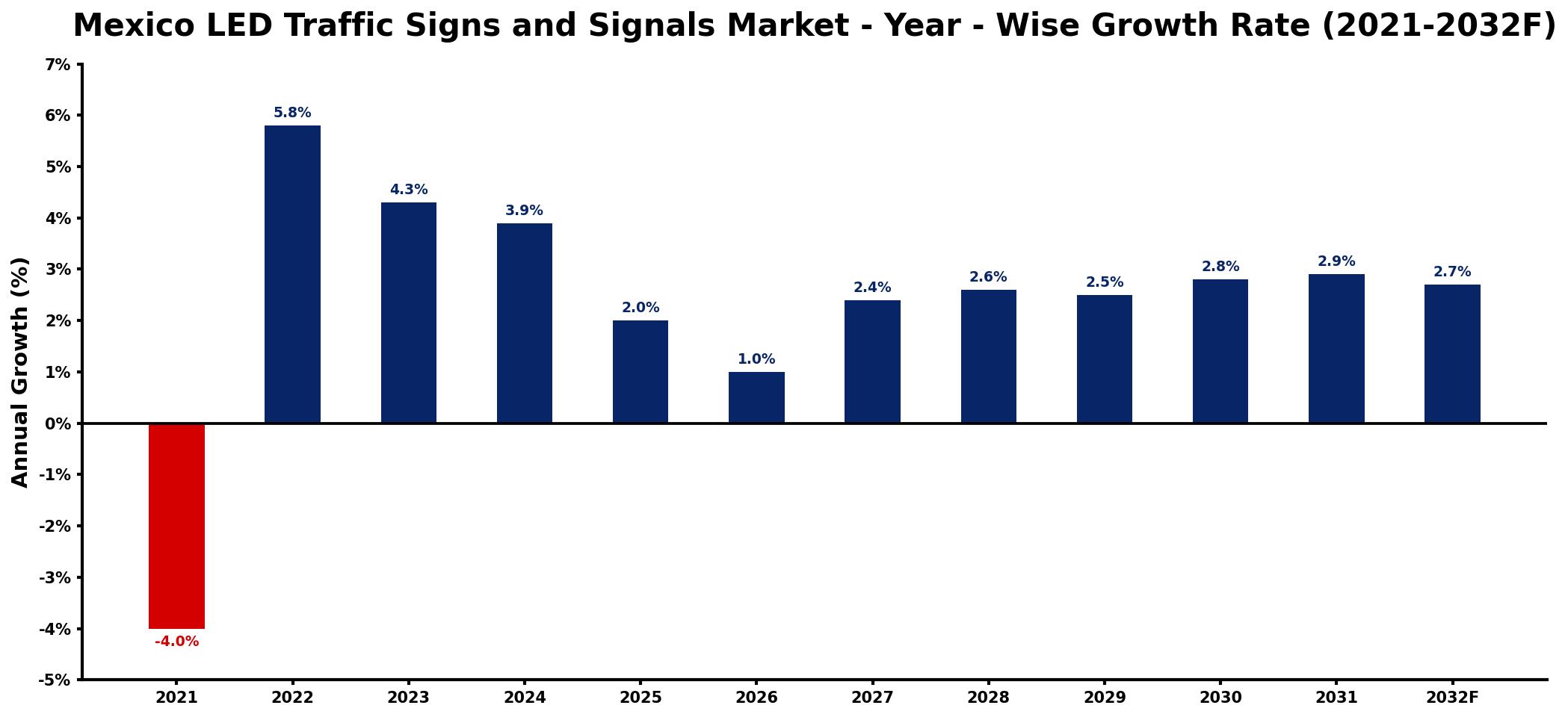
The table below presents the year‑wise growth rates along with the key drivers influencing the market
| Year | Growth Rate | Major Drivers |
| 2021 | -4.0% | Government budget constraints impact projects |
| 2022 | 5.8% | Urbanization drives infrastructure investments |
| 2023 | 4.3% | Smart city initiatives gain traction |
| 2024 | 3.9% | Public safety regulations strengthen enforcement |
| 2025 | 2.0% | Technological advancements enhance systems |
| 2026 | 1.0% | Increased focus on sustainability practices |
| 2027 | 2.4% | Rising demand for energy efficiency |
| 2028 | 2.6% | Public-private partnerships promote development |
| 2029 | 2.5% | Growing awareness of road safety |
| 2030 | 2.8% | Expansion of urban transport networks |
| 2031 | 2.9% | Investment in modernization projects increases |
| 2032 | 2.7% | Integration of IoT solutions accelerates |
Note: Market size estimations and growth projections presented in this report are based on 6Wresearch's proprietary forecasting methodology, utilizing the latest available industry data, government publications, and primary research inputs.
Mexico LED Traffic Signs and Signals Market Synopsis
As cities in Mexico expand, the integration of LED traffic signs and signals has become crucial for managing rising traffic volumes. The shift towards intelligent transportation systems complements this trend, allowing for real-time updates and improved traffic flow. Investments in these technologies are not merely reactive but are increasingly seen as proactive measures to ensure urban safety and efficiency.
Municipalities are adopting LED solutions not only for their cost-saving potential but also for their environmental benefits. The durability and lower maintenance requirements of LED systems promise long-term operational efficiencies, making them attractive for both urban planners and government agencies. This changing landscape highlights the urgency to address outdated infrastructure and enhance safety protocols in growing urban areas.
Mexico LED Traffic Signs and Signals Market Key Takeaways
- The market is experiencing robust growth due to rising urbanization and traffic congestion.
- Government policies are encouraging the adoption of energy-efficient LED technologies.
- There is a notable shift towards intelligent transportation systems utilizing LED signage.
- Investment opportunities are emerging in infrastructure projects focused on road safety enhancements.
- The competitive landscape is marked by innovation and strategic collaborations among key stakeholders.
Evaluation of Restraints in Mexico LED Traffic Signs and Signals Market
Despite its promising outlook, the Mexico LED Traffic Signs and Signals Market faces several restraints. High initial installation costs present a significant barrier, particularly for municipalities with constrained budgets. Furthermore, the lack of standardized regulations has led to inconsistent implementation across different regions, complicating efforts to establish a unified approach to traffic management. Environmental conditions, including extreme heat and humidity, raise concerns over the long-term reliability of LED products, thus necessitating thorough testing and adaptation to local climates.
Mexico LED Traffic Signs and Signals Market Trends
The trend towards energy-efficient solutions is becoming increasingly pronounced in the Mexico LED Traffic Signs and Signals Market. Advances in LED technology have led to products that not only consume less energy but also boast longer lifespans and enhanced visibility. Moreover, smart traffic management systems are emerging, integrating LED traffic signs with data analytics for real-time traffic monitoring and control. This indicates a significant shift towards more adaptive and responsive urban infrastructures.
Mexico LED Traffic Signs and Signals Market Opportunities
Investment opportunities abound in the Mexico LED Traffic Signs and Signals Market, driven by government initiatives aimed at enhancing road safety and modernizing infrastructure. Companies that provide innovative solutions in smart traffic management stand to benefit as municipalities seek to implement technologies that enhance traffic flow and safety. Additionally, ongoing infrastructure projects in urban areas create avenues for the installation and maintenance of LED systems, presenting attractive prospects for investment.
Government Initiatives in the Mexico LED Traffic Signs and Signals Market
The Mexican government has enacted various policies to promote the adoption of LED traffic signs and signals as part of a broader strategy to enhance road safety and operational efficiency. Regulations mandating the use of energy-efficient technologies in traffic management systems are part of this initiative. Incentives such as tax benefits and subsidies are also offered to municipalities and transportation authorities, fostering a favorable environment for the transition to LED systems.
Future Insights of the Mexico LED Traffic Signs and Signals Market
Looking ahead to 2026-2032, the Mexico LED Traffic Signs and Signals Market is set to thrive as urbanization and infrastructure development continue apace. The growing emphasis on smart city projects will drive further demand for LED technologies. As more municipalities recognize the benefits of connected transportation systems, we can anticipate an increase in strategic partnerships among technology providers, which will further catalyze market innovation and growth. Ultimately, the focus on sustainable transportation solutions will remain at the forefront of this evolving market.
Mexico LED Traffic Signs and Signals Market Latest Developments (2025 - 2026)
Recent developments within the Mexico LED Traffic Signs and Signals Market indicate a strong focus on the integration of intelligent traffic systems. Initiatives aimed at updating urban infrastructure are gaining traction, with municipalities increasingly prioritizing the implementation of LED technologies. Furthermore, collaborations between public entities and technology providers are becoming more common, aiming to enhance the performance and reliability of LED traffic solutions under various environmental conditions.
Mexico LED Traffic Signs and Signals Market - Key Attractiveness of the Report
- 10 Years of Market Numbers
- Historical Data Starting from 2022 to 2025
- Base Year: 2025
- Forecast Data until 2032
- Key Performance Indicators Impacting the Market
- Major Upcoming Developments and Projects
Key Highlights of the Report:
- Mexico LED Traffic Signs and Signals Market Outlook
- Market Size of Mexico LED Traffic Signs and Signals Market, 2025
- Forecast of Mexico LED Traffic Signs and Signals Market, 2032
- Historical Data and Forecast of Mexico LED Traffic Signs and Signals Revenues & Volume for the Period 2022-2032F
- Mexico LED Traffic Signs and Signals Market Trend Evolution
- Mexico LED Traffic Signs and Signals Market Drivers and Challenges
- Mexico LED Traffic Signs and Signals Price Trends
- Mexico LED Traffic Signs and Signals Porter's Five Forces
- Mexico LED Traffic Signs and Signals Industry Life Cycle
- Historical Data and Forecast of Mexico LED Traffic Signs and Signals Market Revenues & Volume By Product for the Period 2022-2032F
- Historical Data and Forecast of Mexico LED Traffic Signs and Signals Market Revenues & Volume By LED Traffic Signals for the Period 2022-2032F
- Historical Data and Forecast of Mexico LED Traffic Signs and Signals Market Revenues & Volume By LED Traffic Signs for the Period 2022-2032F
- Mexico LED Traffic Signs and Signals Import Export Trade Statistics
- Market Opportunity Assessment By Product
- Mexico LED Traffic Signs and Signals Top Companies Market Share
- Mexico LED Traffic Signs and Signals Competitive Benchmarking By Technical and Operational Parameters
- Mexico LED Traffic Signs and Signals Company Profiles
- Mexico LED Traffic Signs and Signals Key Strategic Recommendations






































