United Kingdom (UK) LED Traffic Signs and Signals Market Size, Share & Growth Rate
The United Kingdom (UK) LED Traffic Signs and Signals Market was estimated at USD 198 Million in 2025 and is projected to reach USD 244 Million by 2032, growing at a CAGR of 3.0% from 2026 to 2032. This growth trajectory is primarily fueled by heightened government initiatives aimed at improving road safety and traffic management. Moreover, advancements in LED technology, which enhance energy efficiency and visibility, are becoming increasingly essential in modern transportation systems.
United Kingdom (UK) LED Traffic Signs and Signals Market Year-wise Growth Rate and Key Drivers
This graph highlights how the United Kingdom (UK) LED Traffic Signs and Signals Market has steadily grown over the years, supported by major growth factors.
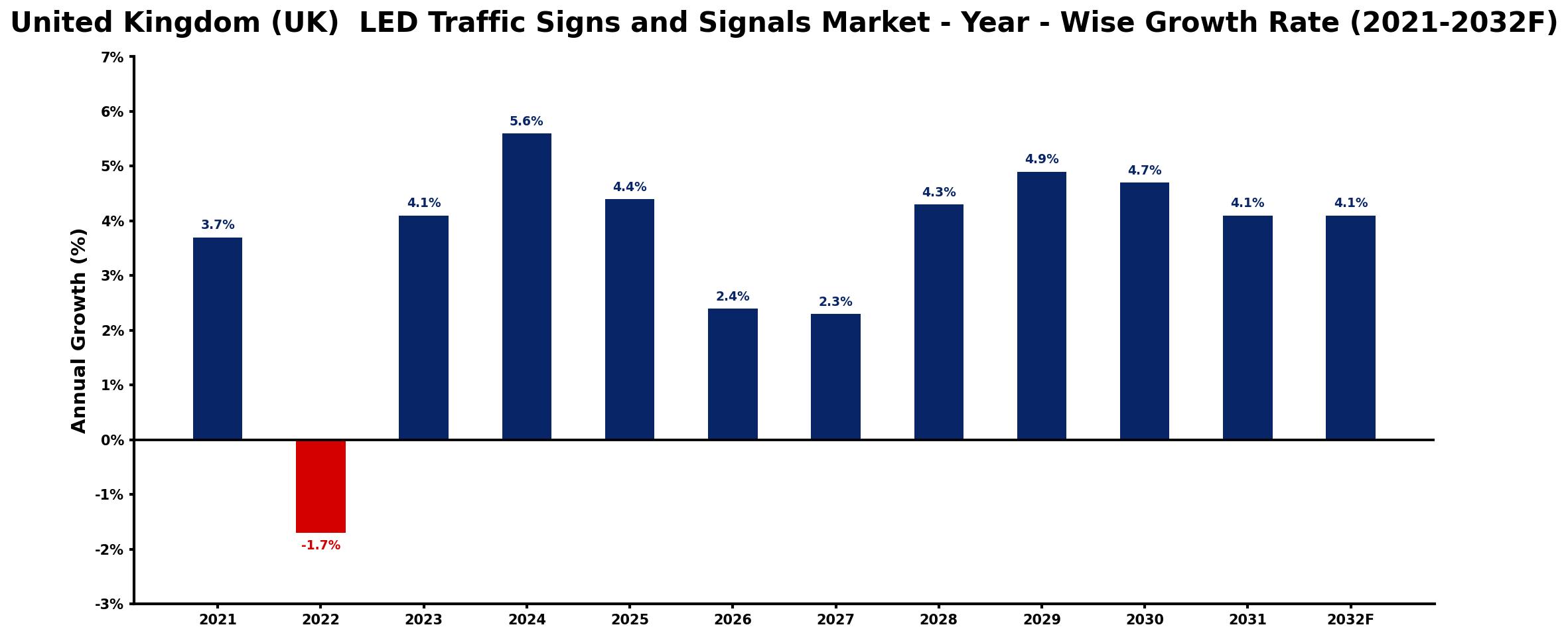
The table below presents the year‑wise growth rates along with the key drivers influencing the market
| Year | Growth Rate | Major Drivers |
| 2021 | 3.7% | Rising investment in smart infrastructure |
| 2022 | -1.7% | Slowdown in infrastructure projects |
| 2023 | 4.1% | Increased focus on road safety |
| 2024 | 5.6% | Growing urbanization and population density |
| 2025 | 4.4% | Expansion of renewable energy initiatives |
| 2026 | 2.4% | Advancements in smart city technologies |
| 2027 | 2.3% | Surge in government funding programs |
| 2028 | 4.3% | Higher demand for energy efficiency |
| 2029 | 4.9% | growing emerging market penetration |
| 2030 | 4.7% | Development of autonomous vehicle systems |
| 2031 | 4.1% | Enhanced public awareness campaigns |
| 2032 | 4.1% | Strengthening regulations for road safety |
Note: Market size estimations and growth projections presented in this report are based on 6Wresearch's proprietary forecasting methodology, utilizing the latest available industry data, government publications, and primary research inputs.
United Kingdom (UK) LED Traffic Signs and Signals Market Synopsis
The strongest force shaping the United Kingdom (UK) LED Traffic Signs and Signals Market is the growing emphasis on intelligent transportation systems. These systems integrate LED technology into traffic management solutions, enabling better traffic flow and enhanced safety measures for all road users.
Furthermore, the UK government is actively pursuing smart city initiatives, which are propelling the modernization of existing infrastructure. This commitment to upgrading traffic management systems is a critical factor in the increasing adoption of LED traffic signs and signals.
United Kingdom (UK) LED Traffic Signs and Signals Market Key Takeaways
- The market is driven by the need for enhanced road safety and efficient traffic management.
- Energy-efficient LED technology is becoming a standard in traffic systems, reducing costs and carbon footprints.
- Government infrastructure projects are vital in facilitating market growth and adoption of smart solutions.
- Integration of smart features, including connectivity and real-time data monitoring, is on the rise.
- Digital signage solutions are increasingly sought after for their visibility and customization options.
Evaluation of Restraints in United Kingdom (UK) LED Traffic Signs and Signals Market
Despite its potential, the United Kingdom (UK) LED Traffic Signs and Signals Market faces several restraints that could hinder its growth. The initial costs associated with installing LED technology can be quite high, which poses a barrier for some municipalities and organizations looking to upgrade. Additionally, regular maintenance is necessary to ensure optimal performance, which can further burden budgets. Compatibility with existing traffic systems also presents challenges, as retrofitting older infrastructure to accommodate new LED solutions often requires significant investment and planning. Lastly, varying regulations and standards, along with environmental conditions that impact LED performance, add layers of complexity that market players must navigate effectively.
United Kingdom (UK) LED Traffic Signs and Signals Market Trends
Several trends are shaping the United Kingdom (UK) LED Traffic Signs and Signals Market. The most notable trend is the increasing adoption of smart technology within traffic management systems. This includes the use of sensors and connectivity to facilitate real-time data monitoring, thereby enhancing operational efficiency. Moreover, the shift towards dynamic messaging systems has gained traction, enabling quick updates for traffic control and emergency notifications. Digital signage is also rising in popularity due to its flexibility and customizable features, which are vital in adapting to varying traffic conditions.
United Kingdom (UK) LED Traffic Signs and Signals Market Opportunities
The market presents numerous opportunities for investment, primarily driven by the urgent need to modernize traffic management systems across the UK. As government initiatives continue to focus on infrastructure development and smart city projects, investors can find potential in manufacturing and supplying advanced LED traffic signals. There is also significant room for growth in developing intelligent traffic management solutions that can adapt to the complexities of urban mobility. Offering maintenance services for existing installations represents another promising area, especially with the increasing adoption of sophisticated technology.
Government Initiatives in the United Kingdom (UK) LED Traffic Signs and Signals Market
The UK government has been proactive in establishing various regulations and standards surrounding LED traffic signs and signals to ensure safety and efficiency on the roads. These policies underscore the importance of energy efficiency and sustainability in utilizing LED technology for traffic management. Specific guidelines regarding the design, installation, and maintenance of LED solutions align with both EU directives and British standards, ultimately enhancing reliability and effectiveness. Compliance with these regulations is imperative for industry stakeholders as they navigate the complexities of the market.
Future Insights of the United Kingdom (UK) LED Traffic Signs and Signals Market
Looking forward to the years 2026-2032, the United Kingdom (UK) LED Traffic Signs and Signals Market is set to experience significant transformation. A sustained focus on road safety and traffic management will drive demand for innovative LED solutions. Additionally, government initiatives aimed at modernizing transportation infrastructure will further support market growth. As the shift towards smart cities and intelligent transportation systems continues to evolve, new opportunities for integrating cutting-edge technology into traffic management will become more prevalent.
United Kingdom (UK) LED Traffic Signs and Signals Market Latest Developments (2025 - 2026)
In recent months, the United Kingdom (UK) LED Traffic Signs and Signals Market has seen a growing emphasis on intelligent transportation systems, with increased investments directed towards R&D in LED technologies. Various municipalities are beginning to roll out pilot programs for advanced traffic management solutions, integrating LED signals with real-time data analytics. Additionally, partnerships between public sector organizations and private firms are being formed to enhance the development and implementation of smart traffic systems that prioritize both efficiency and safety.
United Kingdom (UK) LED Traffic Signs and Signals Market - Key Attractiveness of the Report
- 10 Years of Market Numbers
- Historical Data Starting from 2022 to 2025
- Base Year: 2025
- Forecast Data until 2032
- Key Performance Indicators Impacting the Market
- Major Upcoming Developments and Projects
Key Highlights of the Report:
- United Kingdom (UK) LED Traffic Signs and Signals Market Outlook
- Market Size of United Kingdom (UK) LED Traffic Signs and Signals Market, 2025
- Forecast of United Kingdom (UK) LED Traffic Signs and Signals Market, 2032
- Historical Data and Forecast of United Kingdom (UK) LED Traffic Signs and Signals Revenues & Volume for the Period 2022-2032F
- United Kingdom (UK) LED Traffic Signs and Signals Market Trend Evolution
- United Kingdom (UK) LED Traffic Signs and Signals Market Drivers and Challenges
- United Kingdom (UK) LED Traffic Signs and Signals Price Trends
- United Kingdom (UK) LED Traffic Signs and Signals Porter's Five Forces
- United Kingdom (UK) LED Traffic Signs and Signals Industry Life Cycle
- Historical Data and Forecast of United Kingdom (UK) LED Traffic Signs and Signals Market Revenues & Volume By Product for the Period 2022-2032F
- Historical Data and Forecast of United Kingdom (UK) LED Traffic Signs and Signals Market Revenues & Volume By LED Traffic Signals for the Period 2022-2032F
- Historical Data and Forecast of United Kingdom (UK) LED Traffic Signs and Signals Market Revenues & Volume By LED Traffic Signs for the Period 2022-2032F
- United Kingdom (UK) LED Traffic Signs and Signals Import Export Trade Statistics
- Market Opportunity Assessment By Product
- United Kingdom (UK) LED Traffic Signs and Signals Top Companies Market Share
- United Kingdom (UK) LED Traffic Signs and Signals Competitive Benchmarking By Technical and Operational Parameters
- United Kingdom (UK) LED Traffic Signs and Signals Company Profiles
- United Kingdom (UK) LED Traffic Signs and Signals Key Strategic Recommendations






































