Qatar LED Traffic Signs and Signals Market Size, Share & Growth Rate
The Qatar LED Traffic Signs and Signals Market was estimated at USD 223 Million in 2025 and is projected to reach USD 303 Million by 2032, growing at a CAGR of 4.5% from 2026 to 2032. This robust growth trajectory is primarily driven by the increasing emphasis on road safety and the efficient management of traffic flows in urban areas. As the country continues to urbanize and its population expands, the demand for clearer, more efficient traffic communication through LED technologies becomes imperative.
Qatar LED Traffic Signs and Signals Market Year-wise Growth Rate and Key Drivers
This graph highlights how the Qatar LED Traffic Signs and Signals Market has steadily grown over the years, supported by major growth factors.
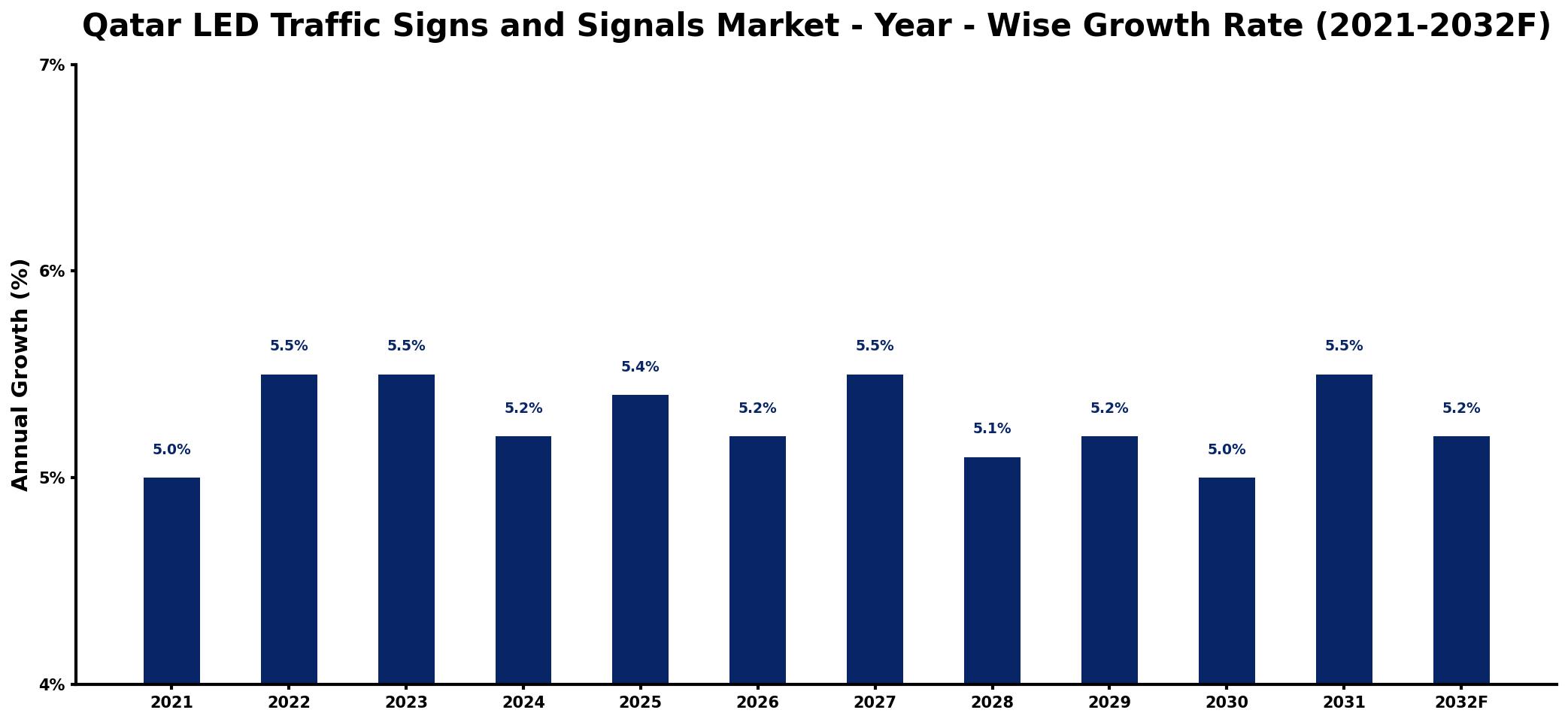
The table below presents the year‑wise growth rates along with the key drivers influencing the market
| Year | Growth Rate | Major Drivers |
| 2021 | 5.0% | Increased urban infrastructure investments |
| 2022 | 5.5% | Growing emphasis on road safety |
| 2023 | 5.5% | Expansion of smart city initiatives |
| 2024 | 5.2% | Rising demand for energy efficiency |
| 2025 | 5.4% | Technological advancements in automation |
| 2026 | 5.2% | Enhanced public transportation systems |
| 2027 | 5.5% | Government initiatives for modernization |
| 2028 | 5.1% | growing regional consumption patterns |
| 2029 | 5.2% | Increased public awareness campaigns |
| 2030 | 5.0% | Growing urban population pressures |
| 2031 | 5.5% | Higher funding for public projects |
| 2032 | 5.2% | Adoption of innovative safety measures |
Note: Market size estimations and growth projections presented in this report are based on 6Wresearch's proprietary forecasting methodology, utilizing the latest available industry data, government publications, and primary research inputs.
Qatar LED Traffic Signs and Signals Market Synopsis
In Qatar, the adoption of LED traffic signs and signals is rapidly becoming a cornerstone of modern traffic management. The strategic development of transportation infrastructure, combined with Qatar's commitment to enhancing road safety, has led to a favorable environment for LED technology integration. With a focus on sustainability, the shift from traditional lighting to energy-efficient LED solutions is transforming how traffic is communicated and managed across the nation.
As vehicular traffic rises in response to urban development, the need for effective traffic control systems is more critical than ever. Qatar's ongoing investments in smart city initiatives are further promoting the incorporation of LED-based solutions, designed to provide clearer visibility and enhance driver awareness. The intersection of technological innovation and regulatory support positions the LED traffic signs and signals market for significant growth in the coming years.
Qatar LED Traffic Signs and Signals Market Key Takeaways
- The market is driven by increasing urbanization and vehicular traffic, necessitating improved traffic management solutions.
- Energy-efficient LED technologies offer longer lifespans and greater brightness compared to traditional lighting systems.
- Smart city initiatives in Qatar are propelling demand for advanced LED traffic signage and signals.
- Government commitments to sustainability align with the transition to energy-saving LED systems.
- Challenges remain in standardization and infrastructure compatibility as the market evolves.
Evaluation of Restraints in Qatar LED Traffic Signs and Signals Market
Despite its promising outlook, the Qatar LED traffic signs and signals market faces notable restraints. Transitioning from traditional systems to LED technology requires careful coordination with existing infrastructure to avoid disruptions in traffic management. Ensuring compatibility and functionality is essential for maintaining road safety. Additionally, the lack of standardization in designs and color schemes for traffic signals can complicate implementation across diverse urban and rural settings. Regulatory frameworks must be established to streamline these transitions and support uniformity in deployment.
Qatar LED Traffic Signs and Signals Market Trends
Several key trends are shaping the Qatar LED traffic signs and signals market. The integration of IoT (Internet of Things) technology is enhancing the functionality of traffic management systems, allowing for real-time monitoring and data-driven decision-making. Moreover, the increasing adoption of smart traffic management solutions is driving investments into LED technologies that can adapt to varying traffic conditions. Additionally, there is a rising awareness among governmental bodies regarding the importance of sustainable urban planning, which further emphasizes the shift towards LED solutions.
Qatar LED Traffic Signs and Signals Market Opportunities
The future presents substantial opportunities for growth within the Qatar LED traffic signs and signals market. As the country prepares for significant events and aims to enhance its global standing in infrastructure development, there is a clear pathway for investments in LED technologies. Public and private sector partnerships are expected to play a pivotal role in advancing smart city initiatives, leading to increased demand for innovative traffic solutions. Furthermore, as awareness of the benefits of energy efficiency continues to rise, opportunities for retrofitting existing traffic systems with modern LED solutions will proliferate.
Government Initiatives in the Qatar LED Traffic Signs and Signals Market
The Qatari government is actively promoting initiatives that support the development and implementation of LED traffic signs and signals. Investments in transportation infrastructure are complemented by policies aimed at enhancing road safety and promoting sustainability. These government initiatives create an enabling environment for private sector innovation and investment in LED technologies. Additionally, ongoing regulatory frameworks are being developed to ensure that new installations meet safety and performance standards, further driving the adoption of advanced traffic management solutions.
Future Insights of the Qatar LED Traffic Signs and Signals Market
Looking ahead to 2026-2032, the Qatar LED traffic signs and signals market is poised for continued expansion. The growth will be underpinned by the ongoing urbanization of the country, coupled with an increasing focus on enhancing road safety through technological advancements. As smart city projects take shape, the demand for sophisticated LED traffic solutions will escalate, promoting a safer and more efficient transportation network. The continuous evolution of regulations and standards will also likely pave the way for greater market stability and growth potential.
Qatar LED Traffic Signs and Signals Market Latest Developments (2025 - 2026)
Recent developments in the Qatar LED traffic signs and signals market indicate a strong push towards the integration of advanced technologies in traffic management. Research and development initiatives are focusing on enhancing the visibility and responsiveness of LED solutions. Additionally, collaborative projects between governmental agencies and private firms are being initiated to leverage smart technologies, aiming to create more interactive traffic systems. These trends signal a transformative shift in how traffic is managed and monitored across the country.
Qatar LED Traffic Signs and Signals Market - Key Attractiveness of the Report
- 10 Years of Market Numbers
- Historical Data Starting from 2022 to 2025
- Base Year: 2025
- Forecast Data until 2032
- Key Performance Indicators Impacting the Market
- Major Upcoming Developments and Projects
Key Highlights of the Report:
- Qatar LED Traffic Signs and Signals Market Outlook
- Market Size of Qatar LED Traffic Signs and Signals Market, 2025
- Forecast of Qatar LED Traffic Signs and Signals Market, 2032
- Historical Data and Forecast of Qatar LED Traffic Signs and Signals Revenues & Volume for the Period 2022-2032F
- Qatar LED Traffic Signs and Signals Market Trend Evolution
- Qatar LED Traffic Signs and Signals Market Drivers and Challenges
- Qatar LED Traffic Signs and Signals Price Trends
- Qatar LED Traffic Signs and Signals Porter's Five Forces
- Qatar LED Traffic Signs and Signals Industry Life Cycle
- Historical Data and Forecast of Qatar LED Traffic Signs and Signals Market Revenues & Volume By Product for the Period 2022-2032F
- Historical Data and Forecast of Qatar LED Traffic Signs and Signals Market Revenues & Volume By LED Traffic Signals for the Period 2022-2032F
- Historical Data and Forecast of Qatar LED Traffic Signs and Signals Market Revenues & Volume By LED Traffic Signs for the Period 2022-2032F
- Qatar LED Traffic Signs and Signals Import Export Trade Statistics
- Market Opportunity Assessment By Product
- Qatar LED Traffic Signs and Signals Top Companies Market Share
- Qatar LED Traffic Signs and Signals Competitive Benchmarking By Technical and Operational Parameters
- Qatar LED Traffic Signs and Signals Company Profiles
- Qatar LED Traffic Signs and Signals Key Strategic Recommendations






































