Mexico Quantum Cryptography Market Size & Growth Rate (2026-2032)
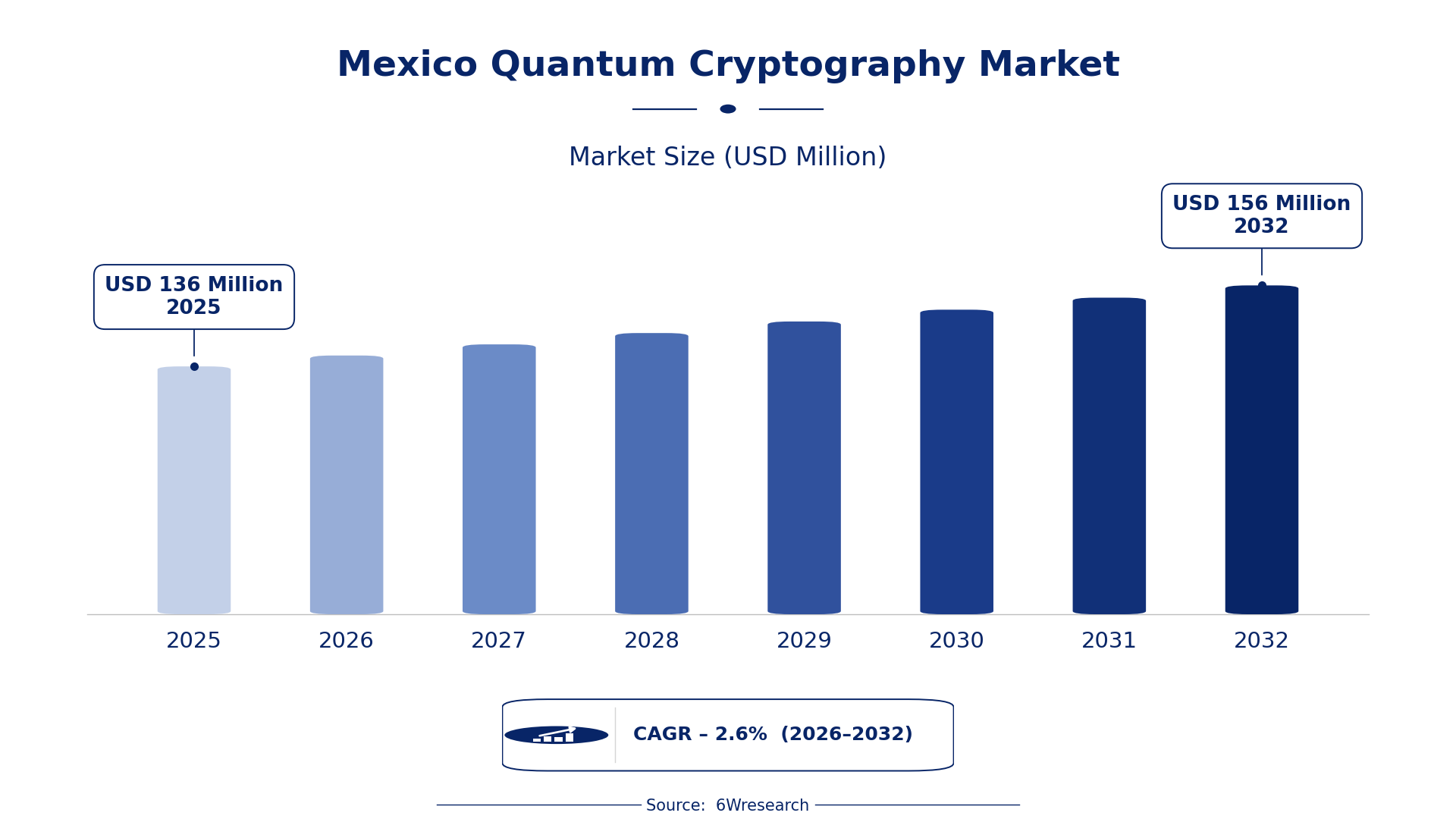
The Mexico Quantum Cryptography Market was estimated at USD 136 Million in 2025 and is projected to reach USD 156 Million by 2032, growing at a CAGR of 2.6% from 2026 to 2032.
Mexico Quantum Cryptography Market Synopsis
The primary force shaping the Mexico Quantum Cryptography Market is the escalating demand for secure communication solutions. As digital threats become more sophisticated, organizations across key sectors are turning to quantum cryptography to safeguard sensitive information.
This market is further propelled by rising cybersecurity concerns and a push for enhanced data privacy. Government, defense, finance, and healthcare sectors are increasingly adopting quantum cryptography as traditional methods fail to adequately protect against emerging quantum computing vulnerabilities.
Mexico Quantum Cryptography Market Year-wise Growth Rate and Key Drivers
This graph illustrates the annual growth rates of the Mexico Quantum Cryptography Market from 2021 to 2032, highlighting a steady upward trajectory and projected expansion over the forecast period.
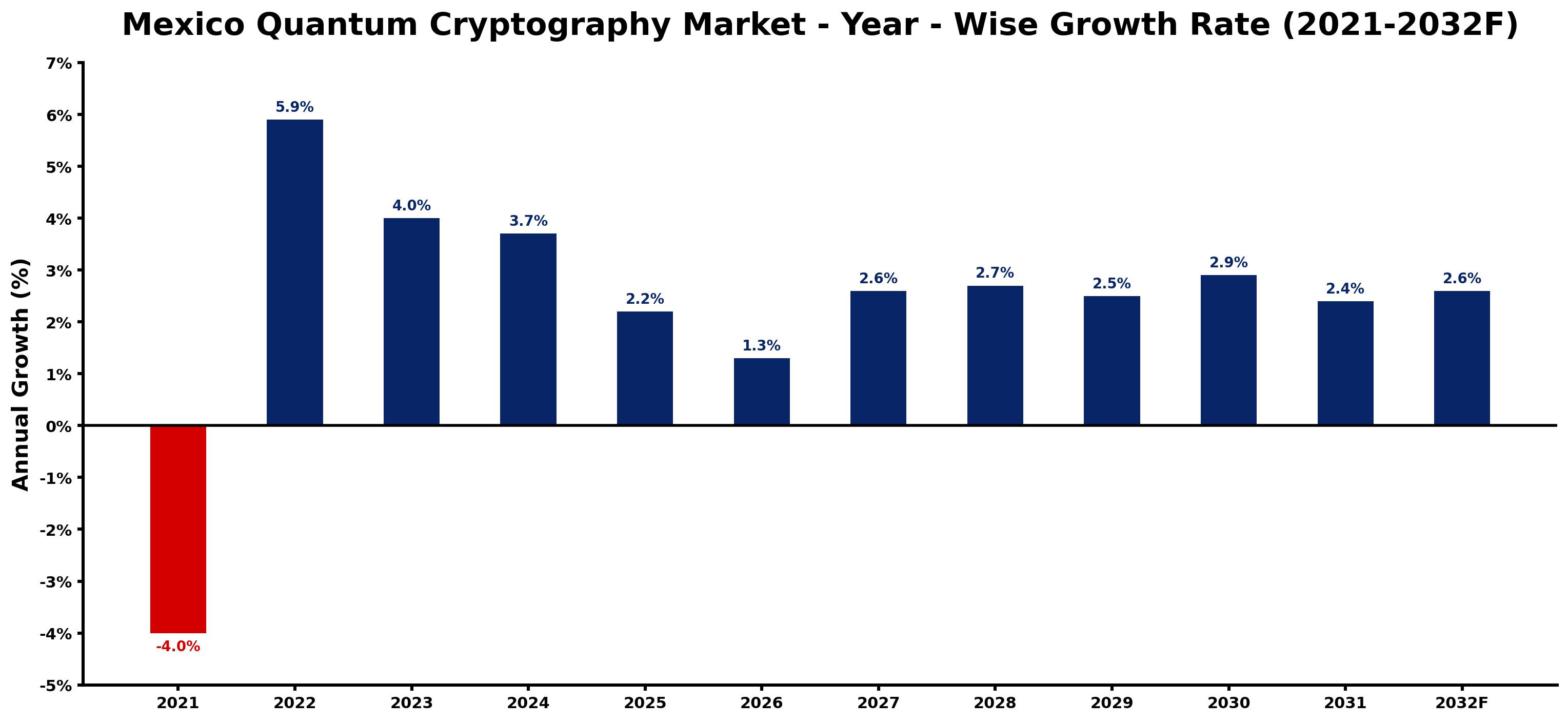
The table below presents the year‑wise growth rates along with the key drivers influencing the market
| Year | Growth Rate | Major Drivers |
| 2021 | -4.0% | Delayed implementation of telecom encryption regulations by IFT |
| 2022 | 5.9% | Implementation of Mexico's National Cybersecurity Strategy |
| 2023 | 4.0% | Increased investment in public sector cybersecurity projects |
| 2024 | 3.7% | Collaboration with local universities on quantum research |
| 2025 | 2.2% | Rising adoption of quantum-safe encryption methods |
| 2026 | 1.3% | Support from Conacyt for quantum technology startups |
| 2027 | 2.6% | Growing awareness of data privacy regulations compliance |
| 2028 | 2.7% | Demand from telecommunications firms for advanced security |
| 2029 | 2.5% | Incorporation of quantum cryptography in governmental frameworks |
| 2030 | 2.9% | Partnerships between tech firms and Mexican academic institutions |
| 2031 | 2.4% | Increased funding for innovation in quantum technologies |
| 2032 | 2.6% | Rising threats of cyberattacks driving security investments |
Note: Market size estimations and growth projections presented in this report are based on 6Wresearch's proprietary forecasting methodology, utilizing the latest available industry data, government publications, and primary research inputs.
Mexico Quantum Cryptography Market Key Takeaways
Below are some of the specific key takeaways from the market, including:
- The market's growth trajectory is driven by critical sectors prioritizing secure communication.
- Organizations are shifting from traditional cryptographic methods to quantum solutions.
- Technological advancements and research initiatives are essential for market expansion.
- Cybersecurity concerns remain a paramount driver of demand.
- Standardization and interoperability challenges must be addressed for widespread adoption.
Evaluation of Restraints in Mexico Quantum Cryptography Market
One of the most pressing constraints in the Mexico Quantum Cryptography Market lies in its technological complexity. Organizations often struggle with the implementation of quantum encryption due to a lack of expertise and the steep learning curve associated with the technology. Standardization issues further complicate matters, as varied protocols can hinder interoperability among different systems. on top of that, ensuring the scalability of quantum solutions while maintaining their security poses an ongoing challenge for providers. Concerns over cybersecurity threats also remain relevant, as any vulnerabilities in quantum systems could negate their intended benefits, creating a cautious approach among potential adopters.
Mexico Quantum Cryptography Market Trends
Several trends are emerging that will shape the future of the Mexico Quantum Cryptography Market. The first is the increasing investment in research and development, aimed at improving the technology's efficiency and effectiveness. Additionally, collaboration between academic institutions and private sectors is becoming more prevalent, fueling innovation and pushing boundaries in quantum communication. The demand for encryption solutions tailored to specific industries, particularly healthcare and finance, is also growing, reflecting a shift toward more customized security measures.
Mexico Quantum Cryptography Market Opportunities
Opportunities abound for growth within the Mexico Quantum Cryptography Market, particularly for organizations willing to innovate. A key area of potential lies in developing quantum-safe solutions that can seamlessly integrate with existing IT infrastructure. on top of that, as industries begin to prioritize compliance with stringent data privacy regulations, quantum cryptography can offer a competitive edge. With the Mexican government's strong support for research initiatives, companies can leverage public funding and partnerships to accelerate the commercialization of quantum solutions.
Government Initiatives in the Mexico Quantum Cryptography Market
Government policy plays a critical role in shaping the Mexico Quantum Cryptography Market. With a clear focus on enhancing cybersecurity and protecting data privacy, the Mexican government is investing in various initiatives. These policies not only stimulate research and development but also aim to create a conducive environment for the commercialization of quantum cryptographic solutions.
- A recently completed national program funded quantum cryptography research projects to strengthen cybersecurity measures.
- Ongoing collaboration between the government and academic institutions focuses on developing cutting-edge quantum communication technologies.
- A planned initiative aims to create a regulatory framework that fosters the adoption of quantum encryption across critical sectors by 2028.
- A public-private partnership expected to boost investment in quantum technology infrastructure is currently underway.
- Future funding opportunities are being structured to support startups focusing on cybersecurity innovations related to quantum cryptography.
Future Insights of the Mexico Quantum Cryptography Market
Looking ahead to 2026-2032, the Mexico Quantum Cryptography Market is set to evolve significantly. As quantum technology matures, we can expect broader adoption across various industries, driven by the urgent need for enhanced security measures. The ongoing development of new protocols and standards will likely ease interoperability issues, further encouraging market growth. With the increasing support from government initiatives, stakeholders can anticipate a more vibrant ecosystem that fosters innovation and collaboration.
Mexico Quantum Cryptography Market Latest Developments
In the last 12-14 months, activity in the Mexico Quantum Cryptography Market has accelerated, reflecting a growing recognition of the need for secure communication solutions. Various stakeholders, including private companies and academic institutions, are increasingly involved in developing and implementing quantum technologies.
- A leading technology vendor launched a pilot program in late 2025 to test quantum encryption applications in financial services.
- In early 2025, a major research institution received government funding to explore new quantum algorithms aimed at enhancing data security.
- An initiative that began in Q3 2025 is currently underway to establish a national quantum communication testbed for industry testing.
- Upcoming plans are in place for a series of workshops and seminars in 2026 focused on educating organizations about quantum cryptography applications.
- A collaborative project between multiple sectors is expected to be announced in early 2026, targeting the integration of quantum cryptography in health data management systems.
Mexico Quantum Cryptography Market - Key Attractiveness of the Report
- 10 Years of Market Numbers
- Historical Data Starting from 2022 to 2025
- Base Year: 2025
- Forecast Data until 2032
- Key Performance Indicators Impacting the Market
- Major Upcoming Developments and Projects
Key Highlights of the Report:
- Mexico Quantum Cryptography Market Outlook
- Market Size of Mexico Quantum Cryptography Market, 2025
- Forecast of Mexico Quantum Cryptography Market, 2032
- Historical Data and Forecast of Mexico Quantum Cryptography Revenues & Volume for the Period 2022-2032F
- Mexico Quantum Cryptography Market Trend Evolution
- Mexico Quantum Cryptography Market Drivers and Challenges
- Mexico Quantum Cryptography Price Trends
- Mexico Quantum Cryptography Porter's Five Forces
- Mexico Quantum Cryptography Industry Life Cycle
- Historical Data and Forecast of Mexico Quantum Cryptography Market Revenues & Volume By Component for the Period 2022-2032F
- Historical Data and Forecast of Mexico Quantum Cryptography Market Revenues & Volume By Solutions for the Period 2022-2032F
- Historical Data and Forecast of Mexico Quantum Cryptography Market Revenues & Volume By Services for the Period 2022-2032F
- Historical Data and Forecast of Mexico Quantum Cryptography Market Revenues & Volume By Services for the Period 2022-2032F
- Historical Data and Forecast of Mexico Quantum Cryptography Market Revenues & Volume By Consulting for the Period 2022-2032F
- Historical Data and Forecast of Mexico Quantum Cryptography Market Revenues & Volume By Advisory for the Period 2022-2032F
- Historical Data and Forecast of Mexico Quantum Cryptography Market Revenues & Volume By Deployment for the Period 2022-2032F
- Historical Data and Forecast of Mexico Quantum Cryptography Market Revenues & Volume By Integration for the Period 2022-2032F
- Historical Data and Forecast of Mexico Quantum Cryptography Market Revenues & Volume By Support for the Period 2022-2032F
- Historical Data and Forecast of Mexico Quantum Cryptography Market Revenues & Volume By Maintenance for the Period 2022-2032F
- Historical Data and Forecast of Mexico Quantum Cryptography Market Revenues & Volume By Security Type for the Period 2022-2032F
- Historical Data and Forecast of Mexico Quantum Cryptography Market Revenues & Volume By Network for the Period 2022-2032F
- Historical Data and Forecast of Mexico Quantum Cryptography Market Revenues & Volume By Application Security for the Period 2022-2032F
- Historical Data and Forecast of Mexico Quantum Cryptography Market Revenues & Volume By Vertical for the Period 2022-2032F
- Historical Data and Forecast of Mexico Quantum Cryptography Market Revenues & Volume By Government and defense for the Period 2022-2032F
- Historical Data and Forecast of Mexico Quantum Cryptography Market Revenues & Volume By BFSI for the Period 2022-2032F
- Historical Data and Forecast of Mexico Quantum Cryptography Market Revenues & Volume By Retail for the Period 2022-2032F
- Historical Data and Forecast of Mexico Quantum Cryptography Market Revenues & Volume By Healthcare for the Period 2022-2032F
- Historical Data and Forecast of Mexico Quantum Cryptography Market Revenues & Volume By Automotive for the Period 2022-2032F
- Historical Data and Forecast of Mexico Quantum Cryptography Market Revenues & Volume By Others (telecom, energy and utilities, logistics, and education) for the Period 2022-2032F
- Mexico Quantum Cryptography Import Export Trade Statistics
- Market Opportunity Assessment By Component
- Market Opportunity Assessment By Services
- Market Opportunity Assessment By Security Type
- Market Opportunity Assessment By Vertical
- Mexico Quantum Cryptography Top Companies Market Share
- Mexico Quantum Cryptography Competitive Benchmarking By Technical and Operational Parameters
- Mexico Quantum Cryptography Company Profiles
- Mexico Quantum Cryptography Key Strategic Recommendations






































