Mexico Three Wheeler Market Size, Share & Growth Rate
The Mexico Three Wheeler Market was estimated at USD 244 Million in 2025 and is projected to reach USD 281 Million by 2032, growing at a CAGR of 2.0% from 2026 to 2032. This steady growth trajectory is underpinned by urbanization and increasing consumer preference for cost-effective transportation options. As cities become more congested, the agile and adaptable nature of three-wheelers presents a practical solution for both personal and commercial transportation needs.
Mexico Three Wheeler Market Year-wise Growth Rate and Key Drivers
This graph highlights how the Mexico Three Wheeler Market has steadily grown over the years, supported by major growth factors.
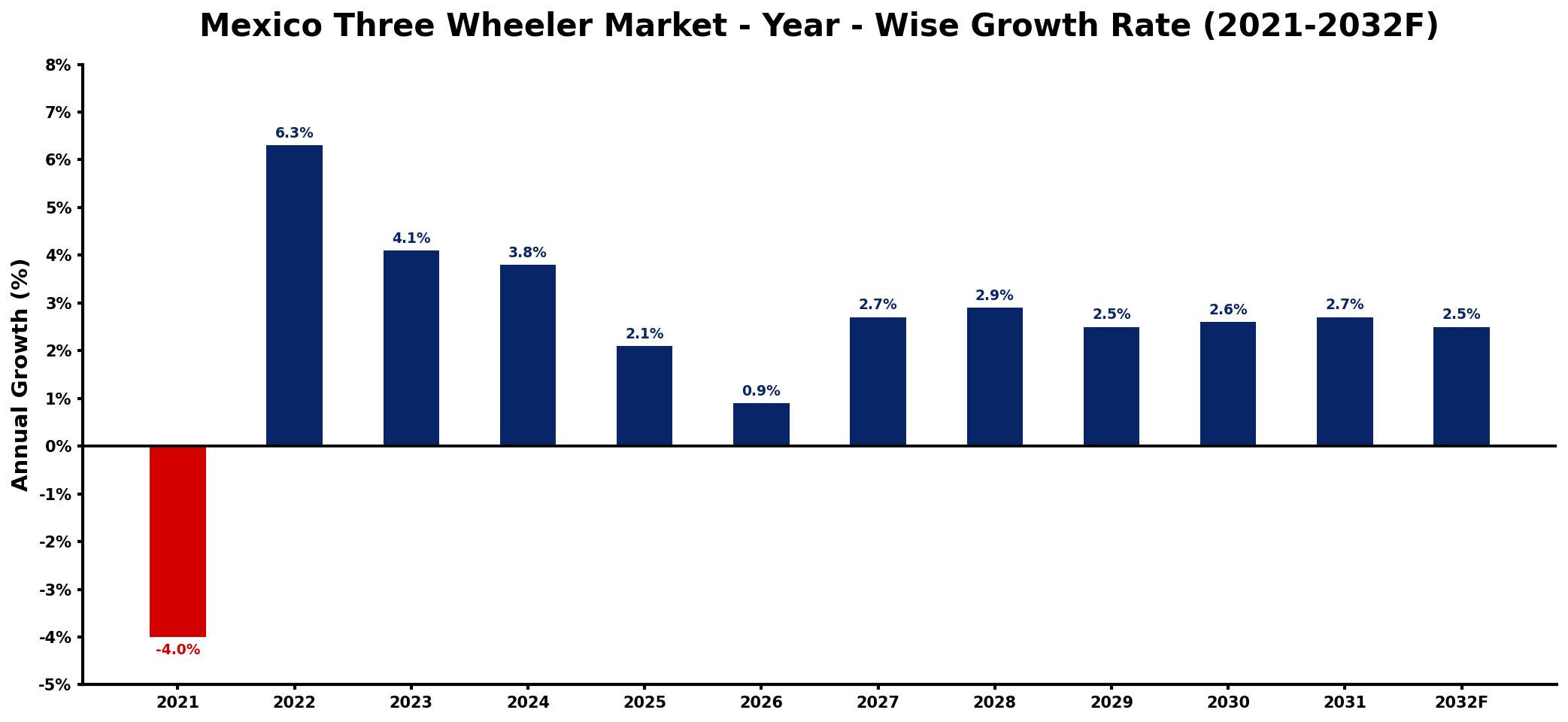
The table below presents the year‑wise growth rates along with the key drivers influencing the market
| Year | Growth Rate | Major Drivers |
| 2021 | -4.0% | decreased urban transportation investment |
| 2022 | 6.3% | increased demand for last mile |
| 2023 | 4.1% | growing popularity of eco-friendly |
| 2024 | 3.8% | expansion of ride-sharing services |
| 2025 | 2.1% | rising urbanization and mobility needs |
| 2026 | 0.9% | enhanced logistics and delivery services |
| 2027 | 2.7% | growing interest in alternative transport |
| 2028 | 2.9% | increased government infrastructure funding |
| 2029 | 2.5% | surge in e-commerce delivery demands |
| 2030 | 2.6% | rising consumer preference for convenience |
| 2031 | 2.7% | expanding tourism and recreational activities |
| 2032 | 2.5% | increased investments in local manufacturing |
Note: Market size estimations and growth projections presented in this report are based on 6Wresearch's proprietary forecasting methodology, utilizing the latest available industry data, government publications, and primary research inputs.
Mexico Three Wheeler Market Synopsis
In urban Mexico, the demand for three-wheelers is on the rise, becoming an essential facet of local transportation. This trend reflects the growing need for efficient last-mile delivery services and affordable commuting alternatives.
As traditional modes of transport struggle with congestion and emissions concerns, three-wheelers emerge as a versatile solution, adept at maneuvering through narrow streets and crowded neighborhoods. With increasing government initiatives supporting electrification, the market is also witnessing a shift towards more environmentally friendly options.
Mexico Three Wheeler Market Key Takeaways
- Growing urbanization in Mexico is catalyzing the demand for three-wheelers as efficient transportation solutions.
- Government incentives are promoting the adoption of electric three-wheelers, enhancing market sustainability.
- Local manufacturers are expanding their product lines to meet diverse consumer and business needs.
- Infrastructure development is essential to support the increasing number of three-wheelers on the road.
- Technological advancements in safety and connectivity are reshaping consumer expectations in the market.
Evaluation of Restraints in Mexico Three Wheeler Market
Despite the promising growth, several key restraints are impacting the Mexico Three Wheeler Market. One major obstacle is the regulatory landscape, which lacks clarity and can create uncertainty for both manufacturers and consumers. Furthermore, the perception of three-wheelers as less safe compared to traditional vehicles poses a significant hurdle in consumer adoption. Lastly, inadequate infrastructure, including a lack of dedicated parking and proper road conditions for three-wheelers, can restrict their widespread use and acceptance in urban settings.
Mexico Three Wheeler Market Trends
Current trends in the Mexico Three Wheeler Market are leaning towards a greener future, as electric models gain traction due to their lower emissions and operational costs. Manufacturers are increasingly integrating advanced safety features and smart technology, responding to consumer demand for more reliable and connected vehicles. Additionally, the versatility of three-wheelers makes them ideal for a variety of applications, including cargo delivery and passenger transport, further solidifying their role in modern urban mobility.
Mexico Three Wheeler Market Opportunities
The Mexico Three Wheeler Market is ripe for investment, especially with the ongoing shift towards electric vehicles. Investors have significant opportunities in manufacturing electric three-wheelers and developing supporting infrastructure such as charging stations. Furthermore, the demand for last-mile delivery services offers a pathway for innovative logistics solutions utilizing three-wheelers, making it an appealing market segment for new entrants.
Government Initiatives in the Mexico Three Wheeler Market
The Mexican government is actively supporting the Three Wheeler Market through policies aimed at improving road safety and reducing emissions. Initiatives include the establishment of safety standards for three-wheelers and various incentives for consumers who choose electric models. By fostering research and development in transportation technology, these policies aim to balance the growing demand for mobility solutions with essential environmental considerations.
Future Insights of the Mexico Three Wheeler Market
Looking ahead to 2026-2032, the Mexico Three Wheeler Market is poised for gradual yet significant growth. The accelerating pace of urbanization, coupled with a societal shift towards more sustainable transportation methods, is expected to amplify the demand for three-wheelers. As environmental regulations tighten, the market will likely continue its transition to electric vehicles, enhancing operational efficiency and safety. In this evolving landscape, manufacturers will need to innovate and adapt to meet changing consumer preferences and regulatory standards.
Mexico Three Wheeler Market Latest Developments (2025 - 2026)
Recent developments in the Mexico Three Wheeler Market include increased collaboration among manufacturers to enhance product safety and technology integration. Notably, advancements in battery technology for electric models are gaining attention, driving interest in more sustainable solutions. Local governments are also ramping up efforts to improve infrastructure tailored for three-wheelers, reflecting a commitment to expanding this transportation segment. These movements signify a vibrant and responsive market landscape, actively adapting to contemporary mobility demands.
Mexico Three Wheeler Market - Key Attractiveness of the Report
- 10 Years of Market Numbers
- Historical Data Starting from 2022 to 2025
- Base Year: 2025
- Forecast Data until 2032
- Key Performance Indicators Impacting the Market
- Major Upcoming Developments and Projects
Key Highlights of the Report:
- Mexico Three Wheeler Market Outlook
- Market Size of Mexico Three Wheeler Market, 2025
- Forecast of Mexico Three Wheeler Market, 2032
- Historical Data and Forecast of Mexico Three Wheeler Revenues & Volume for the Period 2022-2032F
- Mexico Three Wheeler Market Trend Evolution
- Mexico Three Wheeler Market Drivers and Challenges
- Mexico Three Wheeler Price Trends
- Mexico Three Wheeler Porter's Five Forces
- Mexico Three Wheeler Industry Life Cycle
- Historical Data and Forecast of Mexico Three Wheeler Market Revenues & Volume By Fuel Type for the Period 2022-2032F
- Historical Data and Forecast of Mexico Three Wheeler Market Revenues & Volume By Petrol/CNG for the Period 2022-2032F
- Historical Data and Forecast of Mexico Three Wheeler Market Revenues & Volume By Diesel for the Period 2022-2032F
- Historical Data and Forecast of Mexico Three Wheeler Market Revenues & Volume By Electric for the Period 2022-2032F
- Historical Data and Forecast of Mexico Three Wheeler Market Revenues & Volume By Vehicle Type for the Period 2022-2032F
- Historical Data and Forecast of Mexico Three Wheeler Market Revenues & Volume By Passenger Carrier for the Period 2022-2032F
- Historical Data and Forecast of Mexico Three Wheeler Market Revenues & Volume By Load Carrier for the Period 2022-2032F
- Mexico Three Wheeler Import Export Trade Statistics
- Market Opportunity Assessment By Fuel Type
- Market Opportunity Assessment By Vehicle Type
- Mexico Three Wheeler Top Companies Market Share
- Mexico Three Wheeler Competitive Benchmarking By Technical and Operational Parameters
- Mexico Three Wheeler Company Profiles
- Mexico Three Wheeler Key Strategic Recommendations






































