United Kingdom (UK) Three Wheeler Market Size, Share & Growth Rate
The United Kingdom (UK) Three Wheeler Market was estimated at USD 249 Million in 2025 and is projected to reach USD 309 Million by 2032, growing at a CAGR of 3.1% from 2026 to 2032. This growth is primarily driven by the increasing urbanization in the UK, which is leading to a demand for compact and efficient modes of transport. Additionally, the growing emphasis on sustainability and environmental consciousness among consumers is further propelling the adoption of electric three-wheelers.
United Kingdom (UK) Three Wheeler Market Year-wise Growth Rate and Key Drivers
This graph highlights how the United Kingdom (UK) Three Wheeler Market has steadily grown over the years, supported by major growth factors.
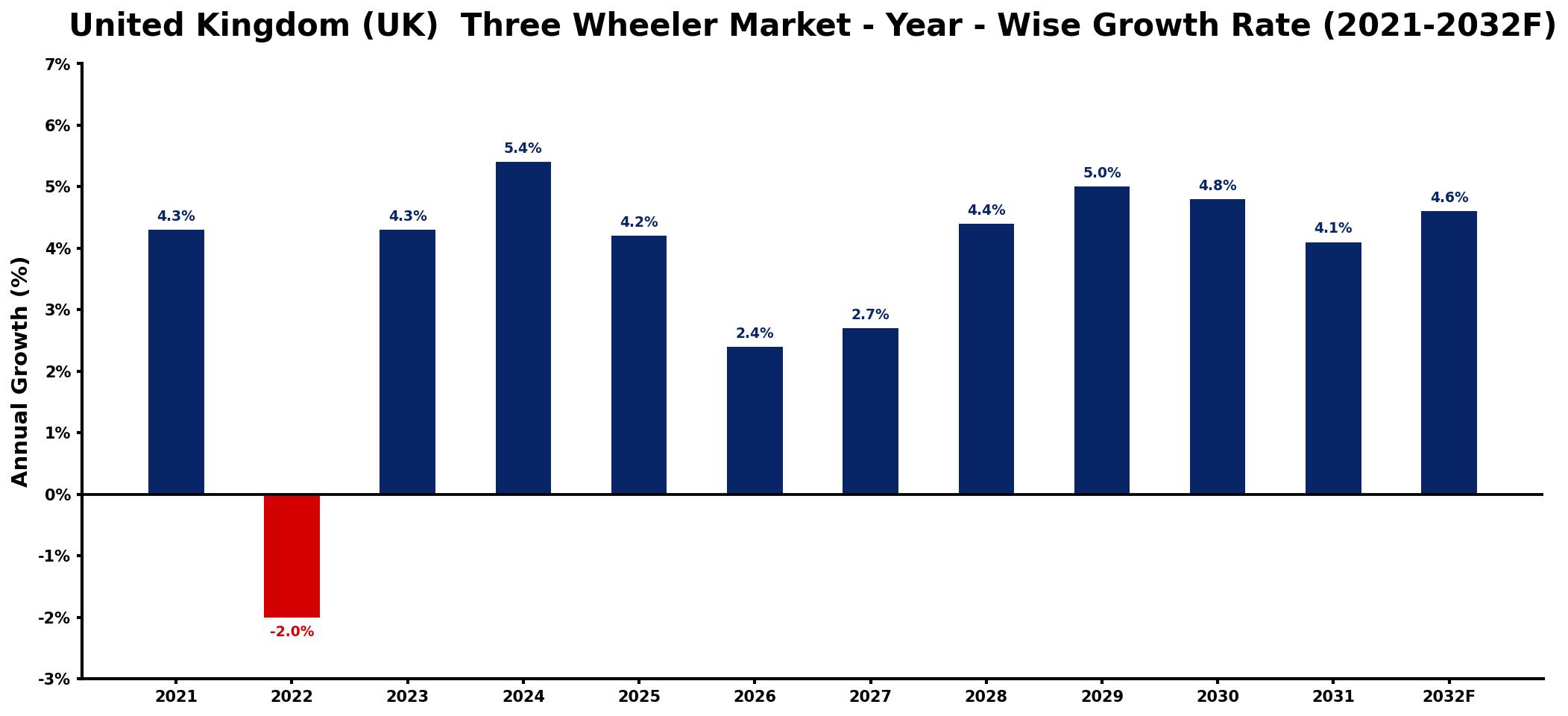
The table below presents the year‑wise growth rates along with the key drivers influencing the market
| Year | Growth Rate | Major Drivers |
| 2021 | 4.3% | Rise in urban transportation demand |
| 2022 | -2.0% | Decrease in consumer spending habits |
| 2023 | 4.3% | Growth in eco-friendly initiatives |
| 2024 | 5.4% | Increase in last mile logistics |
| 2025 | 4.2% | Expansion of local manufacturing capabilities |
| 2026 | 2.4% | Surge in alternative fuel investments |
| 2027 | 2.7% | increased pharmaceutical industry usage |
| 2028 | 4.4% | rising infrastructure development spending |
| 2029 | 5.0% | growing downstream application demand |
| 2030 | 4.8% | growing commercial sector adoption |
| 2031 | 4.1% | increased production capacity utilization |
| 2032 | 4.6% | increased overall sector activity |
Note: Market size estimations and growth projections presented in this report are based on 6Wresearch's proprietary forecasting methodology, utilizing the latest available industry data, government publications, and primary research inputs.
United Kingdom (UK) Three Wheeler Market Synopsis
Recently, the UK Three Wheeler Market has gained significant momentum, characterized by a rising interest in agile urban transport options. As we look ahead, the market is poised for further expansion, particularly as consumers increasingly prioritize eco-friendly alternatives and urban logistics solutions.
The landscape for three-wheelers is evolving, with manufacturers introducing innovative technologies to enhance the user experience. This aligns with broader trends toward sustainable mobility, which positions three-wheelers as a viable solution for urban commuters and delivery services alike.
United Kingdom (UK) Three Wheeler Market Key Takeaways
- The market is set for steady growth, driven by urbanization and sustainability trends.
- Electric three-wheelers are gaining popularity due to government incentives and environmental concerns.
- Investment opportunities are emerging in the commercial sector, particularly for last-mile delivery.
- Innovations in battery technology and connectivity features are enhancing market appeal.
- The competitive pricing and lower maintenance costs of three-wheelers attract a diverse consumer base.
Evaluation of Restraints in United Kingdom (UK) Three Wheeler Market
Despite the promising outlook, the UK Three Wheeler Market faces several restraints that could impact its growth trajectory. The evolving regulatory landscape concerning emissions and safety standards poses challenges for manufacturers seeking to innovate while complying with these regulations. Additionally, competition from traditional four-wheeled vehicles remains strong, as many consumers still perceive cars as safer and more practical. The existing infrastructure for supporting electric three-wheelers, such as charging stations, is also limited, hindering wider adoption. Finally, societal perceptions of three-wheelers as niche or unconventional vehicles may create barriers to capturing a more mainstream audience.
United Kingdom (UK) Three Wheeler Market Trends
A notable trend in the UK Three Wheeler Market is the shift toward electric models, driven by a combination of consumer demand for sustainability and government policies incentivizing electric vehicle adoption. Furthermore, the rise of e-commerce is fueling the demand for efficient last-mile delivery solutions, with three-wheelers emerging as an attractive option due to their compactness and agility. Additionally, manufacturers are investing in advanced technologies, including enhanced battery systems and smart connectivity features, to attract a tech-savvy consumer base.
United Kingdom (UK) Three Wheeler Market Opportunities
The UK Three Wheeler Market offers robust investment opportunities, particularly in the realm of electric three-wheelers, as governmental support accelerates the transition to greener transport solutions. The burgeoning e-commerce sector presents significant potential for commercial three-wheelers, especially for logistics companies seeking efficient delivery options. Collaborations focused on integrating autonomous driving capabilities and innovative safety features could also yield strategic advantages, making this market an attractive proposition for investors aiming to capitalize on the growing demand for sustainable transportation.
Government Initiatives in the United Kingdom (UK) Three Wheeler Market
The UK government is actively promoting policies aimed at enhancing the adoption of three-wheelers, particularly electric variants. Key initiatives include financial incentives through grants for purchasing ultra-low emission vehicles, contributing to the broader goal of reducing vehicular emissions. Additionally, the commitment to phasing out petrol and diesel vehicles by 2030 reflects a proactive stance toward sustainable mobility. Investments in electric vehicle charging infrastructure are also being made to support the growing number of electric three-wheelers on the road, ensuring a conducive environment for market expansion.
Future Insights of the United Kingdom (UK) Three Wheeler Market
Looking ahead to 2026-2032, the UK Three Wheeler Market is expected to flourish as urbanization continues to rise and consumers become increasingly aware of the need for sustainable transport options. The anticipated surge in sales of electric and hybrid three-wheelers will reflect changing consumer preferences toward fuel efficiency and eco-friendliness. Furthermore, the versatility of three-wheelers in commercial applications, such as last-mile deliveries and ride-sharing services, will further enhance their attractiveness. With ongoing technological advancements and shifting public attitudes, the market is well-positioned for sustained growth and innovation in the coming years.
United Kingdom (UK) Three Wheeler Market Latest Developments (2025 - 2026)
In recent months, the UK Three Wheeler Market has witnessed notable developments that indicate a positive trajectory. Manufacturers are focusing on introducing new models that integrate cutting-edge technology, particularly in battery efficiency and connectivity features. Efforts to expand charging infrastructure are underway, with various public and private entities collaborating to enhance the availability of charging stations. The market is also seeing an uptick in partnerships aimed at enhancing commercial applications for three-wheelers, especially in logistics and e-commerce sectors.
United Kingdom (UK) Three Wheeler Market - Key Attractiveness of the Report
- 10 Years of Market Numbers
- Historical Data Starting from 2022 to 2025
- Base Year: 2025
- Forecast Data until 2032
- Key Performance Indicators Impacting the Market
- Major Upcoming Developments and Projects
Key Highlights of the Report:
- United Kingdom (UK) Three Wheeler Market Outlook
- Market Size of United Kingdom (UK) Three Wheeler Market, 2025
- Forecast of United Kingdom (UK) Three Wheeler Market, 2032
- Historical Data and Forecast of United Kingdom (UK) Three Wheeler Revenues & Volume for the Period 2022-2032F
- United Kingdom (UK) Three Wheeler Market Trend Evolution
- United Kingdom (UK) Three Wheeler Market Drivers and Challenges
- United Kingdom (UK) Three Wheeler Price Trends
- United Kingdom (UK) Three Wheeler Porter's Five Forces
- United Kingdom (UK) Three Wheeler Industry Life Cycle
- Historical Data and Forecast of United Kingdom (UK) Three Wheeler Market Revenues & Volume By Fuel Type for the Period 2022-2032F
- Historical Data and Forecast of United Kingdom (UK) Three Wheeler Market Revenues & Volume By Petrol/CNG for the Period 2022-2032F
- Historical Data and Forecast of United Kingdom (UK) Three Wheeler Market Revenues & Volume By Diesel for the Period 2022-2032F
- Historical Data and Forecast of United Kingdom (UK) Three Wheeler Market Revenues & Volume By Electric for the Period 2022-2032F
- Historical Data and Forecast of United Kingdom (UK) Three Wheeler Market Revenues & Volume By Vehicle Type for the Period 2022-2032F
- Historical Data and Forecast of United Kingdom (UK) Three Wheeler Market Revenues & Volume By Passenger Carrier for the Period 2022-2032F
- Historical Data and Forecast of United Kingdom (UK) Three Wheeler Market Revenues & Volume By Load Carrier for the Period 2022-2032F
- United Kingdom (UK) Three Wheeler Import Export Trade Statistics
- Market Opportunity Assessment By Fuel Type
- Market Opportunity Assessment By Vehicle Type
- United Kingdom (UK) Three Wheeler Top Companies Market Share
- United Kingdom (UK) Three Wheeler Competitive Benchmarking By Technical and Operational Parameters
- United Kingdom (UK) Three Wheeler Company Profiles
- United Kingdom (UK) Three Wheeler Key Strategic Recommendations






































