United Arab Emirates (UAE) Three Wheeler Market Size, Share & Growth Rate
The United Arab Emirates (UAE) Three Wheeler Market was estimated at USD 328 Million in 2025 and is projected to reach USD 435 Million by 2032, growing at a CAGR of 4.1% from 2026 to 2032. The growth trajectory is primarily fueled by the rising demand for efficient last-mile transportation solutions in urban areas. Additionally, the acceleration of e-commerce activities is prompting businesses to seek more economical and agile delivery options, leading to increased reliance on three-wheelers for logistical needs.
United Arab Emirates (UAE) Three Wheeler Market Year-wise Growth Rate and Key Drivers
This graph highlights how the United Arab Emirates (UAE) Three Wheeler Market has steadily grown over the years, supported by major growth factors.
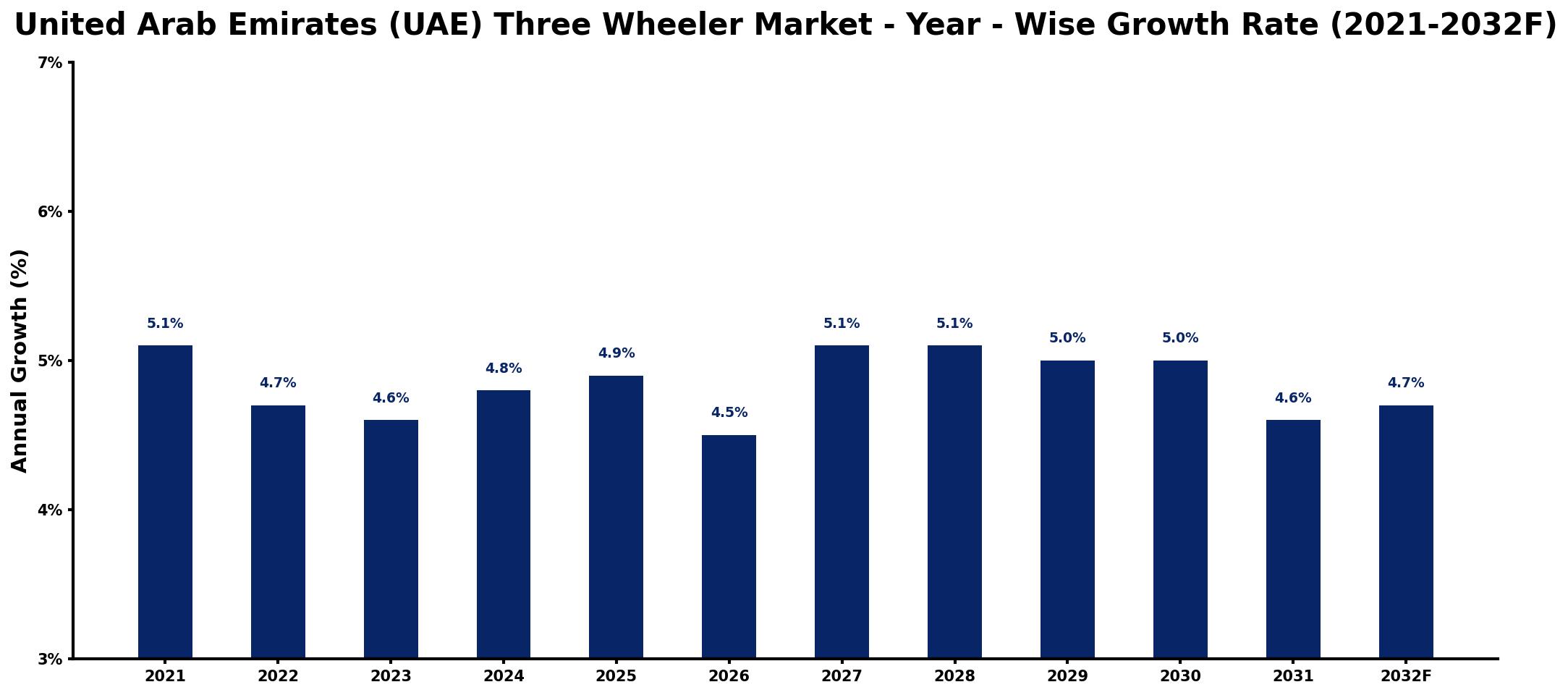
The table below presents the year‑wise growth rates along with the key drivers influencing the market
| Year | Growth Rate | Major Drivers |
| 2021 | 5.1% | Rising demand for urban mobility |
| 2022 | 4.7% | Expansion of delivery service sector |
| 2023 | 4.6% | Increased investment in logistics |
| 2024 | 4.8% | Growth in tourism and hospitality |
| 2025 | 4.9% | Surge in last-mile transportation solutions |
| 2026 | 4.5% | Development of new infrastructure projects |
| 2027 | 5.1% | Boost in e-commerce activities |
| 2028 | 5.1% | Enhancement of public transportation options |
| 2029 | 5.0% | Increase in environmental sustainability initiatives |
| 2030 | 5.0% | increased domestic production output |
| 2031 | 4.6% | Rising popularity of electric vehicles |
| 2032 | 4.7% | Investment in smart city projects |
Note: Market size estimations and growth projections presented in this report are based on 6Wresearch's proprietary forecasting methodology, utilizing the latest available industry data, government publications, and primary research inputs.
United Arab Emirates (UAE) Three Wheeler Market Synopsis
The demand for three-wheelers in the UAE is significantly driven by the need for effective short-distance commuting and delivery services. As urban centers become increasingly congested, three-wheelers are proving to be an ideal solution for navigating tight city environments, minimizing both time and cost.
Additionally, the impact of rapid urbanization is reshaping mobility trends, with three-wheelers emerging as a practical alternative for consumers and businesses alike. This shift is bolstered by the expanding logistics sector, which recognizes three-wheelers as a vital link in the supply chain, enhancing last-mile delivery capabilities.
United Arab Emirates (UAE) Three Wheeler Market Key Takeaways
- The three-wheeler market is poised for sustained growth driven by urban mobility needs.
- Last-mile logistics is a key demand driver, especially in light of rising e-commerce activities.
- Challenges related to infrastructure and consumer safety are significant considerations for market participants.
- Adapting three-wheeler designs to meet contemporary urban needs is essential for future success.
- The market landscape is gradually evolving with innovation and design enhancements.
Evaluation of Restraints in United Arab Emirates (UAE) Three Wheeler Market
Despite its growth potential, the UAE three-wheeler market faces considerable restraints. Infrastructure inadequacies pose a major challenge; the current urban landscape is often not conducive to the integration of three-wheeled vehicles. This includes a lack of dedicated parking, suitable routes, and regulatory frameworks that can accommodate their operation. Furthermore, concerns surrounding the safety and stability of these vehicles remain at the forefront of consumer apprehensions, necessitating focused efforts from stakeholders to build trust and acceptance in the market.
United Arab Emirates (UAE) Three Wheeler Market Trends
Current trends indicate a marked shift towards electric and hybrid three-wheelers, aligning with global sustainability goals. As environmental consciousness grows, manufacturers are increasingly incorporating eco-friendly technologies into their designs. Furthermore, technological advancements are leading to improved safety features and comfort, catering to both personal and commercial users.
United Arab Emirates (UAE) Three Wheeler Market Opportunities
The UAE three-wheeler market presents numerous investment opportunities, particularly in the realms of electric vehicle (EV) technology and logistics solutions. As the government pushes for sustainable transport options, businesses can capitalize on the shift towards greener three-wheelers. Additionally, enhancing service networks and after-sales support can create significant competitive advantages, addressing consumer needs and concerns effectively.
Government Initiatives in the United Arab Emirates (UAE) Three Wheeler Market
The UAE government is actively promoting initiatives to enhance urban mobility and sustainable transport systems. Various policies aimed at improving infrastructure and integrating new vehicle types into the urban fabric are being introduced. There is also a focus on public spending for better roads and parking facilities, alongside regulatory frameworks designed to support the growth of three-wheeled vehicles within the transportation ecosystem.
Future Insights of the United Arab Emirates (UAE) Three Wheeler Market
Looking ahead to 2026-2032, the UAE three-wheeler market is set to evolve significantly, driven by a blend of technological innovation and changing consumer preferences. The integration of smart technologies and connectivity features into three-wheelers is expected to reshape user experiences. Additionally, as urban areas continue to evolve, the demand for adaptable transportation solutions will likely surge, positioning three-wheelers as a critical component of the future mobility landscape.
United Arab Emirates (UAE) Three Wheeler Market Latest Developments (2025 - 2026)
Recent industry developments indicate a push towards enhanced electric vehicle offerings in the three-wheeler segment. Manufacturers are increasingly investing in R&D to innovate designs that meet consumer demands for efficiency and sustainability. Partnerships between logistics companies and three-wheeler manufacturers are also becoming more prevalent, aiming to streamline last-mile delivery processes and improve service capabilities.
United Arab Emirates (UAE) Three Wheeler Market - Key Attractiveness of the Report
- 10 Years of Market Numbers
- Historical Data Starting from 2022 to 2025
- Base Year: 2025
- Forecast Data until 2032
- Key Performance Indicators Impacting the Market
- Major Upcoming Developments and Projects
Key Highlights of the Report:
- United Arab Emirates (UAE) Three Wheeler Market Outlook
- Market Size of United Arab Emirates (UAE) Three Wheeler Market, 2025
- Forecast of United Arab Emirates (UAE) Three Wheeler Market, 2032
- Historical Data and Forecast of United Arab Emirates (UAE) Three Wheeler Revenues & Volume for the Period 2022-2032F
- United Arab Emirates (UAE) Three Wheeler Market Trend Evolution
- United Arab Emirates (UAE) Three Wheeler Market Drivers and Challenges
- United Arab Emirates (UAE) Three Wheeler Price Trends
- United Arab Emirates (UAE) Three Wheeler Porter's Five Forces
- United Arab Emirates (UAE) Three Wheeler Industry Life Cycle
- Historical Data and Forecast of United Arab Emirates (UAE) Three Wheeler Market Revenues & Volume By Fuel Type for the Period 2022-2032F
- Historical Data and Forecast of United Arab Emirates (UAE) Three Wheeler Market Revenues & Volume By Petrol/CNG for the Period 2022-2032F
- Historical Data and Forecast of United Arab Emirates (UAE) Three Wheeler Market Revenues & Volume By Diesel for the Period 2022-2032F
- Historical Data and Forecast of United Arab Emirates (UAE) Three Wheeler Market Revenues & Volume By Electric for the Period 2022-2032F
- Historical Data and Forecast of United Arab Emirates (UAE) Three Wheeler Market Revenues & Volume By Vehicle Type for the Period 2022-2032F
- Historical Data and Forecast of United Arab Emirates (UAE) Three Wheeler Market Revenues & Volume By Passenger Carrier for the Period 2022-2032F
- Historical Data and Forecast of United Arab Emirates (UAE) Three Wheeler Market Revenues & Volume By Load Carrier for the Period 2022-2032F
- United Arab Emirates (UAE) Three Wheeler Import Export Trade Statistics
- Market Opportunity Assessment By Fuel Type
- Market Opportunity Assessment By Vehicle Type
- United Arab Emirates (UAE) Three Wheeler Top Companies Market Share
- United Arab Emirates (UAE) Three Wheeler Competitive Benchmarking By Technical and Operational Parameters
- United Arab Emirates (UAE) Three Wheeler Company Profiles
- United Arab Emirates (UAE) Three Wheeler Key Strategic Recommendations






































