Qatar Three Wheeler Market Size, Share & Growth Rate
The Qatar Three Wheeler Market was estimated at USD 667 Million in 2025 and is projected to reach USD 959 Million by 2032, growing at a CAGR of 5.3% from 2026 to 2032. This trajectory reflects the increasing urbanization and population growth in Qatar, as three-wheelers become essential for navigating congested urban landscapes. The convenience and cost-effectiveness of these vehicles, coupled with supportive government policies, are fueling their adoption across the country.
Qatar Three Wheeler Market Year-wise Growth Rate and Key Drivers
This graph highlights how the Qatar Three Wheeler Market has steadily grown over the years, supported by major growth factors.
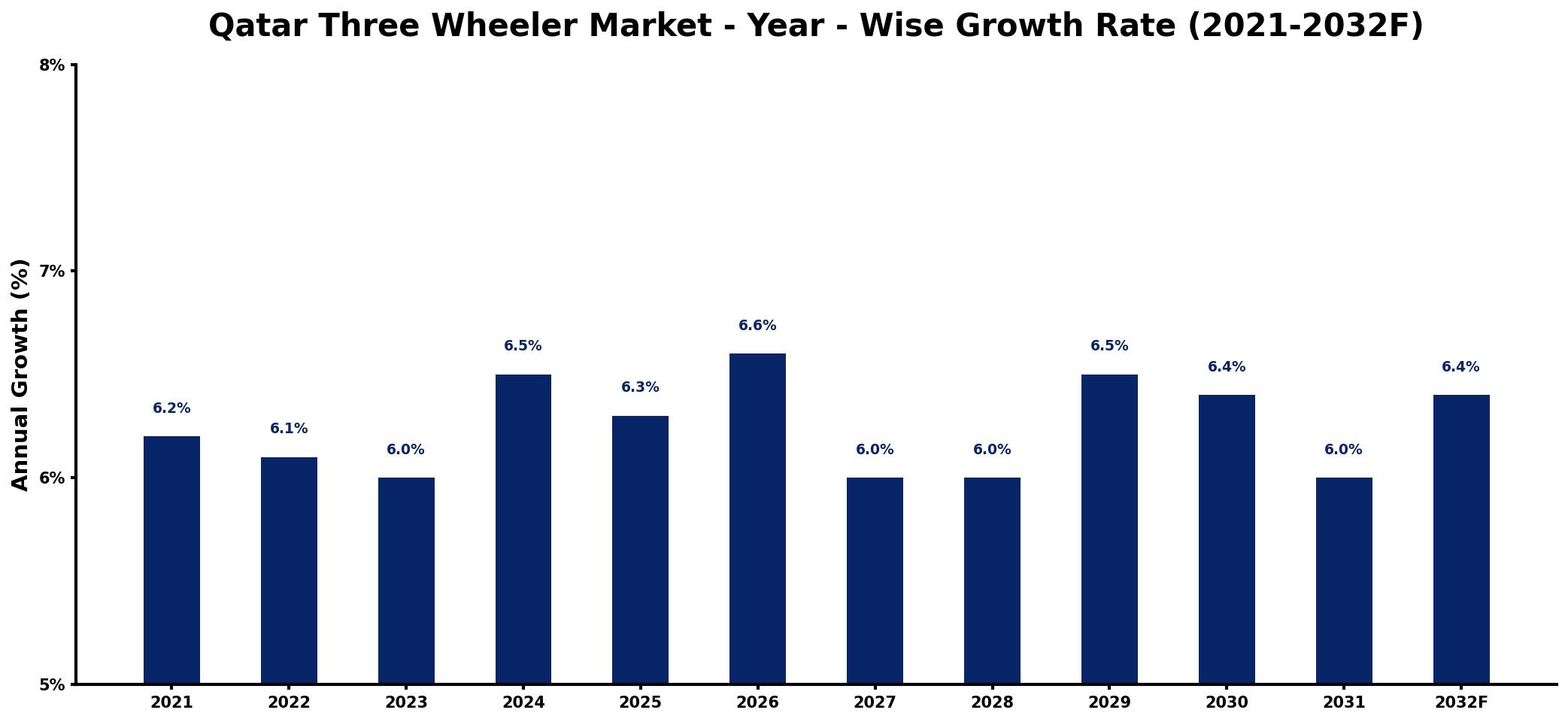
The table below presents the year‑wise growth rates along with the key drivers influencing the market
| Year | Growth Rate | Major Drivers |
| 2021 | 6.2% | Increased urban transportation demand |
| 2022 | 6.1% | Higher fuel efficiency standards |
| 2023 | 6.0% | Expansion of delivery services |
| 2024 | 6.5% | Growing tourism sector investments |
| 2025 | 6.3% | Rising environmental awareness initiatives |
| 2026 | 6.6% | Enhanced logistics and supply chains |
| 2027 | 6.0% | Government support for mobility solutions |
| 2028 | 6.0% | Evolving consumer preferences for convenience |
| 2029 | 6.5% | Technological advancements in vehicles |
| 2030 | 6.4% | Urban infrastructure development projects |
| 2031 | 6.0% | Increased disposable income levels |
| 2032 | 6.4% | Diversification of transportation options |
Note: Market size estimations and growth projections presented in this report are based on 6Wresearch's proprietary forecasting methodology, utilizing the latest available industry data, government publications, and primary research inputs.
Qatar Three Wheeler Market Synopsis
The Qatar three-wheeler market has gained considerable momentum in recent years, driven by its adaptability to the countrys unique transportation challenges. As urban areas become more densely populated, the relevance of three-wheelers as a preferred mode of transport for both passengers and goods continues to rise.
Looking ahead, the market is poised for sustainable growth, bolstered by advancements in electric vehicle technology and ongoing urban development projects. The increasing inclination towards greener alternatives will likely reshape consumer preferences, further solidifying three-wheelers' place in Qatar's transportation ecosystem.
Qatar Three Wheeler Market Key Takeaways
- The market is expanding rapidly due to urbanization and population growth.
- Government initiatives are creating a favorable environment for three-wheeler adoption.
- Electric and eco-friendly models are becoming increasingly popular among consumers.
- Three-wheelers are recognized for their role in alleviating traffic congestion in urban areas.
- Post-pandemic recovery is boosting demand for versatile transportation solutions.
Evaluation of Restraints in Qatar Three Wheeler Market
Despite the growth potential, the Qatar three-wheeler market faces notable restraints. The pervasive car-centric culture in Qatar poses a challenge to the acceptance of three-wheelers as a mainstream transportation option. Furthermore, the extreme climatic conditions in the region necessitate vehicle adaptations that can withstand high temperatures. There are also regulatory hurdles, as navigating the complex landscape of transportation policies can hinder the smooth integration of three-wheelers into the market.
Qatar Three Wheeler Market Trends
Several trends are influencing the Qatar three-wheeler market. The growing popularity of electric vehicles signifies a shift towards more sustainable transport solutions, aligning with global efforts to combat climate change. Additionally, the rise of contactless delivery services and micro-mobility options is reshaping consumer expectations, prompting a move towards more flexible transportation solutions. Technology integration, such as mobile apps for ride-hailing, is also becoming a staple, enhancing user convenience and accessibility.
Qatar Three Wheeler Market Opportunities
The opportunities within the Qatar three-wheeler market are promising. With urbanization driving demand for innovative transport solutions, there is significant potential for investment in electric three-wheelers. Expanding infrastructure and amenities catering to these vehicles can enhance their viability as a key transport mode. Moreover, partnerships between private and public sectors to promote eco-friendly options can open up new avenues for growth.
Government Initiatives in the Qatar Three Wheeler Market
The Qatari government has implemented various initiatives aimed at enhancing public transportation infrastructure, which positively impacts the three-wheeler market. Efforts to promote sustainable transport through policy frameworks and incentives are creating a conducive environment for the adoption of three-wheelers. Public investments in urban mobility projects are also paving the way for integrated transport systems, where three-wheelers can play a significant role.
Future Insights of the Qatar Three Wheeler Market
Looking forward to 2026-2032, the Qatar three-wheeler market is set to experience robust growth as urbanization accelerates. The demand for cost-effective and flexible transportation solutions is likely to drive innovation in vehicle design and technology. Additionally, as the government focuses on sustainability, the transition towards electric models will create new market dynamics, positioning three-wheelers as an integral part of Qatar's future transportation landscape.
Qatar Three Wheeler Market Latest Developments (2025 - 2026)
Recent developments in the Qatar three-wheeler market indicate a shift towards increased electric vehicle offerings and enhanced consumer awareness regarding sustainable transport options. The market is witnessing advancements in technology, with several initiatives focused on improving efficiency and reducing environmental impact. As both private enterprises and government bodies emphasize eco-friendly solutions, the landscape for three-wheelers is poised for transformation.
Qatar Three Wheeler Market - Key Attractiveness of the Report
- 10 Years of Market Numbers
- Historical Data Starting from 2022 to 2025
- Base Year: 2025
- Forecast Data until 2032
- Key Performance Indicators Impacting the Market
- Major Upcoming Developments and Projects
Key Highlights of the Report:
- Qatar Three Wheeler Market Outlook
- Market Size of Qatar Three Wheeler Market, 2025
- Forecast of Qatar Three Wheeler Market, 2032
- Historical Data and Forecast of Qatar Three Wheeler Revenues & Volume for the Period 2022-2032F
- Qatar Three Wheeler Market Trend Evolution
- Qatar Three Wheeler Market Drivers and Challenges
- Qatar Three Wheeler Price Trends
- Qatar Three Wheeler Porter's Five Forces
- Qatar Three Wheeler Industry Life Cycle
- Historical Data and Forecast of Qatar Three Wheeler Market Revenues & Volume By Fuel Type for the Period 2022-2032F
- Historical Data and Forecast of Qatar Three Wheeler Market Revenues & Volume By Petrol/CNG for the Period 2022-2032F
- Historical Data and Forecast of Qatar Three Wheeler Market Revenues & Volume By Diesel for the Period 2022-2032F
- Historical Data and Forecast of Qatar Three Wheeler Market Revenues & Volume By Electric for the Period 2022-2032F
- Historical Data and Forecast of Qatar Three Wheeler Market Revenues & Volume By Vehicle Type for the Period 2022-2032F
- Historical Data and Forecast of Qatar Three Wheeler Market Revenues & Volume By Passenger Carrier for the Period 2022-2032F
- Historical Data and Forecast of Qatar Three Wheeler Market Revenues & Volume By Load Carrier for the Period 2022-2032F
- Qatar Three Wheeler Import Export Trade Statistics
- Market Opportunity Assessment By Fuel Type
- Market Opportunity Assessment By Vehicle Type
- Qatar Three Wheeler Top Companies Market Share
- Qatar Three Wheeler Competitive Benchmarking By Technical and Operational Parameters
- Qatar Three Wheeler Company Profiles
- Qatar Three Wheeler Key Strategic Recommendations






































