Mexico Wine production Machinery Market Summary
The mexico wine production machinery market was estimated at USD 232 Million in 2025 and is projected to reach USD 268 Million by 2032, growing at a CAGR of 1.3% from 2026 to 2032.
Mexico Wine production Machinery Market Year-wise Growth Rate and Key Drivers
This graph highlights how the Mexico Wine production Machinery Market has steadily grown over the past five years, supported by major growth factors.
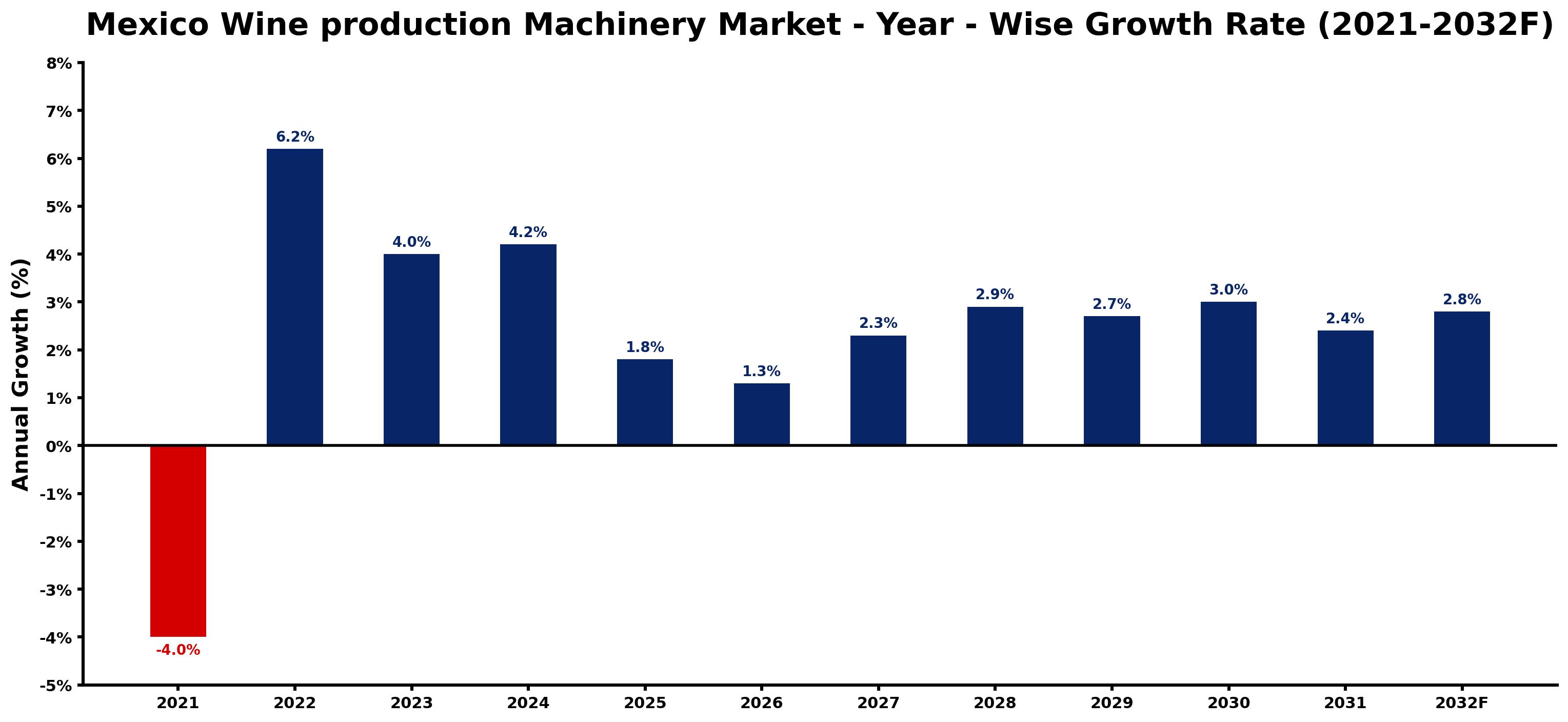
The table below presents the year wise growth rates along with the key drivers influencing the market
| Year | Growth Rate | Major Drivers |
| 2021 | -4.0% | Supply chain disruptions led to increased equipment costs, discouraging investments in wine production technology. |
| 2022 | 6.2% | Emerging brands embraced automation to enhance vineyard efficiency and wine quality. |
| 2023 | 4.0% | Sustainability pressures prompted investments in eco-friendly wine production technologies. |
| 2024 | 4.2% | Consumer preferences shifted towards premium wines, sparking machinery upgrades for small producers. |
| 2025 | 1.8% | Technological partnerships facilitated knowledge transfer, optimizing local production processes significantly. |
| 2026 | 1.3% | International trade agreements opened doors for advanced machinery imports, boosting competition. |
| 2027 | 2.3% | A trend towards organic wine production increased demand for specialized harvesting equipment. |
| 2028 | 2.9% | Rising interest in wine tourism encouraged enhancements in winery infrastructure and machinery. |
| 2029 | 2.7% | Local terroir-focused marketing strategies highlighted the need for precision agriculture tools. |
| 2030 | 3.0% | Urbanization led to increased interest in urban wineries, necessitating compact machinery solutions. |
| 2031 | 2.4% | Investment in training programs improved workforce skills, enhancing machinery operation efficiency. |
| 2032 | 2.8% | Collaboration among local enterprise clusters fostered innovation in production technologies across regions. |
Note - Market size estimations and growth projections presented in this report are based on 6Wresearch's advanced forecasting approach, validated with industry datasets as of June 2026.
Mexico Wine production Machinery Market Synopsis
The Mexico Wine production Machinery Market is projected to reach 1.3% and witness significant growth during the forecast period (2026-2032). This market growth is intricately linked to the burgeoning wine industry in Mexico, which has seen an increase in both the number of wineries and the appreciation for locally produced wines. As a result, there is a rising demand for advanced and efficient production machinery that can meet the quality standards of a competitive market. Industry stakeholders are actively investing in innovative technologies to streamline the winemaking process, thereby enhancing overall productivity.
Mexico Wine production Machinery Market Growth Drivers
The expansion of the Mexico Wine production Machinery Market is driven by several key factors:
- The increasing number of wineries across Mexico enhances the demand for sophisticated machinery that can support diverse winemaking techniques and ensure quality output.
- With a growing global reputation for Mexican wines, the emphasis on higher production standards necessitates investment in modern equipment tailored to meet the evolving needs of winemakers.
- Technological advancements in production machinery, including automation and precision equipment, are attracting wineries aiming to optimize efficiency and minimize production costs.
- The rising consumer preference for premium and organic wines is pushing wineries to adopt advanced machinery that facilitates the production of high-quality products while adhering to sustainable practices.
- Collaborations between technology providers and wineries are fostering innovation and allowing for the development of customized machinery that aligns with specific operational requirements.
Mexico Wine production Machinery Market Challenges and Restraints
Despite the optimistic growth outlook, the Mexico Wine production Machinery Market faces several challenges:
- The regulatory framework governing the alcohol industry in Mexico is stringent, posing challenges for wineries aiming to comply with quality standards, hygiene regulations, and production safety protocols.
- Investment in production machinery requires significant financial resources, which may pose a barrier for smaller wineries operating with limited capital.
- Ensuring sustainable and environmentally friendly practices in winemaking is increasingly crucial. Adapting to these practices necessitates investment in new machinery and processes that may not yet be widely available.
- The global economic fluctuations can impact the availability of funding and investments for machinery upgrades, limiting opportunities for growth in the sector.
- Maintaining a skilled workforce proficient in operating advanced machinery presents an ongoing challenge as the industry transitions towards more technologically advanced operations.
Mexico Wine production Machinery Market Government Investment and Initiatives
Government support plays a critical role in the development of the Mexico Wine production Machinery Market. Policies and initiatives focused on the wine industry are aimed at fostering modernization and enhancing production efficiency:
- Government initiatives are encouraging the modernization of vineyard infrastructure, which includes upgrading winemaking machinery to boost production capabilities.
- Incentives for research and development in vineyard and winery technology aim to drive innovation, inviting partnerships between academic institutions and the wine industry.
- Public spending on promoting Mexican wines in global markets helps to increase visibility, thereby indirectly raising demand for production machinery as wineries expand their operational capacities.
- Regulatory frameworks are being adjusted to streamline the compliance process for wineries, reducing the burden of meeting strict guidelines while encouraging investment in advanced production technologies.
- The encouragement of sustainable practices in the wine industry's machinery procurement aligns with Mexico's commitment to environmental sustainability, which is increasingly becoming a focus in government policies.
Mexico Wine production Machinery Market Latest Developments (May 2025 - June 2026)
Recent developments within the Mexico Wine production Machinery Market indicate a proactive approach towards modernization and sustainability. Over the past year, there has been a marked increase in the adoption of automated winemaking technologies that enhance efficiency and reduce labor costs. The industry has also seen a growing trend towards the incorporation of eco-friendly practices in production processes, with many wineries striving to minimize their environmental footprint. Additionally, collaborations among local wineries have fostered knowledge-sharing, enabling smaller producers to access advanced technologies previously limited to larger establishments. Industry forums have emerged, providing platforms for discussing challenges, innovations, and market dynamics, thereby strengthening the overall supply chain. Investment in training programs for workforce development is also gaining traction, ensuring that staff are equipped to operate sophisticated machinery effectively.
Mexico Wine production Machinery Market - Key Attractiveness of the Report
- 10 Years of Market Numbers
- Historical Data Starting from 2022 to 2025
- Base Year: 2025
- Forecast Data until 2032
- Key Performance Indicators Impacting the Market
- Major Upcoming Developments and Projects
Key Highlights of the Report:
- Mexico Wine production Machinery Market Outlook
- Market Size of Mexico Wine production Machinery Market, 2025
- Forecast of Mexico Wine production Machinery Market, 2032
- Historical Data and Forecast of Mexico Wine production Machinery Revenues & Volume for the Period 2022-2032F
- Mexico Wine production Machinery Market Trend Evolution
- Mexico Wine production Machinery Market Drivers and Challenges
- Mexico Wine production Machinery Price Trends
- Mexico Wine production Machinery Porter's Five Forces
- Mexico Wine production Machinery Industry Life Cycle
- Historical Data and Forecast of Mexico Wine production Machinery Market Revenues & Volume By Type for the Period 2022-2032F
- Historical Data and Forecast of Mexico Wine production Machinery Market Revenues & Volume By Tanks & fermenters for the Period 2022-2032F
- Historical Data and Forecast of Mexico Wine production Machinery Market Revenues & Volume By Crushing & Pressing Equipment for the Period 2022-2032F
- Historical Data and Forecast of Mexico Wine production Machinery Market Revenues & Volume By Temperature Control Equipment for the Period 2022-2032F
- Historical Data and Forecast of Mexico Wine production Machinery Market Revenues & Volume By Filtration Equipment for the Period 2022-2032F
- Historical Data and Forecast of Mexico Wine production Machinery Market Revenues & Volume By Others for the Period 2022-2032F
- Mexico Wine production Machinery Import Export Trade Statistics
- Market Opportunity Assessment By Type
- Mexico Wine production Machinery Top Companies Market Share
- Mexico Wine production Machinery Competitive Benchmarking By Technical and Operational Parameters
- Mexico Wine production Machinery Company Profiles
- Mexico Wine production Machinery Key Strategic Recommendations






































