United Kingdom (UK) Wine production Machinery Market Summary
The united kingdom (uk) wine production machinery market was estimated at USD 327 Million in 2025 and is projected to reach USD 408 Million by 2032, growing at a CAGR of 2.6% from 2026 to 2032.
United Kingdom (UK) Wine production Machinery Market Year-wise Growth Rate and Key Drivers
This graph highlights how the United Kingdom (UK) Wine production Machinery Market has steadily grown over the past five years, supported by major growth factors.
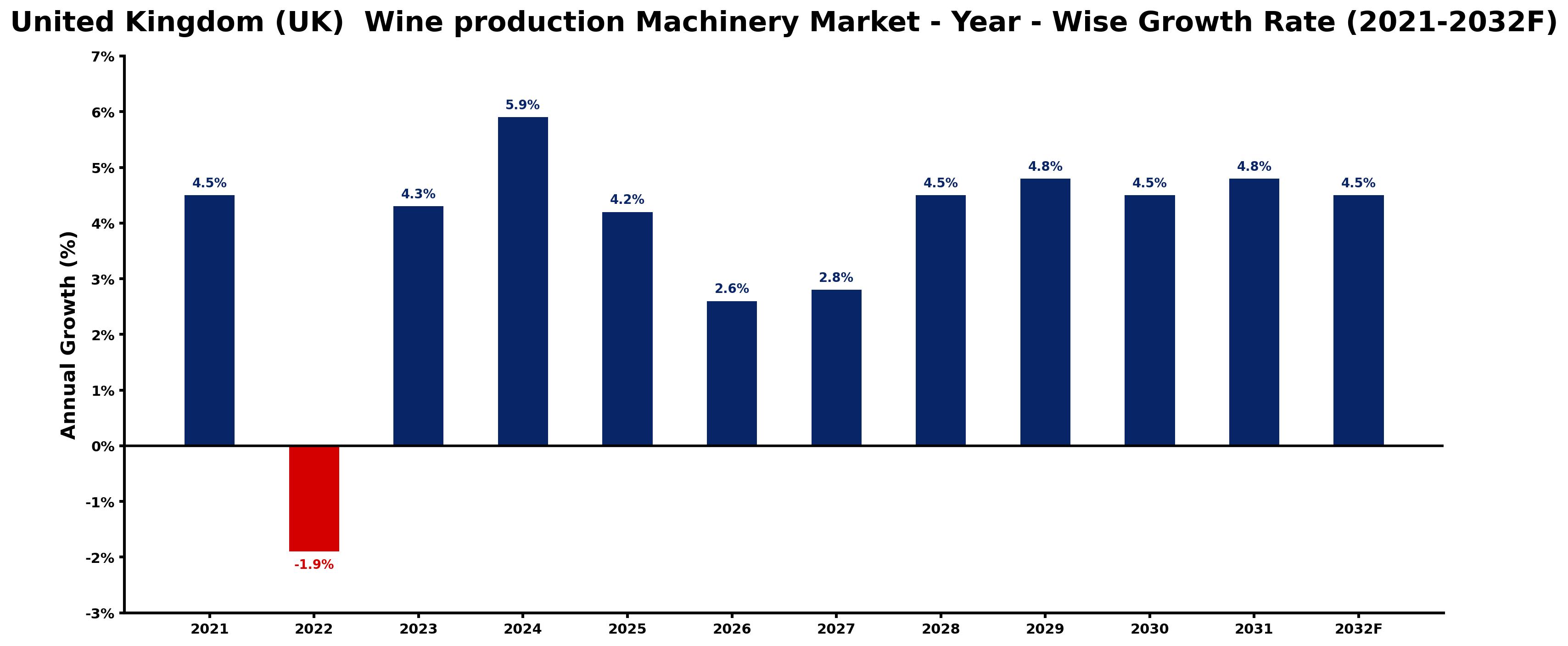
The table below presents the year wise growth rates along with the key drivers influencing the market
| Year | Growth Rate | Major Drivers |
| 2021 | 4.5% | Consumer interest in premium wines is boosting the UK wine production machinery sector. |
| 2022 | -1.9% | Supply chain disruptions from Brexitrelated trade barriers hindered manufacturers' access to essential components. |
| 2023 | 4.3% | Sustainability initiatives are prompting investments in eco-friendly production technologies across the market. |
| 2024 | 5.9% | Emerging wine regions in England are increasing demand for specialized production equipment. |
| 2025 | 4.2% | Technological enhancements in fermentation and bottling processes are shaping industry standards. |
| 2026 | 2.6% | Consumer trends toward organic wines are influencing machinery requirements for production. |
| 2027 | 2.8% | International trade agreements are expanding market opportunities for UK wine machinery exports. |
| 2028 | 4.5% | Digital transformation in wineries is streamlining operations and boosting machinery investments. |
| 2029 | 4.8% | Collaborations between tech firms and wineries are driving innovation in production techniques. |
| 2030 | 4.5% | Increased tourism in wine regions is motivating investments in modern production facilities. |
| 2031 | 4.8% | New educational programs focus on advanced wine production, enhancing machinery understanding. |
| 2032 | 4.5% | The competitive landscape is pushing manufacturers to offer more sophisticated, cost-effective solutions. |
Note - Market size estimations and growth projections presented in this report are based on 6Wresearch's advanced forecasting approach, validated with industry datasets as of June 2026.
United Kingdom (UK) Wine production Machinery Market Synopsis
The United Kingdom (UK) Wine production Machinery Market is projected to reach 2.6% and witness significant growth during the forecast period (2026-2032). The surge in domestic wine consumption, alongside an expanding vineyard landscape, is setting the stage for robust advancements in this sector. The market encompasses a wide array of equipment including grape crushers, fermentation tanks, bottling lines, and labelling machines, each playing a pivotal role in enhancing wine production capabilities. Moreover, as both local and international manufacturers seek to penetrate this growing market, the landscape is becoming increasingly competitive. Enhanced demand for automation and innovative technology is expected to be a major catalyst, driving efficiency and quality improvement in wine production processes.
United Kingdom (UK) Wine production Machinery Market Growth Drivers
Several growth drivers are shaping the United Kingdom (UK) Wine production Machinery Market. Firstly, the burgeoning interest in domestic wines is creating a strong demand for advanced machinery that can support higher production volumes and improved quality. Secondly, technology innovation is a key factor; the integration of automated systems and digital solutions enhances operational efficiency, allowing for better resource management and streamlined production processes. Thirdly, the increasing number of vineyards, driven by favourable climatic conditions, is boosting the machinery market as new players enter the industry with a focus on modern equipment. Furthermore, consumer preferences are shifting toward more sustainable and organic wines, prompting producers to adopt environmentally friendly production practices, including the use of eco-efficient machinery. Lastly, industry players are investing in R&D to explore cutting-edge technologies, further propelling market growth.
United Kingdom (UK) Wine production Machinery Market Trends and Opportunities
In the United Kingdom (UK) Wine production Machinery Market, notable trends are emerging that illustrate the direction of industry evolution. The trend towards increased automation is particularly prominent, as wineries are looking to implement advanced machinery like automated bottling lines and grape sorting systems to enhance productivity. Additionally, the demand for eco-friendly machinery is on the rise, driven by consumer awareness of sustainability issues and the need for wineries to comply with environmental regulations. Digital transformation is also significantly impacting the market; tools for production planning, quality control, and vineyard management are being developed to maximize efficiency. Another trend is the adoption of flexible manufacturing systems that allow for greater adaptability to changing consumer demands and production volumes. These emerging trends present numerous opportunities for manufacturers to innovate and cater to the evolving needs of the wine production industry in the UK.
United Kingdom (UK) Wine production Machinery Market Challenges and Restraints
Despite its growth potential, the United Kingdom (UK) Wine production Machinery Market faces several challenges that could hinder progress. High initial investment costs associated with modern machinery pose a significant barrier for smaller wineries seeking to upgrade their production capabilities. Additionally, certain regions in the UK are still heavily reliant on traditional practices, limiting access to advanced technology and machinery. The repercussions of post-Brexit trade agreements also create uncertainties regarding the importation of essential machinery components, potentially affecting costs and competitiveness. Moreover, the industry's reliance on specialized training to operate sophisticated equipment is a challenge for wineries in developing the necessary skills within their workforce. As a result, addressing these challenges will be crucial for sustained growth in the market.
United Kingdom (UK) Wine production Machinery Market Investment Opportunities
Investment opportunities in the United Kingdom (UK) Wine production Machinery Market are abundant, driven by the increasing popularity of English wines and a rise in new vineyard establishments. Investors can explore opportunities in developing specialized machinery tailored to the unique needs of local wineries, such as grape harvesters and fermentation tanks. Additionally, the growing focus on innovative technologies presents a lucrative landscape for investment in solutions aimed at enhancing productivity and sustainability. Collaborating with vineyards to provide customized machinery solutions can also yield significant returns, as flexibility and adaptability become key competitive advantages. In light of these factors, potential investors should view the UK wine production machinery space as a promising area for development and growth.
United Kingdom (UK) Wine production Machinery Market Government Investment and Initiatives
The United Kingdom government has recognized the importance of the wine production machinery market and has implemented various policies to support its growth. Investment in research and development is being encouraged through grants and tax incentives aimed at advancing technologies in the sector. Initiatives promoting sustainability and innovation require machinery producers to comply with environmental regulations, and these measures often come with incentives for companies adopting green practices. Furthermore, the government is focused on enhancing international trade relationships to bolster the competitiveness of UK-produced wine machinery in global markets. Such governmental support aims to catalyze advancements in technology and production practices, fostering a conducive environment for long-term market expansion.
United Kingdom (UK) Wine production Machinery Market Latest Developments (May 2025 - June 2026)
In the period from May 2025 to June 2026, the United Kingdom (UK) Wine production Machinery Market is expected to witness several critical developments. The emphasis on sustainability within the industry has led to the introduction of new eco-friendly machinery designed to minimize environmental footprints and optimize energy efficiency. Additionally, the trend of digital integration is accelerating, with wineries increasingly adopting software systems for inventory management and production tracking. The rise of boutique wineries is expected to inspire innovation in bespoke machinery solutions tailored to small-scale producers. As competition intensifies, market participants are likely to enhance customer relationships through improved service offerings and support for machinery operation and maintenance.
United Kingdom (UK) Wine production Machinery Market - Key Attractiveness of the Report
- 10 Years of Market Numbers
- Historical Data Starting from 2022 to 2025
- Base Year: 2025
- Forecast Data until 2032
- Key Performance Indicators Impacting the Market
- Major Upcoming Developments and Projects
Key Highlights of the Report:
- United Kingdom (UK) Wine production Machinery Market Outlook
- Market Size of United Kingdom (UK) Wine production Machinery Market, 2025
- Forecast of United Kingdom (UK) Wine production Machinery Market, 2032F
- Historical Data and Forecast of United Kingdom (UK) Wine production Machinery Revenues & Volume for the Period 2022-2032F
- United Kingdom (UK) Wine production Machinery Market Trend Evolution
- United Kingdom (UK) Wine production Machinery Market Drivers and Challenges
- United Kingdom (UK) Wine production Machinery Price Trends
- United Kingdom (UK) Wine production Machinery Porter's Five Forces
- United Kingdom (UK) Wine production Machinery Industry Life Cycle
- Historical Data and Forecast of United Kingdom (UK) Wine production Machinery Market Revenues & Volume By Type for the Period 2022-2032F
- Historical Data and Forecast of United Kingdom (UK) Wine production Machinery Market Revenues & Volume By Tanks & fermenters for the Period 2022-2032F
- Historical Data and Forecast of United Kingdom (UK) Wine production Machinery Market Revenues & Volume By Crushing & Pressing Equipment for the Period 2022-2032F
- Historical Data and Forecast of United Kingdom (UK) Wine production Machinery Market Revenues & Volume By Temperature Control Equipment for the Period 2022-2032F
- Historical Data and Forecast of United Kingdom (UK) Wine production Machinery Market Revenues & Volume By Filtration Equipment for the Period 2022-2032F
- Historical Data and Forecast of United Kingdom (UK) Wine production Machinery Market Revenues & Volume By Others for the Period 2022-2032F
- United Kingdom (UK) Wine production Machinery Import Export Trade Statistics
- Market Opportunity Assessment By Type
- United Kingdom (UK) Wine production Machinery Top Companies Market Share
- United Kingdom (UK) Wine production Machinery Competitive Benchmarking By Technical and Operational Parameters
- United Kingdom (UK) Wine production Machinery Company Profiles
- United Kingdom (UK) Wine production Machinery Key Strategic Recommendations






































