Morocco AI in Telecommunication Market Size & Growth Rate (2026-2032)
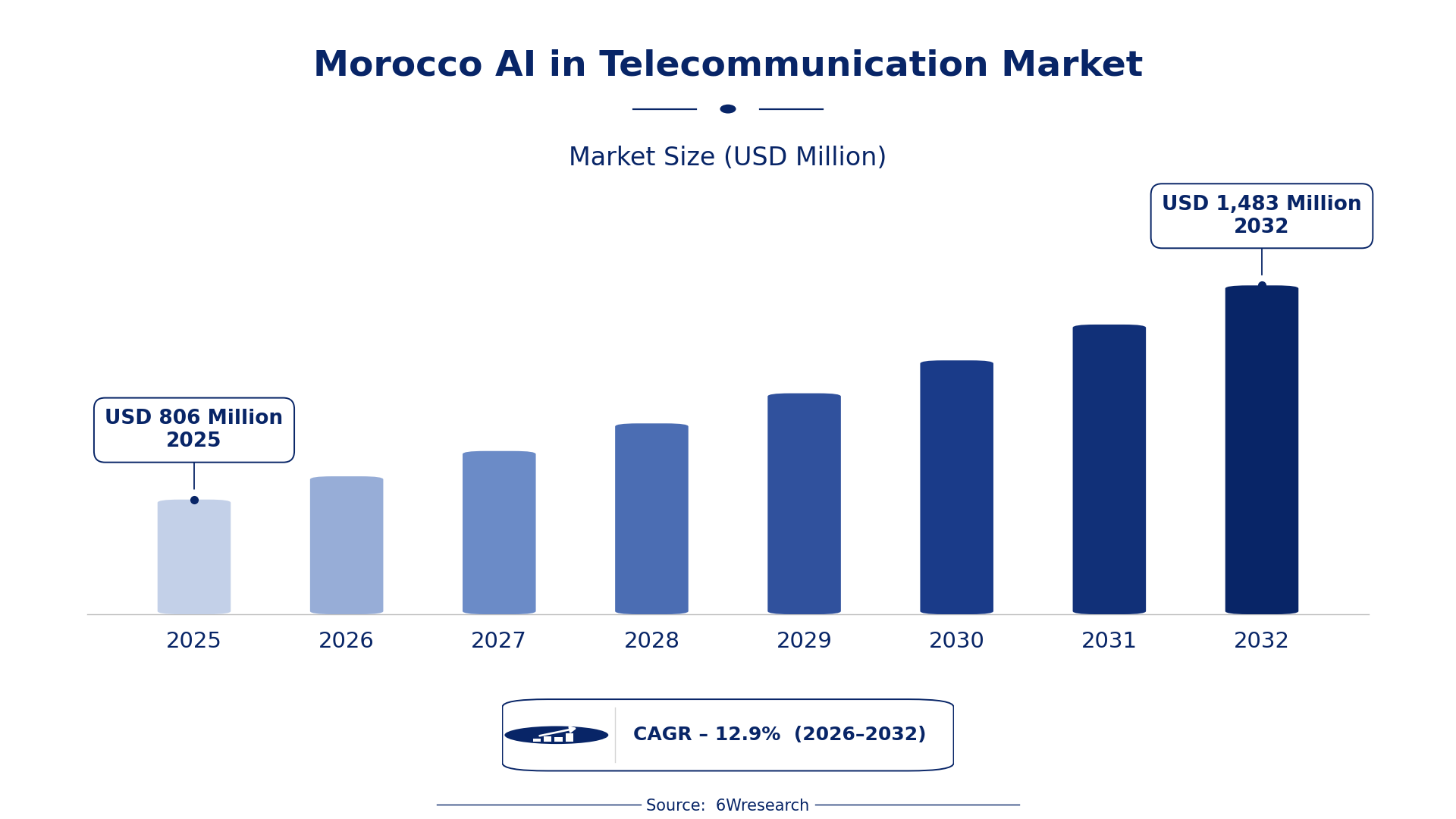
The Morocco AI in Telecommunication Market was estimated at USD 806 Million in 2025 and is projected to reach USD 1483 Million by 2032, growing at a CAGR of 12.9% from 2026 to 2032.
Morocco AI in Telecommunication Market Synopsis
The Morocco AI in Telecommunication Market is currently witnessing a paradigm shift as telecommunications companies embrace artificial intelligence solutions. This shift is fueled by a pressing need to enhance customer service, optimize operations, and adapt to rapidly changing market demands.
Integration of AI technologies such as chatbots, predictive analytics, and automated customer support systems is becoming a necessity. Companies are investing heavily in R&D to tailor AI applications that address specific challenges within the Moroccan telecom sector, ultimately driving customer satisfaction and operational excellence.
Morocco AI in Telecommunication Market Year-wise Growth Rate and Key Drivers
This graph illustrates the annual growth rates of the Morocco AI in Telecommunication Market from 2021 to 2032, highlighting a steady upward trajectory and projected expansion over the forecast period.
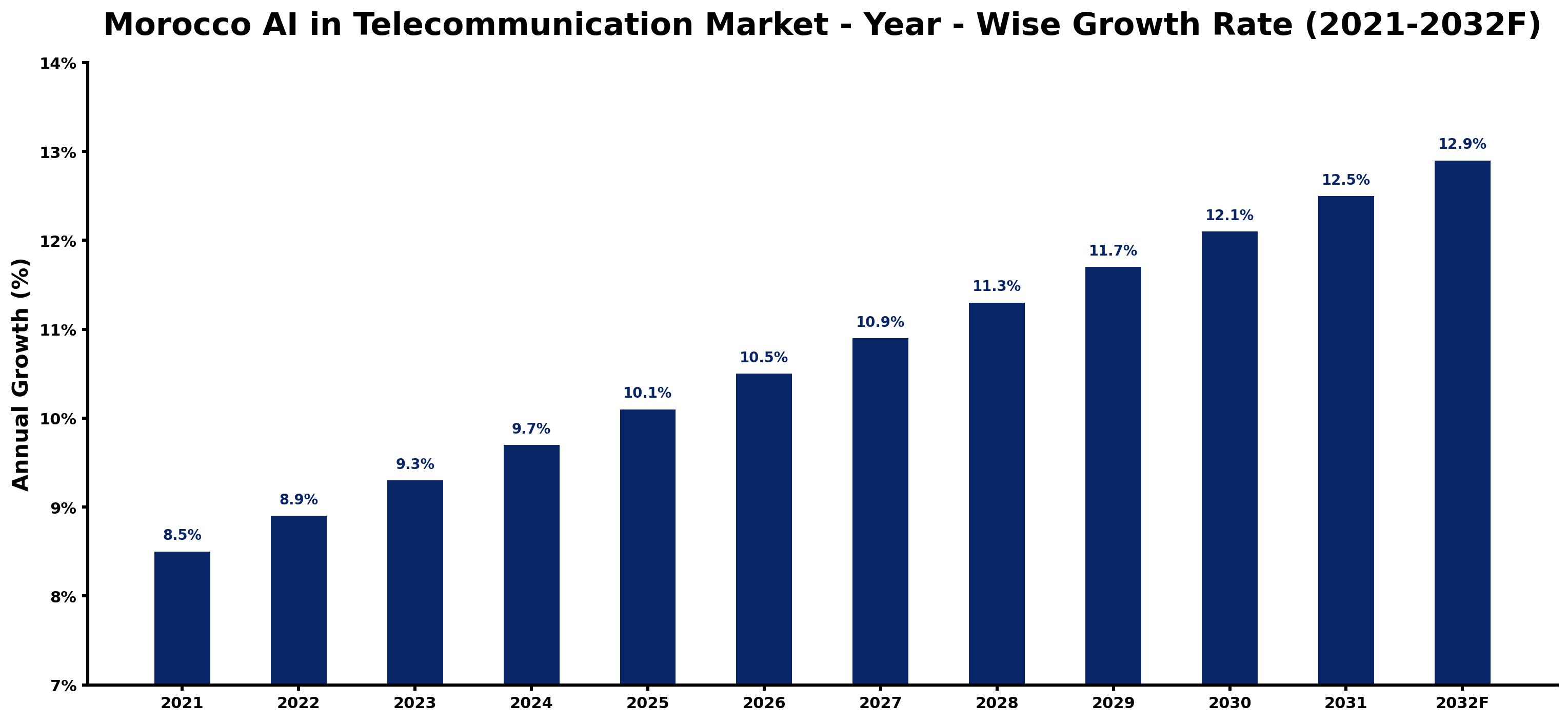
The table below presents the year‑wise growth rates along with the key drivers influencing the market
| Year | Growth Rate | Major Drivers |
| 2021 | 8.5% | ANAPEC initiatives boosting tech-driven job creation |
| 2022 | 8.9% | 5G rollout accelerating AI adoption in telecommunications |
| 2023 | 9.3% | Government investment in digital infrastructure enhancing connectivity |
| 2024 | 9.7% | Increased smartphone penetration fueling AI service demand |
| 2025 | 10.1% | Cybersecurity regulations promoting AI for threat detection |
| 2026 | 10.5% | Telecom market liberalization encouraging innovative AI solutions |
| 2027 | 10.9% | Rising mobile data consumption driving AI analytics needs |
| 2028 | 11.3% | Local startups launching AI-driven telecom applications |
| 2029 | 11.7% | Partnership with international AI firms enhancing capability |
| 2030 | 12.1% | Telecom operators leveraging AI for predictive maintenance |
| 2031 | 12.5% | Increasing regulatory support for AI in telecommunications |
| 2032 | 12.9% | AI-based solutions improving rural telecom service quality |
Note: Market size estimations and growth projections presented in this report are based on 6Wresearch's proprietary forecasting methodology, utilizing the latest available industry data, government publications, and primary research inputs.
Morocco AI in Telecommunication Market Key Takeaways
Below are some of the specific key takeaways from the market, including:
- Rising demand for AI-driven customer service solutions is reshaping the telecommunications sector.
- Investment in predictive analytics is leading to more efficient network operations.
- Collaboration between telecom operators and tech firms is accelerating innovation.
- The government’s digital transformation initiatives are significantly influencing market growth.
- Moroccan telecom companies are actively exploring AI applications in fraud detection and data management.
Evaluation of Restraints in Morocco AI in Telecommunication Market
Several key challenges are currently limiting the growth of AI in the Moroccan telecommunications market. Firstly, the substantial investment required for advanced infrastructure can be a major hurdle. Additionally, data privacy and security compliance present ongoing concerns that telecom operators must address.
There's also a notable shortage of skilled AI professionals in Morocco, complicating the integration of AI into existing systems. This lack of expertise can slow progress and increase operational risks, making it imperative for companies to invest in workforce training and development.
Morocco AI in Telecommunication Market Trends
The demand for enhanced customer experiences is driving trends toward the adoption of AI technologies in telecommunications. Companies are increasingly deploying AI-powered chatbots to provide instantaneous customer support, thus minimizing wait times and improving service efficiency.
Predictive analytics is gaining traction as it allows companies to preemptively address network issues, thereby optimizing performance and reducing downtime. There is also a strong push towards utilizing AI for data analytics, enabling telecom firms to derive actionable insights from vast datasets.
Morocco AI in Telecommunication Market Opportunities
Investment opportunities in the Moroccan AI in Telecommunication Market are abundant. With growing competition, telecom companies are keen to invest in AI technologies that enhance network optimization and customer interactions.
Partnerships with local tech firms can offer strategic advantages, enabling companies to tailor AI solutions that meet the unique challenges of the Moroccan market. This cooperative approach not only fosters innovation but also allows for a more rapid deployment of AI applications.
Government Initiatives in the Morocco AI in Telecommunication Market
The Moroccan government plays a vital role in shaping the AI in Telecommunication Market through various supportive policies. The establishment of a regulatory framework by the National Telecommunications Regulatory Agency (ANRT) has provided a clear direction for implementing AI technologies. Such policies are crucial for enhancing network management and customer service.
- A national digital infrastructure upgrade programme launched in late 2023 aims to enhance the overall telecom framework.
- Current initiatives include the establishment of AI research collaborations between telecom companies and academic institutions to foster innovation.
- Plans are underway for a public-private partnership initiative designed to expand access to telecommunications services by 2028.
- A framework introduced in 2025 mandates compliance with data protection regulations tailored for AI applications in telecommunications.
Future Insights of the Morocco AI in Telecommunication Market
Looking ahead, the Morocco AI in Telecommunication Market is set for robust growth. As the adoption of technologies like 5G and IoT expands, the integration of AI will be crucial for managing the increased complexity of network operations.
The combination of enhanced telecom infrastructure and the government's focus on digital transformation will create a fertile environment for AI-driven solutions. Companies that adapt quickly to these changes will not only improve operational efficiency but also significantly enhance customer experiences.
Morocco AI in Telecommunication Market Latest Developments
Recent activity within the Morocco AI in Telecommunication Market indicates a strong momentum toward technological advancements. Telecom operators are increasingly focusing on AI-driven solutions that enhance service delivery and operational performance.
- A major technology vendor began piloting AI-based network management solutions in early 2023, showing promising improvements in operational efficiency.
- A leading regional operator is currently underway with the deployment of AI chatbots for customer service, expected to be fully operational by mid-2025.
- An initiative aimed at integrating AI into cybersecurity measures was recently launched to combat fraud and protect customer data.
- Plans for a comprehensive AI training program for employees are set to kick off in early 2026 to address the skills gap in the industry.
Morocco AI in Telecommunication Market - Key Attractiveness of the Report
- 10 Years of Market Numbers
- Historical Data Starting from 2022 to 2025
- Base Year: 2025
- Forecast Data until 2032
- Key Performance Indicators Impacting the Market
- Major Upcoming Developments and Projects
Key Highlights of the Report:
- Morocco AI in Telecommunication Market Outlook
- Market Size of Morocco AI in Telecommunication Market, 2025
- Forecast of Morocco AI in Telecommunication Market, 2032
- Historical Data and Forecast of Morocco AI in Telecommunication Revenues & Volume for the Period 2022-2032F
- Morocco AI in Telecommunication Market Trend Evolution
- Morocco AI in Telecommunication Market Drivers and Challenges
- Morocco AI in Telecommunication Price Trends
- Morocco AI in Telecommunication Porter's Five Forces
- Morocco AI in Telecommunication Industry Life Cycle
- Historical Data and Forecast of Morocco AI in Telecommunication Market Revenues & Volume By Application for the Period 2022-2032F
- Historical Data and Forecast of Morocco AI in Telecommunication Market Revenues & Volume By Customer analytics for the Period 2022-2032F
- Historical Data and Forecast of Morocco AI in Telecommunication Market Revenues & Volume By Network security for the Period 2022-2032F
- Historical Data and Forecast of Morocco AI in Telecommunication Market Revenues & Volume By Network optimization for the Period 2022-2032F
- Historical Data and Forecast of Morocco AI in Telecommunication Market Revenues & Volume By Self-diagnostics for the Period 2022-2032F
- Historical Data and Forecast of Morocco AI in Telecommunication Market Revenues & Volume By Virtual assistance for the Period 2022-2032F
- Historical Data and Forecast of Morocco AI in Telecommunication Market Revenues & Volume By Others (contact center analytics and marketing campaign analytics) for the Period 2022-2032F
- Historical Data and Forecast of Morocco AI in Telecommunication Market Revenues & Volume By Component for the Period 2022-2032F
- Historical Data and Forecast of Morocco AI in Telecommunication Market Revenues & Volume By Solutions for the Period 2022-2032F
- Historical Data and Forecast of Morocco AI in Telecommunication Market Revenues & Volume By Services for the Period 2022-2032F
- Historical Data and Forecast of Morocco AI in Telecommunication Market Revenues & Volume By Deployment Mode for the Period 2022-2032F
- Historical Data and Forecast of Morocco AI in Telecommunication Market Revenues & Volume By Cloud for the Period 2022-2032F
- Historical Data and Forecast of Morocco AI in Telecommunication Market Revenues & Volume By On-premises for the Period 2022-2032F
- Historical Data and Forecast of Morocco AI in Telecommunication Market Revenues & Volume By Technology for the Period 2022-2032F
- Historical Data and Forecast of Morocco AI in Telecommunication Market Revenues & Volume By Machine learning and deep learning for the Period 2022-2032F
- Historical Data and Forecast of Morocco AI in Telecommunication Market Revenues & Volume By Natural Language Processing (NLP) for the Period 2022-2032F
- Morocco AI in Telecommunication Import Export Trade Statistics
- Market Opportunity Assessment By Application
- Market Opportunity Assessment By Component
- Market Opportunity Assessment By Deployment Mode
- Market Opportunity Assessment By Technology
- Morocco AI in Telecommunication Top Companies Market Share
- Morocco AI in Telecommunication Competitive Benchmarking By Technical and Operational Parameters
- Morocco AI in Telecommunication Company Profiles
- Morocco AI in Telecommunication Key Strategic Recommendations






































