Morocco Alcohol Testing Market Summary
The morocco alcohol testing market was estimated at USD 1049 Million in 2025 and is projected to reach USD 1512 Million by 2032, growing at a CAGR of 6.1% from 2026 to 2032.
Morocco Alcohol Testing Market Year-wise Growth Rate and Key Drivers
This graph highlights how the Morocco Alcohol Testing Market has steadily grown over the past five years, supported by major growth factors.
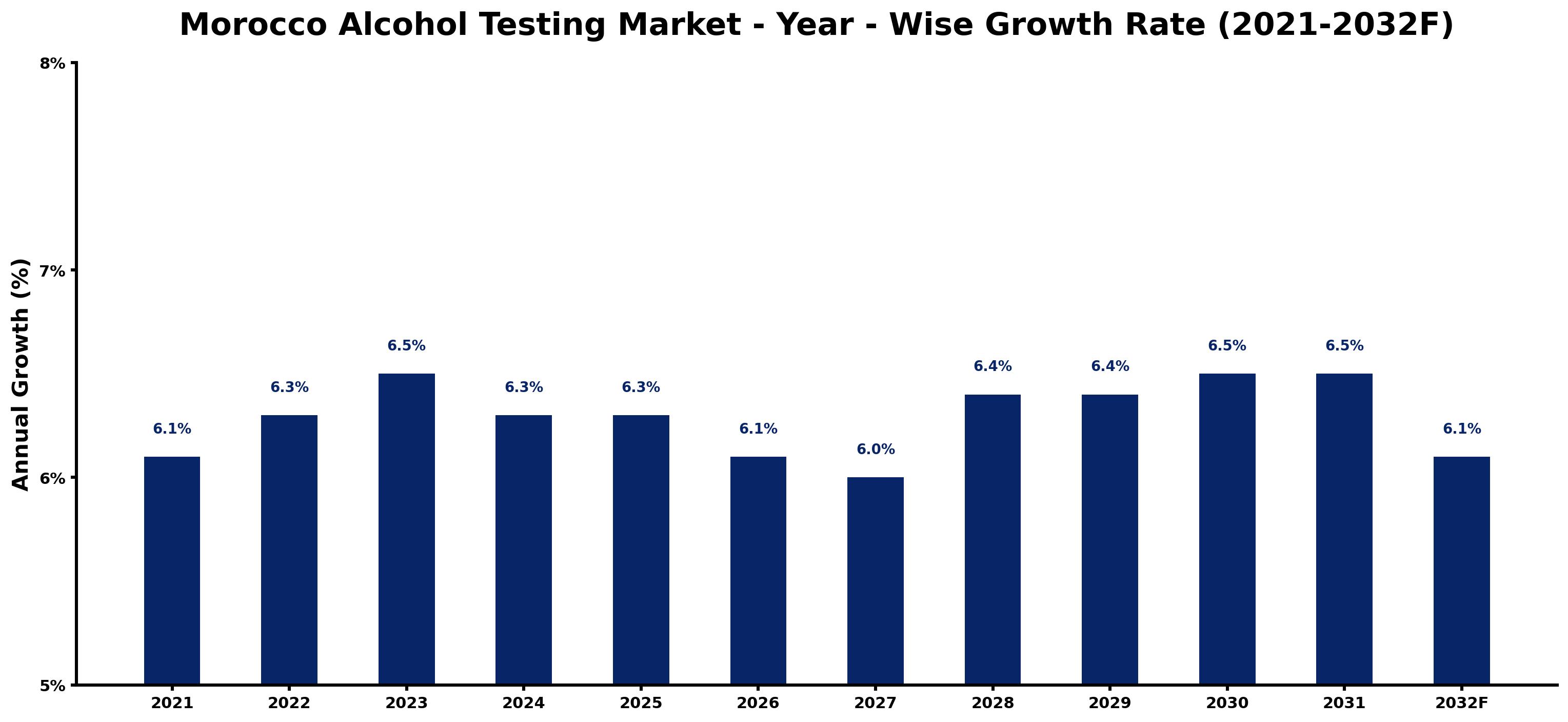
The table below presents the year wise growth rates along with the key drivers influencing the market
| Year | Growth Rate | Major Drivers |
| 2021 | 6.1% | Public awareness campaigns on alcohol-related issues support testing market expansion. |
| 2022 | 6.3% | Local partnerships enhance the distribution of testing devices across urban areas. |
| 2023 | 6.5% | Increased road safety initiatives create a favorable environment for alcohol testing solutions. |
| 2024 | 6.3% | Emergence of mobile testing units provides greater accessibility to rural populations. |
| 2025 | 6.3% | Technological improvements enable more accurate and faster alcohol testing methods. |
| 2026 | 6.1% | Corporate responsibility programs encourage businesses to implement testing policies more widely. |
| 2027 | 6.0% | Tourism growth demands higher alcohol testing standards in hospitality and transportation. |
| 2028 | 6.4% | Social media campaigns stimulate consumer interest in responsible drinking and testing. |
| 2029 | 6.4% | Educational programs in schools incorporate alcohol testing awareness and prevention strategies. |
| 2030 | 6.5% | Research collaborations foster innovations in testing technology tailored to local needs. |
| 2031 | 6.5% | Continued urbanization leads to higher demand for alcohol testing in nightlife hotspots. |
| 2032 | 6.1% | International events hosted in Morocco drive the need for robust alcohol testing infrastructure. |
Note - Market size estimations and growth projections presented in this report are based on 6Wresearch's advanced forecasting approach, validated with industry datasets as of June 2026.
Morocco Alcohol Testing Market Synopsis
The Morocco Alcohol Testing Market is projected to reach 6.1% and witness significant growth during the forecast period (2026-2032). The market is influenced by a convergence of factors, including heightened awareness regarding the implications of driving under the influence, stringent regulatory frameworks concerning alcohol consumption, and an increasing emphasis on safety across various sectors. These dynamics are culminating in an environment ripe for the adoption of alcohol testing solutions, particularly among law enforcement and corporate entities aiming to ensure compliance and promote safety.
Morocco Alcohol Testing Market Growth Drivers
Several key drivers are initiating momentum in the Morocco Alcohol Testing Market. The foremost among these is the rising public consciousness surrounding the hazards associated with drunk driving. Continuous education on the consequences of impaired driving is fostering a demand for reliable alcohol testing devices.
- Stringent governmental regulations regarding blood alcohol concentration are playing a crucial role in driving demand. The legal limit established at 0.02% necessitates efficient testing solutions for compliance.
- A focus on workplace safety is prompting organizations to implement regular alcohol testing protocols. This is particularly prevalent in sectors where operations involve heavy machinery or transportation.
- Increased investment in law enforcement efforts aimed at curbing drunk driving incidents further propels the market. Random sobriety checkpoints are becoming more common, necessitating portable testing equipment.
- Technological advancements are enhancing the functionalities of alcohol testing devices, making them more accurate and user-friendly. The integration of digital technologies into testing solutions provides real-time data management capabilities.
- The ongoing public health campaigns surrounding alcohol consumption are raising awareness and subsequently increasing demand for alcohol testing technologies.
Morocco Alcohol Testing Market Trends and Opportunities
The Morocco Alcohol Testing Market is witnessing notable trends that are shaping its future landscape. A significant trend is the shift towards portable and non-invasive alcohol testing devices. Increasing preference for breathalyzers over traditional testing methods is observable, particularly within law enforcement and corporate settings.
- The rise in smartphone-integrated breathalyzers is transforming how individuals approach alcohol testing. Real-time monitoring, enabled through mobile applications, is fostering user engagement and compliance.
- Innovations in data management software accompanying breathalyzer use are facilitating comprehensive alcohol testing programs tailored for organizations.
- Moreover, the growing trend of integrating health and safety measures into corporate policies is prompting more businesses to adopt regular alcohol testing procedures.
- There is a marked increase in the demand for comprehensive testing kits that can be utilized across various settings, including home use and events where alcohol is served.
- The tourism sector is contributing to the market growth as establishments are mandated to implement alcohol testing measures to ensure the safety of their patrons.
Morocco Alcohol Testing Market Challenges and Restraints
Despite its growth potential, the Morocco Alcohol Testing Market faces several challenges that could impede its expansion. Cultural and religious sentiments towards alcohol consumption present significant barriers. Many Moroccans hold views that discourage alcohol use, which can limit the market for testing products designed specifically for alcohol.
- The lack of stringent enforcement of existing drunk driving laws is another hurdle. Insufficient policing and random testing may reduce the perceived need for testing equipment.
- Competition from alternative testing methods, such as blood tests conducted in healthcare settings, could divert demand away from portable solutions.
- The high cost of sophisticated alcohol testing devices may deter smaller businesses or individual consumers from investing in such technologies.
- Limited public knowledge regarding the importance of regular alcohol testing in preventing accidents may also hinder the adoption of testing products in everyday environments.
Morocco Alcohol Testing Market Government Investment and Initiatives
The Moroccan government plays a crucial role in shaping the future of the alcohol testing market through various initiatives aimed at reinforcing public safety. The enforcement of strict regulations surrounding alcohol testing, such as the legal blood alcohol concentration limit and the imposition of penalties for violations, exemplifies governmental commitment to curbing drunk driving.
- Public funds are allocated towards the establishment of checkpoints across major roadways, ensuring consistent enforcement of alcohol testing protocols.
- Government campaigns aimed at raising awareness about the dangers of drunk driving indirectly promote the adoption of alcohol testing devices.
- Development plans for infrastructure improvements often include provisions for the installation of testing equipment in high-traffic areas.
- Incentives for businesses that voluntarily implement alcohol testing programs as part of their safety measures are also on the rise.
- Collaborative efforts with local and international organizations are enhancing the capabilities of law enforcement agencies to handle alcohol-related incidents effectively.
Morocco Alcohol Testing Market Latest Developments (May 2025 - June 2026)
Recent developments in the Morocco Alcohol Testing Market signal a period of progression and adaptation. Law enforcement agencies are increasingly acquiring improved testing devices, emphasizing the importance of accuracy and reliability in alcohol testing. Simultaneously, educational campaigns have gained traction, further aligning public sentiment towards the necessity of responsible alcohol consumption.
- Regulatory bodies have stepped up their efforts to include comprehensive alcohol testing measures in safety audits conducted for establishments serving alcohol.
- Increased partnerships between private firms and government agencies are paving the way for advancements in alcohol testing technologies and methodologies.
- Emerging trends of integrating technology in alcohol testing are evident, with a focus on developing applications that assist in monitoring alcohol consumption and testing.
- Ongoing discussions regarding policy reforms related to alcohol consumption are presenting opportunities for businesses in the alcohol testing market to engage with regulators.
- Public feedback mechanisms have been introduced, allowing citizens to voice their concerns and suggestions regarding alcohol testing measures, leading to more community-driven initiatives.
Morocco Alcohol Testing Market - Key Attractiveness of the Report
- 10 Years of Market Numbers
- Historical Data Starting from 2022 to 2025
- Base Year: 2025
- Forecast Data until 2032
- Key Performance Indicators Impacting the Market
- Major Upcoming Developments and Projects
Key Highlights of the Report:
- Morocco Alcohol Testing Market Outlook
- Market Size of Morocco Alcohol Testing Market, 2025
- Forecast of Morocco Alcohol Testing Market, 2032F
- Historical Data and Forecast of Morocco Alcohol Testing Revenues & Volume for the Period 2022-2032F
- Morocco Alcohol Testing Market Trend Evolution
- Morocco Alcohol Testing Market Drivers and Challenges
- Morocco Alcohol Testing Price Trends
- Morocco Alcohol Testing Porter's Five Forces
- Morocco Alcohol Testing Industry Life Cycle
- Historical Data and Forecast of Morocco Alcohol Testing Market Revenues & Volume By Testing Equipment Types for the Period 2022-2032F
- Historical Data and Forecast of Morocco Alcohol Testing Market Revenues & Volume By Infrared Based Breathalyzer for the Period 2022-2032F
- Historical Data and Forecast of Morocco Alcohol Testing Market Revenues & Volume By Semi-conductor Based Breathalyzer for the Period 2022-2032F
- Historical Data and Forecast of Morocco Alcohol Testing Market Revenues & Volume By Immunoassay Analyzers for the Period 2022-2032F
- Historical Data and Forecast of Morocco Alcohol Testing Market Revenues & Volume By Fuel Cell Based Breathalyzer for the Period 2022-2032F
- Historical Data and Forecast of Morocco Alcohol Testing Market Revenues & Volume By Oral Fluid Testing Devices for the Period 2022-2032F
- Historical Data and Forecast of Morocco Alcohol Testing Market Revenues & Volume By Hair Testing Devices for the Period 2022-2032F
- Historical Data and Forecast of Morocco Alcohol Testing Market Revenues & Volume By Urine Testing Devices for the Period 2022-2032F
- Historical Data and Forecast of Morocco Infrared Based Breathalyzer Alcohol Testing Market Revenues & Volume By Others for the Period 2022-2032F
- Historical Data and Forecast of Morocco Alcohol Testing Market Revenues & Volume By Applications for the Period 2022-2032F
- Historical Data and Forecast of Morocco Alcohol Testing Market Revenues & Volume By Alcohol Detection for the Period 2022-2032F
- Historical Data and Forecast of Morocco Alcohol Testing Market Revenues & Volume By Drug Detection for the Period 2022-2032F
- Morocco Alcohol Testing Import Export Trade Statistics
- Market Opportunity Assessment By Testing Equipment Types
- Market Opportunity Assessment By Applications
- Morocco Alcohol Testing Top Companies Market Share
- Morocco Alcohol Testing Competitive Benchmarking By Technical and Operational Parameters
- Morocco Alcohol Testing Company Profiles
- Morocco Alcohol Testing Key Strategic Recommendations






































