Morocco Insecticide Market Size, Share & Growth Rate
The Morocco Insecticide Market was estimated at USD 204 Million in 2025 and is projected to reach USD 272 Million by 2032, growing at a CAGR of 4.2% from 2026 to 2032. This growth trajectory is primarily driven by the pressing need for effective pest control solutions in the agricultural sector, which is a linchpin of Morocco's economy. As farmers seek to bolster crop yield and quality, the demand for innovative and sustainable insecticide solutions continues to surge.
Morocco Insecticide Market Year-wise Growth Rate and Key Drivers
This graph highlights how the Morocco Insecticide Market has steadily grown over the years, supported by major growth factors.
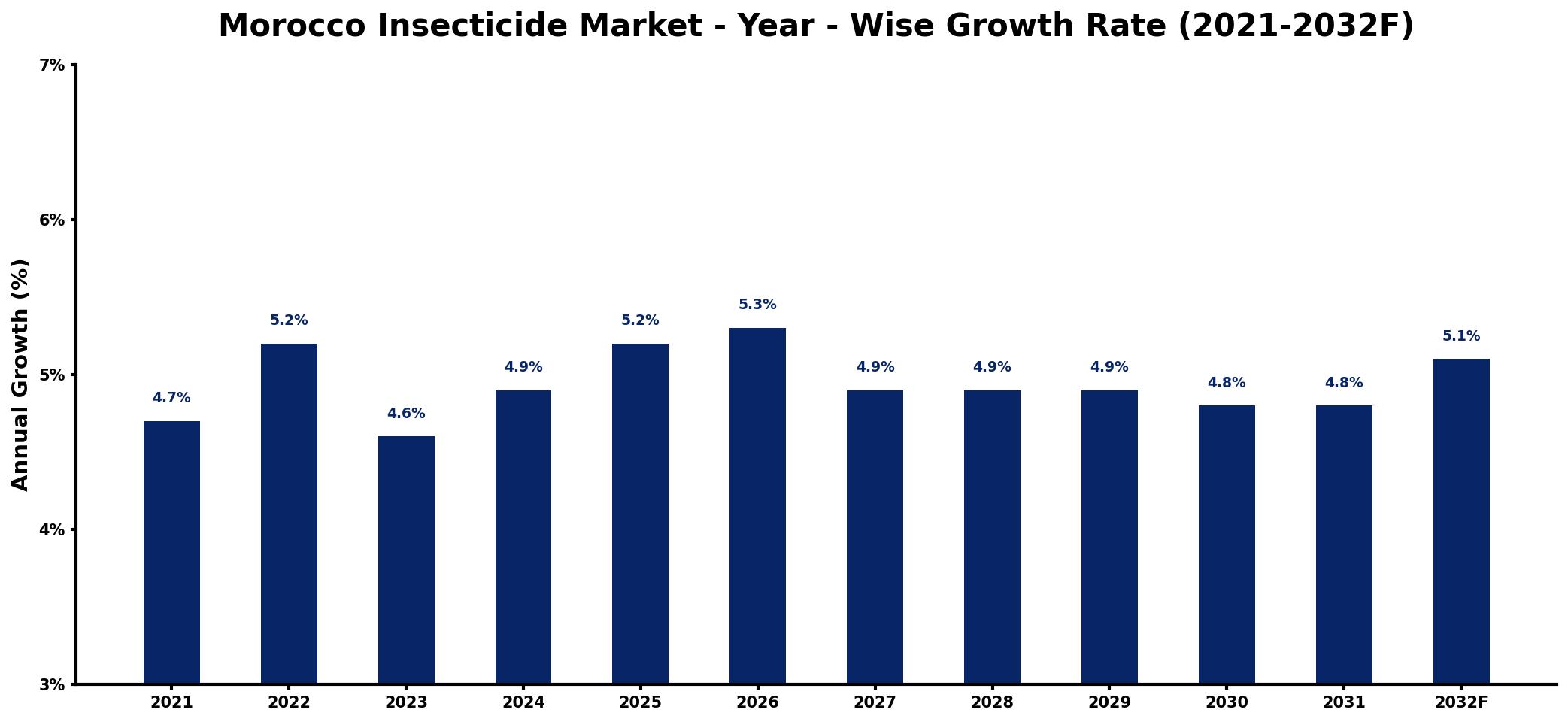
The table below presents the year‑wise growth rates along with the key drivers influencing the market
| Year | Growth Rate | Major Drivers |
| 2021 | 4.7% | Rising agricultural production demands |
| 2022 | 5.2% | Increased awareness of pest control |
| 2023 | 4.6% | Expansion of organic farming practices |
| 2024 | 4.9% | Growth in export market opportunities |
| 2025 | 5.2% | Technological advancements in application |
| 2026 | 5.3% | Higher consumer spending on agriculture |
| 2027 | 4.9% | Emergence of new pest species |
| 2028 | 4.9% | Investment in sustainable farming solutions |
| 2029 | 4.9% | Improvement in distribution networks |
| 2030 | 4.8% | Focus on environmental protection measures |
| 2031 | 4.8% | Rising urbanization and population growth |
| 2032 | 5.1% | Strengthened regulatory frameworks supporting |
Note: Market size estimations and growth projections presented in this report are based on 6Wresearch's proprietary forecasting methodology, utilizing the latest available industry data, government publications, and primary research inputs.
Morocco Insecticide Market Synopsis
The Morocco Insecticide Market is currently experiencing a period of growth, buoyed by increasing awareness of integrated pest management and the adoption of modern farming techniques. However, as the market evolves, it faces new challenges in terms of pesticide resistance and safety regulations that will shape its future landscape.
Looking ahead, the focus on agricultural innovation and eco-friendly pest control methods is expected to continue driving the market. As government policies increasingly support sustainable practices, stakeholders are likely to invest in biopesticides and advanced formulations that align with these goals.
Morocco Insecticide Market Key Takeaways
- The market is projected to grow steadily, reaching USD 272 Million by 2032.
- Demand for insecticides is significantly driven by agricultural productivity and crop protection needs.
- Technological advancements are paving the way for more effective and environmentally friendly insecticide solutions.
- Government policies are actively promoting sustainable pest management practices.
- Addressing pesticide resistance remains a critical focus for the market's growth and development.
Evaluation of Restraints in Morocco Insecticide Market
Despite its growth potential, the Morocco Insecticide Market faces several restraints that could hinder progress. Pesticide resistance among pests remains a persistent challenge, impacting the efficacy of conventional insecticides. Furthermore, regulatory pressures around product safety and environmental impact necessitate continuous innovation and compliance from manufacturers. The diverse agricultural landscape also complicates the development of a one-size-fits-all solution, requiring tailored approaches that can meet varying local needs. Addressing these restraints will be crucial for sustainable market expansion.
Morocco Insecticide Market Trends
Emerging trends in the Morocco Insecticide Market include a significant shift towards biopesticides and integrated pest management practices. Farmers are increasingly prioritizing sustainable agricultural methods that minimize chemical use while ensuring effective pest control. Additionally, advancements in technology are leading to the development of more targeted insecticide formulations that reduce environmental impact. Digital agriculture is also gaining traction, enabling data-driven decisions that enhance pest management strategies.
Morocco Insecticide Market Opportunities
The market presents genuine growth opportunities for stakeholders willing to innovate. The increasing demand for biopesticides and eco-friendly insecticides opens avenues for research and development investment. Collaborations between academia and industry can spur breakthroughs in pest management technologies, while government incentives for sustainable practices can further encourage market participation. Additionally, expanding distribution channels and access to emerging markets can help capture untapped segments within the agricultural sector.
Government Initiatives in the Morocco Insecticide Market
The Moroccan government plays a pivotal role in regulating the insecticide market through stringent safety and environmental standards. Policies are in place to ensure that new insecticides undergo rigorous testing and monitoring to protect public health. Additionally, there is a concerted effort to promote biopesticides and sustainable agricultural practices through financial incentives and technical support. These initiatives are designed to foster innovation while ensuring a balanced approach to pest management.
Future Insights of the Morocco Insecticide Market
Looking toward 2026-2032, the Morocco Insecticide Market is anticipated to evolve significantly. As agricultural practices shift towards sustainability, the emphasis on biopesticides and integrated pest management will only intensify. Technological advancements will facilitate the creation of more effective solutions that minimize environmental impacts. Simultaneously, the market will need to navigate regulatory landscapes and consumer expectations regarding safety and efficacy. This dual focus on innovation and compliance will likely define the future trajectory of the market.
Morocco Insecticide Market Latest Developments (2025 - 2026)
Recent developments in the Morocco Insecticide Market indicate a robust push towards sustainable practices, with increased investments in biopesticide research. Collaborative projects between universities and agricultural bodies have emerged, focusing on innovative pest control solutions. Additionally, new regulations are being implemented to facilitate the introduction of environmentally friendly products, aligning with global sustainability trends. These advancements reflect the market's ongoing transformation towards a more sustainable agricultural ecosystem.
Morocco Insecticide Market - Key Attractiveness of the Report
- 10 Years of Market Numbers
- Historical Data Starting from 2022 to 2025
- Base Year: 2025
- Forecast Data until 2032
- Key Performance Indicators Impacting the Market
- Major Upcoming Developments and Projects
Key Highlights of the Report:
- Morocco Insecticide Market Outlook
- Market Size of Morocco Insecticide Market, 2025
- Forecast of Morocco Insecticide Market, 2032
- Historical Data and Forecast of Morocco Insecticide Revenues & Volume for the Period 2022-2032F
- Morocco Insecticide Market Trend Evolution
- Morocco Insecticide Market Drivers and Challenges
- Morocco Insecticide Price Trends
- Morocco Insecticide Porter's Five Forces
- Morocco Insecticide Industry Life Cycle
- Historical Data and Forecast of Morocco Insecticide Market Revenues & Volume By Type for the Period 2022-2032F
- Historical Data and Forecast of Morocco Insecticide Market Revenues & Volume By Pyrethroids for the Period 2022-2032F
- Historical Data and Forecast of Morocco Insecticide Market Revenues & Volume By Organophosphorus for the Period 2022-2032F
- Historical Data and Forecast of Morocco Insecticide Market Revenues & Volume By Carbamates for the Period 2022-2032F
- Historical Data and Forecast of Morocco Insecticide Market Revenues & Volume By Organochlorine for the Period 2022-2032F
- Historical Data and Forecast of Morocco Insecticide Market Revenues & Volume By Botanicals for the Period 2022-2032F
- Historical Data and Forecast of Morocco Insecticide Market Revenues & Volume By Other Types for the Period 2022-2032F
- Historical Data and Forecast of Morocco Insecticide Market Revenues & Volume By Crop Type for the Period 2022-2032F
- Historical Data and Forecast of Morocco Insecticide Market Revenues & Volume By Cereals & Grains for the Period 2022-2032F
- Historical Data and Forecast of Morocco Insecticide Market Revenues & Volume By Oilseeds & Pulses for the Period 2022-2032F
- Historical Data and Forecast of Morocco Insecticide Market Revenues & Volume By Fruits & Vegetables for the Period 2022-2032F
- Historical Data and Forecast of Morocco Insecticide Market Revenues & Volume By Other Crop Types for the Period 2022-2032F
- Historical Data and Forecast of Morocco Insecticide Market Revenues & Volume By Formulation for the Period 2022-2032F
- Historical Data and Forecast of Morocco Insecticide Market Revenues & Volume By Wettable Powder for the Period 2022-2032F
- Historical Data and Forecast of Morocco Insecticide Market Revenues & Volume By Emulsifiable Concentrate for the Period 2022-2032F
- Historical Data and Forecast of Morocco Insecticide Market Revenues & Volume By Suspension Concentrate for the Period 2022-2032F
- Historical Data and Forecast of Morocco Insecticide Market Revenues & Volume By Oil Emulsion In Water for the Period 2022-2032F
- Historical Data and Forecast of Morocco Insecticide Market Revenues & Volume By Microencapsulated Suspension for the Period 2022-2032F
- Historical Data and Forecast of Morocco Insecticide Market Revenues & Volume By Granules for the Period 2022-2032F
- Historical Data and Forecast of Morocco Insecticide Market Revenues & Volume By Other Formulations for the Period 2022-2032F
- Historical Data and Forecast of Morocco Insecticide Market Revenues & Volume By Form for the Period 2022-2032F
- Historical Data and Forecast of Morocco Insecticide Market Revenues & Volume By Sprays for the Period 2022-2032F
- Historical Data and Forecast of Morocco Insecticide Market Revenues & Volume By Baits for the Period 2022-2032F
- Historical Data and Forecast of Morocco Insecticide Market Revenues & Volume By Strips for the Period 2022-2032F
- Morocco Insecticide Import Export Trade Statistics
- Market Opportunity Assessment By Type
- Market Opportunity Assessment By Crop Type
- Market Opportunity Assessment By Formulation
- Market Opportunity Assessment By Form
- Morocco Insecticide Top Companies Market Share
- Morocco Insecticide Competitive Benchmarking By Technical and Operational Parameters
- Morocco Insecticide Company Profiles
- Morocco Insecticide Key Strategic Recommendations






































