Morocco Nuclear Fuel Market Size, Share & Growth Rate
The Morocco Nuclear Fuel Market was estimated at USD 233 Million in 2025 and is projected to reach USD 308 Million by 2032, growing at a CAGR of 4.1% from 2026 to 2032. This steady growth trajectory is primarily driven by Moroccos strategic initiatives to diversify its energy portfolio and reduce dependency on fossil fuel imports. As the government increasingly considers nuclear power as a viable energy alternative, significant investments in nuclear technology and infrastructure are expected to follow, reinforcing the market's expansion.
Morocco Nuclear Fuel Market Year-wise Growth Rate and Key Drivers
This graph highlights how the Morocco Nuclear Fuel Market has steadily grown over the years, supported by major growth factors.
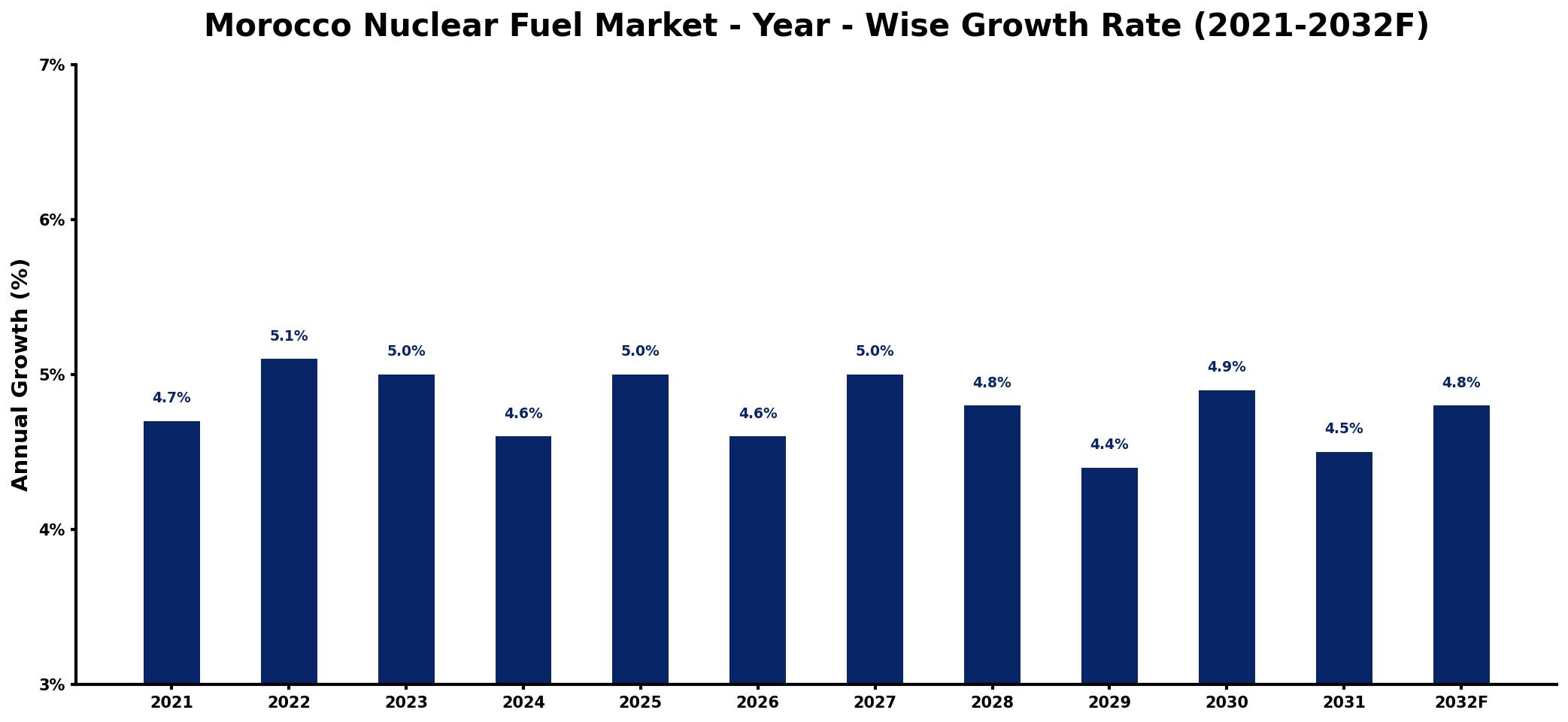
The table below presents the year‑wise growth rates along with the key drivers influencing the market
| Year | Growth Rate | Major Drivers |
| 2021 | 4.7% | Increased energy security initiatives |
| 2022 | 5.1% | Rising investments in renewable technologies |
| 2023 | 5.0% | Growing industrial energy consumption |
| 2024 | 4.6% | Expansion of energy infrastructure projects |
| 2025 | 5.0% | Increased demand for clean energy |
| 2026 | 4.6% | Strengthening regional energy partnerships |
| 2027 | 5.0% | Innovations in energy efficiency solutions |
| 2028 | 4.8% | Enhancing grid modernization efforts |
| 2029 | 4.4% | Diversification of energy sources strategies |
| 2030 | 4.9% | Heightened regulatory support for sustainability |
| 2031 | 4.5% | Boosting research in advanced technologies |
| 2032 | 4.8% | Strengthened public-private collaboration initiatives |
Note: Market size estimations and growth projections presented in this report are based on 6Wresearch's proprietary forecasting methodology, utilizing the latest available industry data, government publications, and primary research inputs.
Morocco Nuclear Fuel Market Synopsis
The Morocco Nuclear Fuel Market is characterized by its current dependence on imported nuclear fuel primarily for research and medical applications. With ambitious plans to explore nuclear power generation, Morocco is aiming to establish a more robust domestic infrastructure that caters to future energy demands.
The nations political stability and its geographical positioning at the crossroads of Europe, Africa, and the Middle East enhance its attractiveness for nuclear fuel suppliers. This stability fosters an environment conducive to investments and partnerships, aligning with the countrys evolving energy strategies.
Morocco Nuclear Fuel Market Key Takeaways
- The market is projected to grow from USD 233 Million in 2025 to USD 308 Million by 2032.
- Government initiatives are focused on developing nuclear power capabilities to reduce fossil fuel dependency.
- Morocco's strategic location positions it as a potential hub for nuclear fuel trade in the region.
- Challenges such as regulatory frameworks and public acceptance need to be addressed for market growth.
- Investment opportunities abound in uranium mining, conversion, enrichment, and fuel fabrication sectors.
Evaluation of Restraints in Morocco Nuclear Fuel Market
Despite its potential, the Morocco Nuclear Fuel Market faces significant constraints that could impede its growth. The country's lack of domestic uranium resources necessitates a heavy reliance on imports, exposing it to supply chain vulnerabilities and price volatility. Moreover, the high initial capital required for establishing nuclear infrastructure and regulatory compliance presents financial challenges for stakeholders. Public opposition and varying perceptions about nuclear energy safety further complicate acceptance, necessitating strategic outreach and education efforts.
Morocco Nuclear Fuel Market Trends
The trend of increasing interest in nuclear energy as a power generation source is becoming pronounced within the Morocco Nuclear Fuel Market. The government is diligently exploring nuclear options to bolster its energy mix, aiming to integrate cleaner energy technologies. Concurrently, advancements in nuclear technologies globally are inspiring local initiatives for developing associated infrastructures and capabilities. This dynamic landscape signifies an evolving market with promising potential, influenced by a worldwide shift towards sustainability and clean energy.
Morocco Nuclear Fuel Market Opportunities
Investment opportunities within the Morocco Nuclear Fuel Market are multifaceted, spanning uranium mining, conversion, enrichment, and fuel fabrication. As the country positions itself to develop nuclear power capabilities, there emerges a burgeoning demand for reliable nuclear fuel supply. Companies looking to invest in the market stand to benefit from long-term contracts and partnerships with prospective nuclear projects. Additionally, the global push towards cleaner energy solutions further enhances the potential for lucrative investments in this sector.
Government Initiatives in the Morocco Nuclear Fuel Market
The Moroccan government is actively facilitating the development of its nuclear fuel market through a series of strategic policies. Notably, in 2016, Morocco entered into a cooperation agreement with Russia to explore nuclear energy development, which includes uranium mining initiatives. Regulatory frameworks have been established via the National Centre for Nuclear Energy, Sciences and Techniques (CNESTEN) to ensure the safe utilization of nuclear technologies. These initiatives demonstrate Moroccos commitment to diversifying its energy sources while adhering to international safety standards.
Future Insights of the Morocco Nuclear Fuel Market
Looking ahead to the period between 2026 and 2032, the Morocco Nuclear Fuel Market is positioned for growth driven by both governmental support and increasing energy demands. Moroccos vision of integrating nuclear energy into its broader energy strategy reflects its commitment to minimizing greenhouse gas emissions. Addressing existing challenges, particularly in public perception and regulatory frameworks, will be crucial for realizing the markets full potential. The strategic location of Morocco further underscores its prospects as an emerging leader in regional nuclear fuel distribution.
Morocco Nuclear Fuel Market Latest Developments (2025 - 2026)
Recent developments in the Morocco Nuclear Fuel Market indicate a growing commitment to enhancing nuclear energy capabilities. As the government continues to explore partnerships and foreign investments, various initiatives aimed at building necessary infrastructure and regulatory frameworks are underway. The market is witnessing increased activity around research and development to support nuclear technology advancements, aligning with the global trend towards sustainable energy practices.
Morocco Nuclear Fuel Market - Key Attractiveness of the Report
- 10 Years of Market Numbers
- Historical Data Starting from 2022 to 2025
- Base Year: 2025
- Forecast Data until 2032
- Key Performance Indicators Impacting the Market
- Major Upcoming Developments and Projects
Key Highlights of the Report:
- Morocco Nuclear Fuel Market Outlook
- Market Size of Morocco Nuclear Fuel Market, 2025
- Forecast of Morocco Nuclear Fuel Market, 2032
- Historical Data and Forecast of Morocco Nuclear Fuel Revenues & Volume for the Period 2022-2032F
- Morocco Nuclear Fuel Market Trend Evolution
- Morocco Nuclear Fuel Market Drivers and Challenges
- Morocco Nuclear Fuel Price Trends
- Morocco Nuclear Fuel Porter's Five Forces
- Morocco Nuclear Fuel Industry Life Cycle
- Historical Data and Forecast of Morocco Nuclear Fuel Market Revenues & Volume By Fuel Type for the Period 2022-2032F
- Historical Data and Forecast of Morocco Nuclear Fuel Market Revenues & Volume By Uranium Fuel for the Period 2022-2032F
- Historical Data and Forecast of Morocco Nuclear Fuel Market Revenues & Volume By Mixed Oxidenuclear Fuel for the Period 2022-2032F
- Historical Data and Forecast of Morocco Nuclear Fuel Market Revenues & Volume By Reactor Type for the Period 2022-2032F
- Historical Data and Forecast of Morocco Nuclear Fuel Market Revenues & Volume By Boiling Water Reactor for the Period 2022-2032F
- Historical Data and Forecast of Morocco Nuclear Fuel Market Revenues & Volume By Pressurized Water Reactor for the Period 2022-2032F
- Morocco Nuclear Fuel Import Export Trade Statistics
- Market Opportunity Assessment By Fuel Type
- Market Opportunity Assessment By Reactor Type
- Morocco Nuclear Fuel Top Companies Market Share
- Morocco Nuclear Fuel Competitive Benchmarking By Technical and Operational Parameters
- Morocco Nuclear Fuel Company Profiles
- Morocco Nuclear Fuel Key Strategic Recommendations






































