Morocco Real Estate Market Size, Share & Growth Rate
The Morocco Real Estate Market was estimated at USD 264 Million in 2025 and is projected to reach USD 356 Million by 2032, growing at a CAGR of 4.4% from 2026 to 2032. This growth is predominantly fueled by increasing urbanization and a burgeoning middle class, creating a robust demand for diverse property types. Additionally, government initiatives aimed at attracting foreign investment are further propelling the market, particularly in thriving urban hubs such as Casablanca and Marrakech.
Morocco Real Estate Market Year-wise Growth Rate and Key Drivers
This graph highlights how the Morocco Real Estate Market has steadily grown over the years, supported by major growth factors.
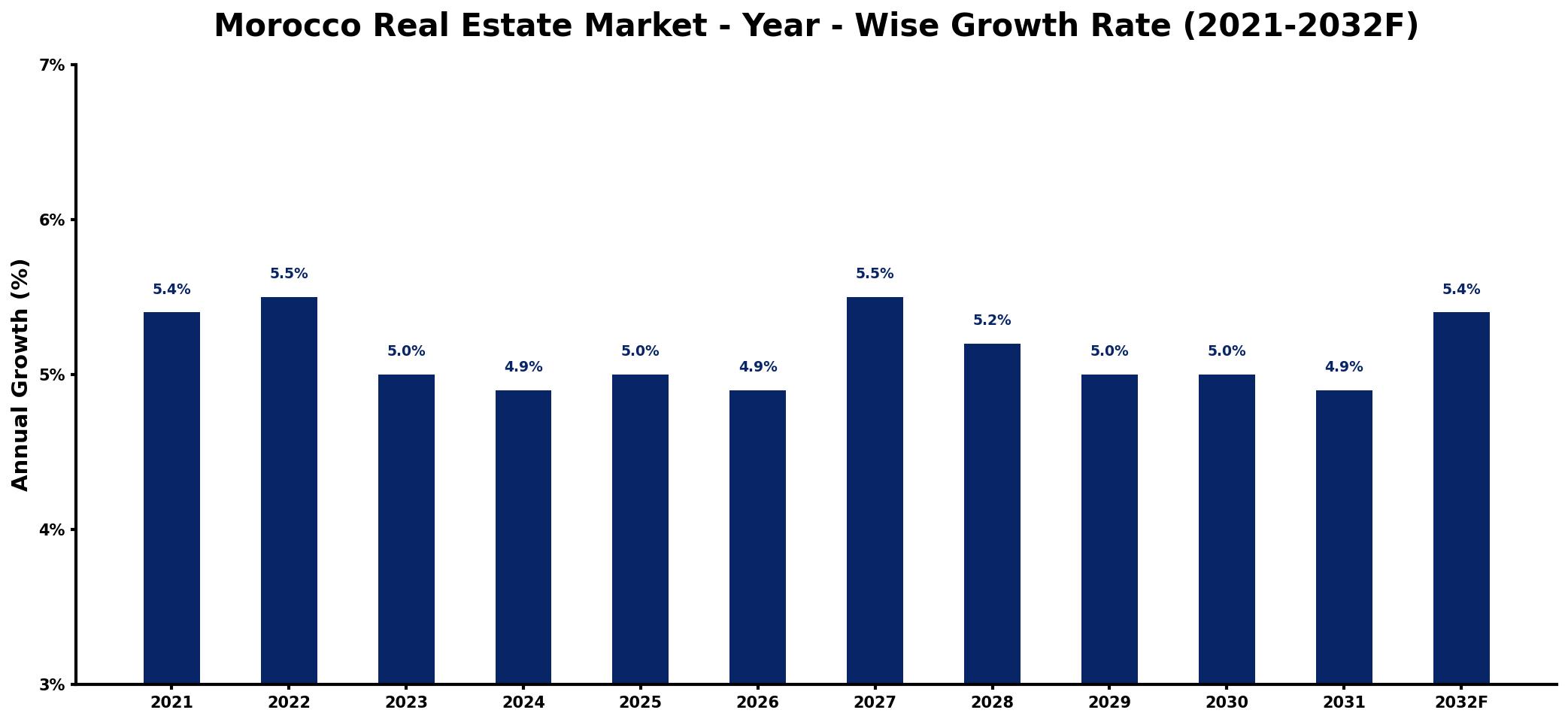
The table below presents the year‑wise growth rates along with the key drivers influencing the market
| Year | Growth Rate | Major Drivers |
| 2021 | 5.4% | Increased foreign investment interest |
| 2022 | 5.5% | Growing urban population demands |
| 2023 | 5.0% | Expansion of tourism infrastructure projects |
| 2024 | 4.9% | Rise in expatriate housing needs |
| 2025 | 5.0% | Strengthening local construction industry |
| 2026 | 4.9% | Increased availability of financing options |
| 2027 | 5.5% | Development of smart city initiatives |
| 2028 | 5.2% | Surge in luxury housing demand |
| 2029 | 5.0% | Growth in rental market opportunities |
| 2030 | 5.0% | Strengthened government housing policies |
| 2031 | 4.9% | Increased focus on sustainable projects |
| 2032 | 5.4% | rising export shipment volumes |
Note: Market size estimations and growth projections presented in this report are based on 6Wresearch's proprietary forecasting methodology, utilizing the latest available industry data, government publications, and primary research inputs.
Morocco Real Estate Market Synopsis
In recent years, the Morocco Real Estate Market has become a focal point for both domestic and foreign investors, marked by significant growth in residential and commercial properties. Major cities have witnessed the emergence of luxury and mixed-use developments, catering to a growing affluent population as well as international tourists.
Despite the promising landscape, the market is not without its complexities. Investors must navigate legal and financial hurdles that can impede transaction processes. Nonetheless, the overall sentiment remains optimistic, as Morocco offers a strategic investment destination bridging Africa and Europe.
Morocco Real Estate Market Key Takeaways
- The market is set to grow from USD 264 Million in 2025 to USD 356 Million by 2032.
- Significant urbanization trends and a rising middle class are driving property demand.
- Government initiatives are enhancing accessibility to affordable housing.
- A surge in interest for sustainable and eco-friendly properties is emerging.
- Mixed-use developments are redefining urban living and working spaces.
Evaluation of Restraints in Morocco Real Estate Market
The Morocco Real Estate Market faces notable restraints that can hinder its potential. A significant oversupply of residential properties in certain urban areas has resulted in price stagnation, creating challenging conditions for investors. Furthermore, bureaucratic obstacles complicate property transactions, deterring potential investments. Coupled with inadequate infrastructure in some regions and fluctuating economic conditions, these challenges necessitate careful navigation for sustained growth.
Morocco Real Estate Market Trends
Current trends in the Morocco Real Estate Market highlight a strong preference for luxury properties, especially in tourist-favored cities like Marrakech and Casablanca. Buyers increasingly favor sustainable living, leading to a rise in eco-friendly developments. Additionally, mixed-use projects are gaining traction, combining residential, commercial, and recreational spaces to create holistic communities. The demand for affordable housing continues to grow as the government makes strides to address housing shortages, reflecting a diverse market evolution.
Morocco Real Estate Market Opportunities
Opportunities abound within the Morocco Real Estate Market, particularly in the tourism sector, where high demand for short-term rentals presents lucrative avenues for investors. With government initiatives focusing on affordable housing and urban development, investors can explore residential project opportunities. The commercial real estate sector is equally promising, with the demand for office and retail spaces steadily increasing in urban areas, enhancing the overall attractiveness for diverse investors.
Government Initiatives in the Morocco Real Estate Market
The Moroccan government has actively implemented policies to bolster the real estate sector, focusing on sustainable growth. Initiatives such as the National Housing Strategy aim to address housing shortages, particularly for low and middle-income families. Incentives, including tax breaks and subsidies, are being offered to attract investment, while urban development projects enhance infrastructure and create a more favorable environment for real estate investment.
Future Insights of the Morocco Real Estate Market
Looking ahead to 2026-2032, the Morocco Real Estate Market is poised for a positive trajectory, driven by economic stability, urban expansion, and a growing middle class. Continued government efforts to improve infrastructure and stimulate the real estate sector will likely lead to increased demand for various property types. However, investors should remain mindful of potential regulatory uncertainties and market saturation in certain regions, necessitating a prudent approach to investment strategies.
Morocco Real Estate Market Latest Developments (2025 - 2026)
Recent developments in the Morocco Real Estate Market have shown a noticeable trend toward increased foreign investment, especially in luxury and mixed-use projects. Urban centers are experiencing an upswing in development activities, with new initiatives focusing on sustainable living. The government's commitment to enhancing infrastructure is also gaining momentum, promising to further attract potential investors and enhance market accessibility in the coming years.
Morocco Real Estate Market - Key Attractiveness of the Report
- 10 Years of Market Numbers
- Historical Data Starting from 2022 to 2025
- Base Year: 2025
- Forecast Data until 2032
- Key Performance Indicators Impacting the Market
- Major Upcoming Developments and Projects
Key Highlights of the Report:
- Morocco Real Estate Market Outlook
- Market Size of Morocco Real Estate Market, 2025
- Forecast of Morocco Real Estate Market, 2032
- Historical Data and Forecast of Morocco Real Estate Revenues & Volume for the Period 2022-2032F
- Morocco Real Estate Market Trend Evolution
- Morocco Real Estate Market Drivers and Challenges
- Morocco Real Estate Price Trends
- Morocco Real Estate Porter's Five Forces
- Morocco Real Estate Industry Life Cycle
- Historical Data and Forecast of Morocco Real Estate Market Revenues & Volume By Property for the Period 2022-2032F
- Historical Data and Forecast of Morocco Real Estate Market Revenues & Volume By Residential for the Period 2022-2032F
- Historical Data and Forecast of Morocco Real Estate Market Revenues & Volume By Commercial for the Period 2022-2032F
- Historical Data and Forecast of Morocco Real Estate Market Revenues & Volume By Industrial for the Period 2022-2032F
- Historical Data and Forecast of Morocco Real Estate Market Revenues & Volume By Land for the Period 2022-2032F
- Historical Data and Forecast of Morocco Real Estate Market Revenues & Volume By Others for the Period 2022-2032F
- Historical Data and Forecast of Morocco Real Estate Market Revenues & Volume By Type for the Period 2022-2032F
- Historical Data and Forecast of Morocco Real Estate Market Revenues & Volume By Sales for the Period 2022-2032F
- Historical Data and Forecast of Morocco Real Estate Market Revenues & Volume By Rental for the Period 2022-2032F
- Historical Data and Forecast of Morocco Real Estate Market Revenues & Volume By Lease for the Period 2022-2032F
- Morocco Real Estate Import Export Trade Statistics
- Market Opportunity Assessment By Property
- Market Opportunity Assessment By Type
- Morocco Real Estate Top Companies Market Share
- Morocco Real Estate Competitive Benchmarking By Technical and Operational Parameters
- Morocco Real Estate Company Profiles
- Morocco Real Estate Key Strategic Recommendations






































