Morocco Styrene Market Size, Share & Growth Rate
The Morocco Styrene Market was estimated at USD 875 Million in 2025 and is projected to reach USD 1265 Million by 2032, growing at a CAGR of 5.4% from 2026 to 2032. This upward trajectory is largely propelled by the increasing utilization of styrene in key sectors, including automotive and construction, as well as the rising demand for innovative packaging solutions. The evolving industrial landscape in Morocco, coupled with heightened urbanization and consumer spending, underscores the growth potential of this vibrant market.
Morocco Styrene Market Year-wise Growth Rate and Key Drivers
This graph highlights how the Morocco Styrene Market has steadily grown over the years, supported by major growth factors.
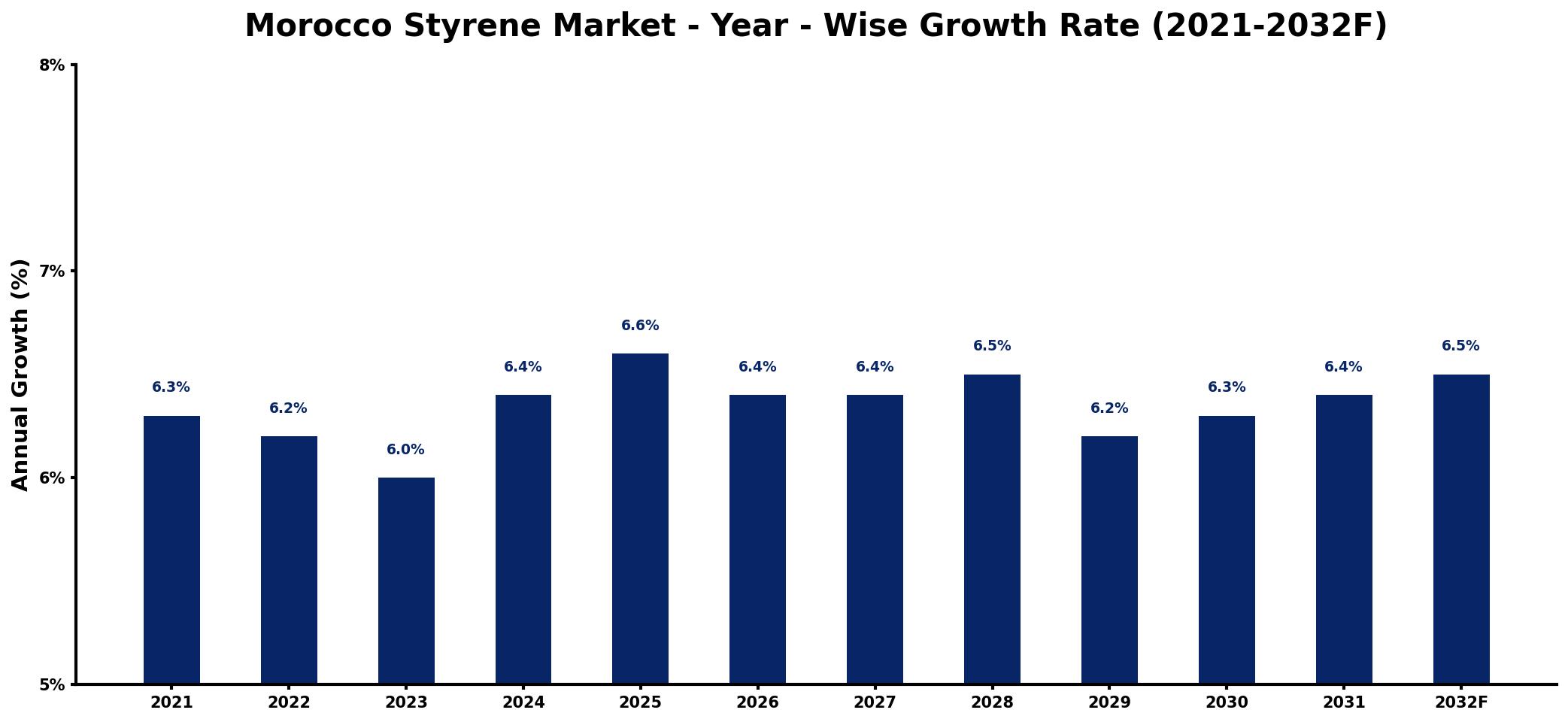
The table below presents the year‑wise growth rates along with the key drivers influencing the market
| Year | Growth Rate | Major Drivers |
| 2021 | 6.3% | Rising demand from packaging industry |
| 2022 | 6.2% | Increased automotive production rates |
| 2023 | 6.0% | Growth in construction activities |
| 2024 | 6.4% | Expansion of electronics manufacturing |
| 2025 | 6.6% | Investments in renewable energy sectors |
| 2026 | 6.4% | Boost in consumer goods production |
| 2027 | 6.4% | Emergence of new markets |
| 2028 | 6.5% | Technological advancements in manufacturing |
| 2029 | 6.2% | Surge in healthcare applications |
| 2030 | 6.3% | strengthening international trade flows |
| 2031 | 6.4% | rising end-use demand growth |
| 2032 | 6.5% | Increase in export opportunities |
Note: Market size estimations and growth projections presented in this report are based on 6Wresearch's proprietary forecasting methodology, utilizing the latest available industry data, government publications, and primary research inputs.
Morocco Styrene Market Synopsis
The strongest force shaping the Morocco Styrene Market today is the rapid industrialization and infrastructure development within the country. With rising investments in construction and manufacturing, the demand for styrene-based products is surging, reflecting a broader trend of economic expansion.
Furthermore, an increase in disposable income among consumers has stimulated growth in the production of consumer goods, leading to greater demand for versatile and high-performance styrene applications. This combination of factors positions the market for sustained growth in the coming years.
Morocco Styrene Market Key Takeaways
- The market is driven by industrial growth, particularly in construction and automotive sectors.
- Rising disposable incomes are increasing consumer goods manufacturing, which directly boosts demand for styrene.
- Investment in innovative and eco-friendly styrene derivatives is becoming a priority for manufacturers.
- Challenges such as raw material price fluctuations and regulatory compliance could impact profitability.
- The government is supporting market growth through policies that promote sustainability and attract foreign investments.
Evaluation of Restraints in Morocco Styrene Market
Despite promising growth, the Morocco Styrene Market faces significant restraints, primarily stemming from fluctuating raw material prices. Benzene, as a crucial feedstock for styrene production, is particularly vulnerable to market volatility, which could affect production costs and profitability for local manufacturers. Additionally, competition from lower-cost imports continues to pose a threat to domestic production, as does the necessity to comply with stringent environmental regulations. These factors contribute to a complex market landscape that stakeholders must navigate carefully.
Morocco Styrene Market Trends
Current trends in the Morocco Styrene Market indicate a shift towards sustainability, with manufacturers increasingly focusing on the development of bio-based styrene derivatives. Additionally, technological advancements in production processes are enhancing the efficiency and performance of styrene-based products. The growing demand for innovative packaging solutions, particularly in the e-commerce sector, further fuels the expansion of styrene applications, marking a pivotal shift in how products are conceived and delivered.
Morocco Styrene Market Opportunities
Investment opportunities in the Morocco Styrene Market are robust, particularly for entities looking to capitalize on the increasing chemical industry demand. The government's initiatives to foster domestic production and attract foreign investments create a fertile environment for new ventures in styrene production. Furthermore, Morocco's strategic location serves as a gateway to both African and European markets, enhancing trade prospects for styrene-based products.
Government Initiatives in the Morocco Styrene Market
The Moroccan government has implemented a variety of policies aimed at promoting growth within the styrene market. These policies prioritize environmental sustainability, with regulations designed to manage emissions and waste in production processes. Additionally, the government offers incentives such as tax breaks to encourage local production and enhance competitiveness among domestic manufacturers. Collaborative efforts with international stakeholders are also being pursued to foster innovation and technology transfer in this evolving sector.
Future Insights of the Morocco Styrene Market
Looking ahead to 2026-2032, the Morocco Styrene Market is set for positive growth, underpinned by rising demand from key industries and sustained industrial activities. Ongoing infrastructure projects and government-backed initiatives to bolster domestic manufacturing are expected to contribute significantly to market expansion. However, the evolving global economic landscape and its associated uncertainties necessitate adaptive strategies for producers, ensuring they remain resilient and competitive in an increasingly dynamic market.
Morocco Styrene Market Latest Developments (2025 - 2026)
Recent developments in the Morocco Styrene Market reflect an active pursuit of innovation and sustainability. Manufacturers are increasingly investing in research and development to create eco-friendly styrene products, aligning with global sustainability trends. Additionally, partnerships with international firms have been established to enhance technological capabilities, ensuring competitiveness in both local and international markets.
Morocco Styrene Market - Key Attractiveness of the Report
- 10 Years of Market Numbers
- Historical Data Starting from 2022 to 2025
- Base Year: 2025
- Forecast Data until 2032
- Key Performance Indicators Impacting the Market
- Major Upcoming Developments and Projects
Key Highlights of the Report:
- Morocco Styrene Market Outlook
- Market Size of Morocco Styrene Market, 2025
- Forecast of Morocco Styrene Market, 2032
- Historical Data and Forecast of Morocco Styrene Revenues & Volume for the Period 2022-2032F
- Morocco Styrene Market Trend Evolution
- Morocco Styrene Market Drivers and Challenges
- Morocco Styrene Price Trends
- Morocco Styrene Porter's Five Forces
- Morocco Styrene Industry Life Cycle
- Historical Data and Forecast of Morocco Styrene Market Revenues & Volume By Type for the Period 2022-2032F
- Historical Data and Forecast of Morocco Styrene Market Revenues & Volume By Acrylonitrile Butadiene Styrene (ABS) for the Period 2022-2032F
- Historical Data and Forecast of Morocco Styrene Market Revenues & Volume By Expanded Polystyrene (EPS) for the Period 2022-2032F
- Historical Data and Forecast of Morocco Styrene Market Revenues & Volume By Others for the Period 2022-2032F
- Historical Data and Forecast of Morocco Styrene Market Revenues & Volume By Application for the Period 2022-2032F
- Historical Data and Forecast of Morocco Styrene Market Revenues & Volume By Automotive for the Period 2022-2032F
- Historical Data and Forecast of Morocco Styrene Market Revenues & Volume By Construction for the Period 2022-2032F
- Historical Data and Forecast of Morocco Styrene Market Revenues & Volume By Packaging Consumer Goods for the Period 2022-2032F
- Historical Data and Forecast of Morocco Styrene Market Revenues & Volume By Others for the Period 2022-2032F
- Historical Data and Forecast of Morocco Styrene Market Revenues & Volume By Distribution Channel for the Period 2022-2032F
- Historical Data and Forecast of Morocco Styrene Market Revenues & Volume By Offline for the Period 2022-2032F
- Historical Data and Forecast of Morocco Styrene Market Revenues & Volume By Online for the Period 2022-2032F
- Morocco Styrene Import Export Trade Statistics
- Market Opportunity Assessment By Type
- Market Opportunity Assessment By Application
- Market Opportunity Assessment By Distribution Channel
- Morocco Styrene Top Companies Market Share
- Morocco Styrene Competitive Benchmarking By Technical and Operational Parameters
- Morocco Styrene Company Profiles
- Morocco Styrene Key Strategic Recommendations






































