Myanmar Alcohol Testing Market Summary
The myanmar alcohol testing market was estimated at USD 405 Million in 2025 and is projected to reach USD 565 Million by 2032, growing at a CAGR of 5.6% from 2026 to 2032.
Myanmar Alcohol Testing Market Year-wise Growth Rate and Key Drivers
This graph highlights how the Myanmar Alcohol Testing Market has steadily grown over the past five years, supported by major growth factors.
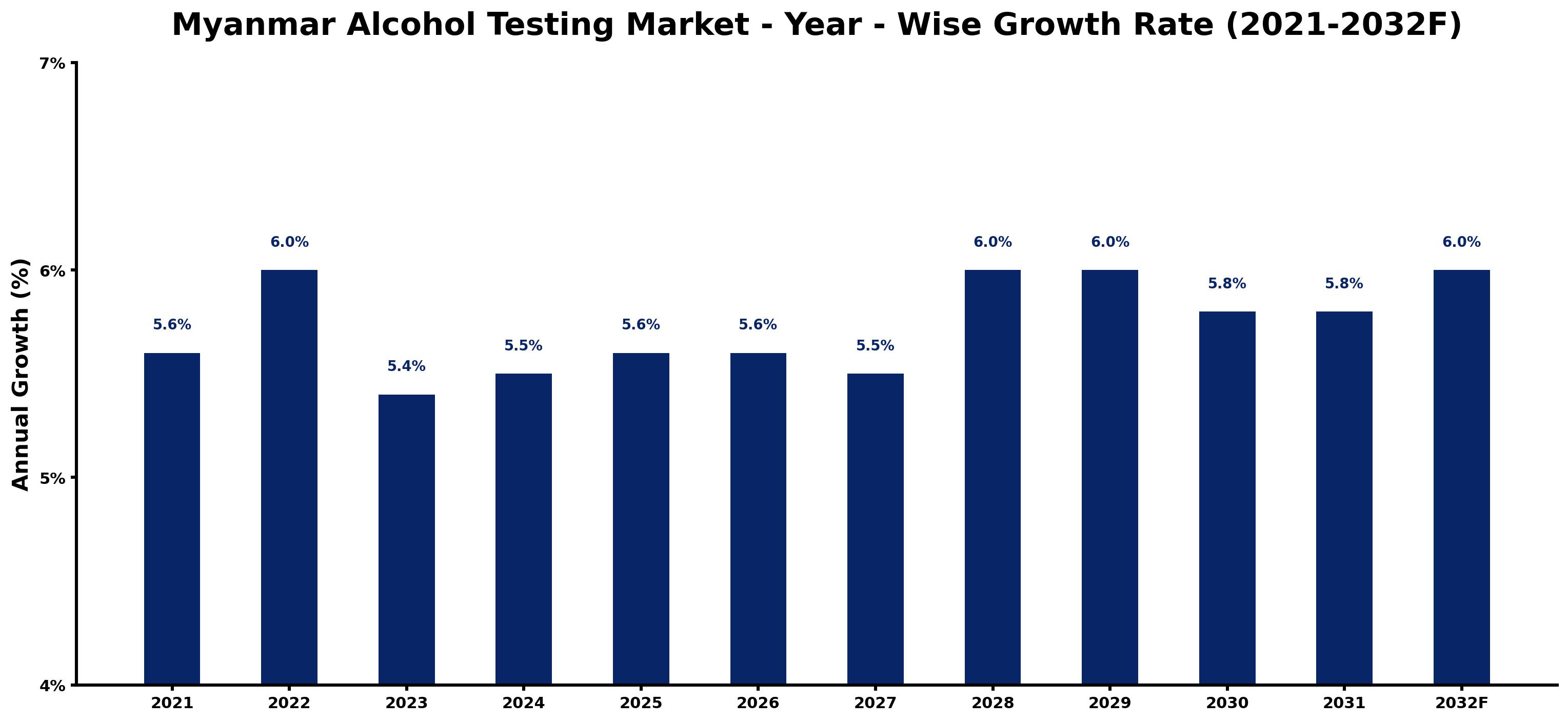
The table below presents the year wise growth rates along with the key drivers influencing the market
| Year | Growth Rate | Major Drivers |
| 2021 | 5.6% | Consumer awareness about alcohol-related incidents prompts interest in testing solutions. |
| 2022 | 6.0% | Local manufacturers begin producing affordable alcohol testing devices, improving market accessibility. |
| 2023 | 5.4% | Educational campaigns by NGOs highlight the importance of alcohol testing for public health. |
| 2024 | 5.5% | Increased tourism creates a need for reliable testing methods in hospitality settings. |
| 2025 | 5.6% | Corporate responsibility initiatives motivate organizations to invest in employee safety measures. |
| 2026 | 5.6% | Mobile app integration for testing services enhances user engagement and convenience. |
| 2027 | 5.5% | Partnerships between tech firms and health agencies drive innovation in testing technologies. |
| 2028 | 6.0% | E-commerce platforms begin offering alcohol testing kits, expanding market reach and visibility. |
| 2029 | 6.0% | Local government incentives support businesses that implement alcohol testing protocols. |
| 2030 | 5.8% | Emergence of health-conscious consumer trends influences demand for alcohol safety products. |
| 2031 | 5.8% | International collaborations facilitate knowledge sharing, bolstering local testing capabilities. |
| 2032 | 6.0% | Cultural shifts towards accountability encourage wider acceptance of alcohol testing measures. |
Note - Market size estimations and growth projections presented in this report are based on 6Wresearch's advanced forecasting approach, validated with industry datasets as of June 2026.
Myanmar Alcohol Testing Market Synopsis
The Myanmar Alcohol Testing Market is projected to reach 5.6% and witness significant growth during the forecast period (2026-2032). This market trajectory has been largely influenced by an increasing public awareness of the dangers associated with drinking and driving. The government's proactive measures, including mandatory breathalyzer tests for vehicles on public roads, have contributed to amplifying the demand for various alcohol testing devices. Additionally, both private enterprises and local authorities are exploring drug screening implementations to promote a safe working environment. Consequently, the proliferation of suppliers offering diverse alcohol testing devices has characterized the market landscape in Myanmar.
Myanmar Alcohol Testing Market Growth Drivers
Several factors are fueling the growth of the Myanmar Alcohol Testing Market. Firstly, heightened awareness regarding road safety is leading to increased governmental and societal emphasis on alcohol testing. Secondly, the steady rise in road traffic accidents attributed to alcohol consumption has prompted both public and private sectors to invest in effective testing solutions. Thirdly, the expanding industrial landscape in Myanmar is fostering demand for workplace safety measures, making alcohol testing devices essential for many organizations. Fourthly, technological advancements in alcohol testing equipment have made devices more accessible and reliable, further driving their adoption. Lastly, community initiatives and public campaigns aimed at educating the populace about the dangers of impaired driving continue to bolster market growth.
Myanmar Alcohol Testing Market Trends and Opportunities
The Myanmar Alcohol Testing Market is experiencing several notable trends that present various opportunities for stakeholders. One significant trend is the increasing adoption of portable testing devices, which allow for convenient and accurate assessments in various environments. Additionally, the growing focus on health and safety regulations in the workplace is encouraging more organizations to implement routine alcohol testing. Another trend is the integration of digital technologies, such as mobile applications that sync with testing devices to provide real-time data analysis and reporting. Furthermore, the rise in public-private partnerships aimed at enhancing road safety creates opportunities for collaborative efforts in developing effective alcohol testing strategies. Lastly, there is an emerging interest in education and training programs focusing on the importance of responsible drinking and alcohol testing protocols, which can help shape future market dynamics.
Myanmar Alcohol Testing Market Challenges and Restraints
Despite its growth prospects, the Myanmar Alcohol Testing Market faces several challenges and restraints that could impact its trajectory. One of the primary challenges is the lack of standardization in alcohol testing methods and devices, which can lead to inconsistencies in results and skepticism among consumers and regulatory bodies. Additionally, the relatively high cost of advanced testing equipment may hinder widespread adoption, especially among smaller enterprises. Furthermore, cultural attitudes towards alcohol consumption could influence market acceptance and compliance with testing protocols. The evolving regulatory landscape poses another challenge, as changes in laws and enforcement policies may impact the demand for testing devices. Lastly, limited awareness and education regarding the benefits and necessity of alcohol testing can stymie market growth.
Myanmar Alcohol Testing Market Government Investment and Initiatives
The government of Myanmar has implemented various investments and initiatives aimed at enhancing road safety and promoting responsible drinking as part of its broader public health strategy. These initiatives include the introduction of legislation mandating the use of alcohol testing devices for drivers on major thoroughfares. Public funding has been allocated for road safety campaigns that focus on educating citizens about the dangers of alcohol consumption and its effects on driving capabilities. Moreover, there are efforts to establish partnerships with local organizations to facilitate training on the use of alcohol testing equipment and proper testing procedures. These government initiatives are aimed at reducing alcohol-related accidents and instilling a cultural shift towards safer driving practices.
Myanmar Alcohol Testing Market Latest Developments (May 2025 - June 2026)
In the period from May 2025 to June 2026, the Myanmar Alcohol Testing Market has continued to evolve in response to changing regulatory and social landscapes. Notable developments include enhanced scrutiny on compliance with alcohol testing legislations, leading to increased enforcement measures by local authorities. There has been a rise in public awareness campaigns that emphasize the importance of alcohol testing, which are gaining traction across multiple regions. Furthermore, advancements in testing technologies have resulted in improved accuracy and usability of testing devices, catering to the growing needs of both consumers and businesses. Engagement with local communities to promote responsible drinking behaviors has been a key focus, reflecting a collective effort to reduce road accidents and promote workplace safety. Overall, these developments indicate a commitment to fostering a safer environment through effective alcohol testing initiatives.
Myanmar Alcohol Testing Market - Key Attractiveness of the Report
- 10 Years of Market Numbers
- Historical Data Starting from 2022 to 2025
- Base Year: 2025
- Forecast Data until 2032
- Key Performance Indicators Impacting the Market
- Major Upcoming Developments and Projects
Key Highlights of the Report:
- Myanmar Alcohol Testing Market Outlook
- Market Size of Myanmar Alcohol Testing Market, 2025
- Forecast of Myanmar Alcohol Testing Market, 2032
- Historical Data and Forecast of Myanmar Alcohol Testing Revenues & Volume for the Period 2022-2032
- Myanmar Alcohol Testing Market Trend Evolution
- Myanmar Alcohol Testing Market Drivers and Challenges
- Myanmar Alcohol Testing Price Trends
- Myanmar Alcohol Testing Porter's Five Forces
- Myanmar Alcohol Testing Industry Life Cycle
- Historical Data and Forecast of Myanmar Alcohol Testing Market Revenues & Volume By Testing Equipment Types for the Period 2022-2032
- Historical Data and Forecast of Myanmar Alcohol Testing Market Revenues & Volume By Infrared Based Breathalyzer for the Period 2022-2032
- Historical Data and Forecast of Myanmar Alcohol Testing Market Revenues & Volume By Semi-conductor Based Breathalyzer for the Period 2022-2032
- Historical Data and Forecast of Myanmar Alcohol Testing Market Revenues & Volume By Immunoassay Analyzers for the Period 2022-2032
- Historical Data and Forecast of Myanmar Alcohol Testing Market Revenues & Volume By Fuel Cell Based Breathalyzer for the Period 2022-2032
- Historical Data and Forecast of Myanmar Alcohol Testing Market Revenues & Volume By Oral Fluid Testing Devices for the Period 2022-2032
- Historical Data and Forecast of Myanmar Alcohol Testing Market Revenues & Volume By Hair Testing Devices for the Period 2022-2032
- Historical Data and Forecast of Myanmar Alcohol Testing Market Revenues & Volume By Urine Testing Devices for the Period 2022-2032
- Historical Data and Forecast of Myanmar Infrared Based Breathalyzer Alcohol Testing Market Revenues & Volume By Others for the Period 2022-2032
- Historical Data and Forecast of Myanmar Alcohol Testing Market Revenues & Volume By Applications for the Period 2022-2032
- Historical Data and Forecast of Myanmar Alcohol Testing Market Revenues & Volume By Alcohol Detection for the Period 2022-2032
- Historical Data and Forecast of Myanmar Alcohol Testing Market Revenues & Volume By Drug Detection for the Period 2022-2032
- Myanmar Alcohol Testing Import Export Trade Statistics
- Market Opportunity Assessment By Testing Equipment Types
- Market Opportunity Assessment By Applications
- Myanmar Alcohol Testing Top Companies Market Share
- Myanmar Alcohol Testing Competitive Benchmarking By Technical and Operational Parameters
- Myanmar Alcohol Testing Company Profiles
- Myanmar Alcohol Testing Key Strategic Recommendations






































