Myanmar Beer Mug Market Size, Share & Growth Rate
The Myanmar Beer Mug Market was estimated at USD 1354 Million in 2025 and is projected to reach USD 1951 Million by 2032, growing at a CAGR of 5.4% from 2026 to 2032. This growth trajectory is primarily fueled by the rise of the craft beer culture and an expanding middle class that values quality drinkware. As the hospitality industry flourishes with new bars and restaurants, the demand for both traditional and modern beer mugs continues to increase.
Myanmar Beer Mug Market Year-wise Growth Rate and Key Drivers
This graph highlights how the Myanmar Beer Mug Market has steadily grown over the years, supported by major growth factors.
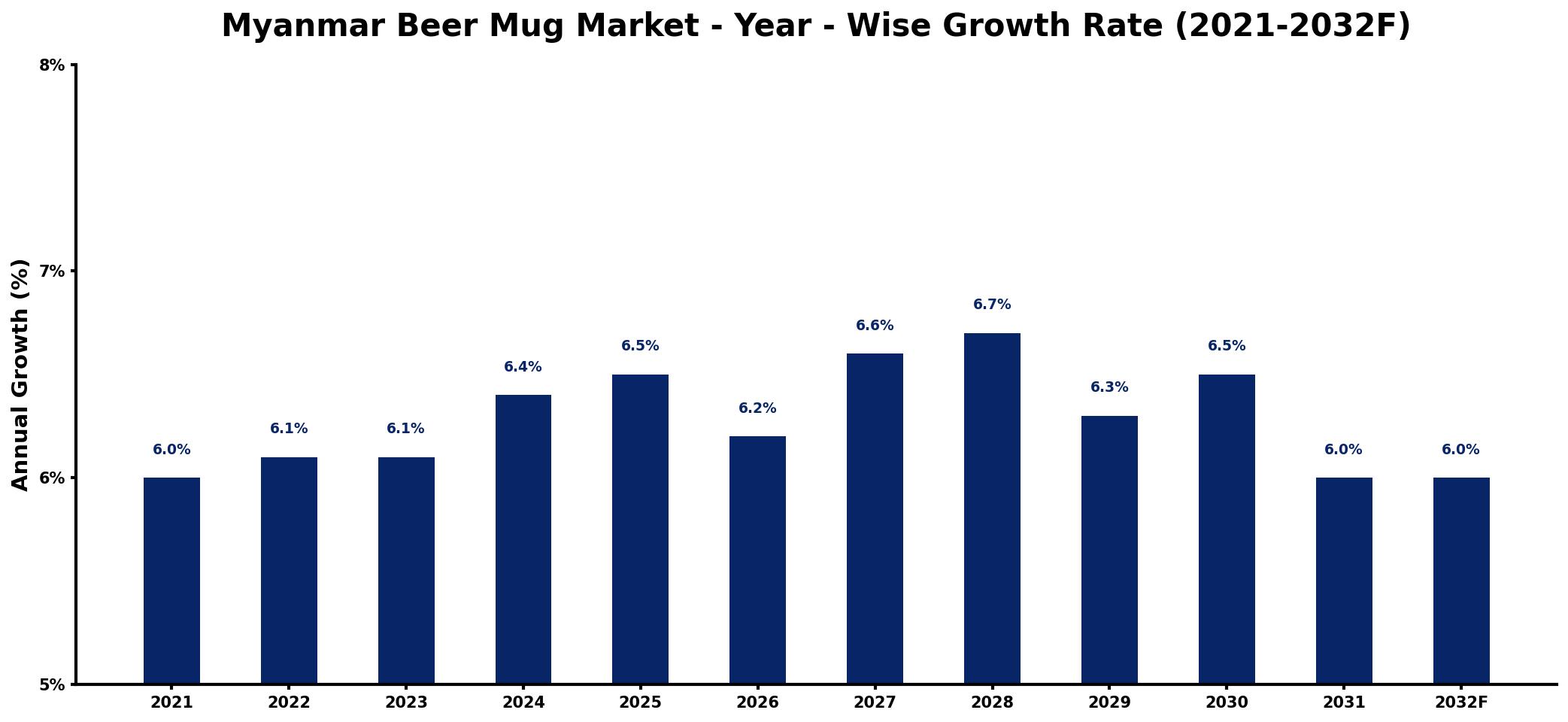
The table below presents the year‑wise growth rates along with the key drivers influencing the market
| Year | Growth Rate | Major Drivers |
| 2021 | 6.0% | Rising disposable income levels |
| 2022 | 6.1% | Increased tourism and hospitality |
| 2023 | 6.1% | Growing social drinking culture |
| 2024 | 6.4% | Expansion of retail distribution |
| 2025 | 6.5% | Enhanced marketing strategies employed |
| 2026 | 6.2% | Emerging craft beverage trends |
| 2027 | 6.6% | Diversification of product offerings |
| 2028 | 6.7% | Innovations in packaging solutions |
| 2029 | 6.3% | Strengthened local production capabilities |
| 2030 | 6.5% | Growing online retail platforms |
| 2031 | 6.0% | Increased focus on sustainability |
| 2032 | 6.0% | Expansion into new markets |
Note: Market size estimations and growth projections presented in this report are based on 6Wresearch's proprietary forecasting methodology, utilizing the latest available industry data, government publications, and primary research inputs.
Myanmar Beer Mug Market Synopsis
The strongest force shaping the Myanmar beer mug market is the evolving consumer preference for quality and design. Traditional ceramic mugs remain favored for their cultural significance, but innovative materials like glass and stainless steel are gaining popularity for their modern aesthetics and durability.
Furthermore, the increasing awareness of sustainability is prompting consumers to seek eco-friendly options, such as bamboo and recycled materials. This shift in preferences presents ample opportunities for both established manufacturers and new entrants to innovate and cater to diverse market demands.
Myanmar Beer Mug Market Key Takeaways
- The market is experiencing a transition toward modern designs appealing to younger consumers.
- Craft beer culture is driving demand for mugs that enhance the drinking experience.
- Personalization options are increasingly important, as consumers seek unique products.
- Sustainable materials are becoming more prominent, reflecting changing consumer values.
- Growth in the hospitality sector is expected to further boost beer mug demand.
Evaluation of Restraints in Myanmar Beer Mug Market
Despite its promising outlook, the Myanmar beer mug market faces several restraints that could impede growth. Limited consumer awareness regarding the benefits of high-quality mugs can lead to hesitancy in purchasing. Furthermore, competition from cheaper imported products threatens local manufacturers. An inconsistent supply chain further complicates distribution, while economic instability and political challenges may adversely impact overall consumer spending. Addressing these issues is crucial for market players to unlock the full potential of this growing market.
Myanmar Beer Mug Market Trends
The trends shaping the Myanmar beer mug market are diverse and dynamic. There is a clear shift toward stylish, unique designs that cater to a younger demographic. Craft beer's growing popularity necessitates the need for specialized drinkware that not only complements the experience but also highlights the variety of flavors. Additionally, the trend of customization is on the rise, with consumers increasingly interested in designing personalized mugs for special occasions. Sustainability remains a key focus, with more brands exploring eco-friendly materials to meet environmentally conscious consumer demands.
Myanmar Beer Mug Market Opportunities
The Myanmar beer mug market holds significant investment opportunities, especially as the country's beer consumption rises. Local artisans can play a vital role in creating handcrafted mugs that resonate with consumers seeking authenticity. Collaborations with local craftsmen can yield unique products that celebrate cultural heritage while appealing to modern aesthetics. Moreover, companies that prioritize innovative designs and sustainable practices can effectively differentiate themselves, positioning their products as desirable within an increasingly competitive landscape.
Government Initiatives in the Myanmar Beer Mug Market
Government policies in Myanmar focus largely on regulating alcoholic beverages, which indirectly influences the beer mug market. Strict licensing requirements for breweries help ensure compliance with health standards, while import and export regulations impact the availability of drinkware. There is an emphasis on responsible consumption, including advertising restrictions to protect public health. These policies aim to support local businesses while fostering a balanced economic environment, thereby creating a stable platform for the beer mug industry.
Future Insights of the Myanmar Beer Mug Market
Looking ahead to 2026-2032, the Myanmar beer mug market is poised for considerable growth driven by increasing beer consumption and the flourishing craft beer segment. As consumer preferences continue to evolve, there will be a growing demand for innovative and sustainable drinkware. The burgeoning hospitality sector will further fuel this demand, leading to an environment ripe for innovation and investment. Players in the market must remain agile, adapting to new trends and consumer preferences to capture opportunities and thrive in this expanding landscape.
Myanmar Beer Mug Market Latest Developments (2025 - 2026)
Recent developments in the Myanmar beer mug market indicate a notable shift towards sustainable practices and innovative designs. Companies are increasingly exploring collaborations with local artisans to enhance product uniqueness. Meanwhile, consumers are showing a strong preference for brands that incorporate eco-friendly materials into their products. The market is witnessing enhanced marketing efforts focused on educating consumers about the benefits of high-quality beer mugs, which is gradually raising awareness and stimulating demand.
Myanmar Beer Mug Market - Key Attractiveness of the Report
- 10 Years of Market Numbers
- Historical Data Starting from 2022 to 2025
- Base Year: 2025
- Forecast Data until 2032
- Key Performance Indicators Impacting the Market
- Major Upcoming Developments and Projects
Key Highlights of the Report:
- Myanmar Beer Mug Market Outlook
- Market Size of Myanmar Beer Mug Market, 2025
- Forecast of Myanmar Beer Mug Market, 2032
- Historical Data and Forecast of Myanmar Beer Mug Revenues & Volume for the Period 2022-2032F
- Myanmar Beer Mug Market Trend Evolution
- Myanmar Beer Mug Market Drivers and Challenges
- Myanmar Beer Mug Price Trends
- Myanmar Beer Mug Porter's Five Forces
- Myanmar Beer Mug Industry Life Cycle
- Historical Data and Forecast of Myanmar Beer Mug Market Revenues & Volume By Products type for the Period 2022-2032F
- Historical Data and Forecast of Myanmar Beer Mug Market Revenues & Volume By Glass for the Period 2022-2032F
- Historical Data and Forecast of Myanmar Beer Mug Market Revenues & Volume By Wood for the Period 2022-2032F
- Historical Data and Forecast of Myanmar Beer Mug Market Revenues & Volume By Fiber for the Period 2022-2032F
- Historical Data and Forecast of Myanmar Beer Mug Market Revenues & Volume By Stainless Steel for the Period 2022-2032F
- Historical Data and Forecast of Myanmar Beer Mug Market Revenues & Volume By Ceramic for the Period 2022-2032F
- Historical Data and Forecast of Myanmar Beer Mug Market Revenues & Volume By Price Point for the Period 2022-2032F
- Historical Data and Forecast of Myanmar Beer Mug Market Revenues & Volume By Premium for the Period 2022-2032F
- Historical Data and Forecast of Myanmar Beer Mug Market Revenues & Volume By Medium for the Period 2022-2032F
- Historical Data and Forecast of Myanmar Beer Mug Market Revenues & Volume By Economy for the Period 2022-2032F
- Historical Data and Forecast of Myanmar Beer Mug Market Revenues & Volume By Application for the Period 2022-2032F
- Historical Data and Forecast of Myanmar Beer Mug Market Revenues & Volume By Bars for the Period 2022-2032F
- Historical Data and Forecast of Myanmar Beer Mug Market Revenues & Volume By Pubs for the Period 2022-2032F
- Historical Data and Forecast of Myanmar Beer Mug Market Revenues & Volume By Home Crockery for the Period 2022-2032F
- Historical Data and Forecast of Myanmar Beer Mug Market Revenues & Volume By Distribution Channel for the Period 2022-2032F
- Historical Data and Forecast of Myanmar Beer Mug Market Revenues & Volume By E-commerce for the Period 2022-2032F
- Historical Data and Forecast of Myanmar Beer Mug Market Revenues & Volume By Gift Shops for the Period 2022-2032F
- Historical Data and Forecast of Myanmar Beer Mug Market Revenues & Volume By Hypermarkets /Supermarkets for the Period 2022-2032F
- Historical Data and Forecast of Myanmar Beer Mug Market Revenues & Volume By Utensils Shop for the Period 2022-2032F
- Historical Data and Forecast of Myanmar Beer Mug Market Revenues & Volume By Specialty Stores for the Period 2022-2032F
- Myanmar Beer Mug Import Export Trade Statistics
- Market Opportunity Assessment By Products type
- Market Opportunity Assessment By Price Point
- Market Opportunity Assessment By Application
- Market Opportunity Assessment By Distribution Channel
- Myanmar Beer Mug Top Companies Market Share
- Myanmar Beer Mug Competitive Benchmarking By Technical and Operational Parameters
- Myanmar Beer Mug Company Profiles
- Myanmar Beer Mug Key Strategic Recommendations






































