Myanmar Chlorine Market Size Growth Rate
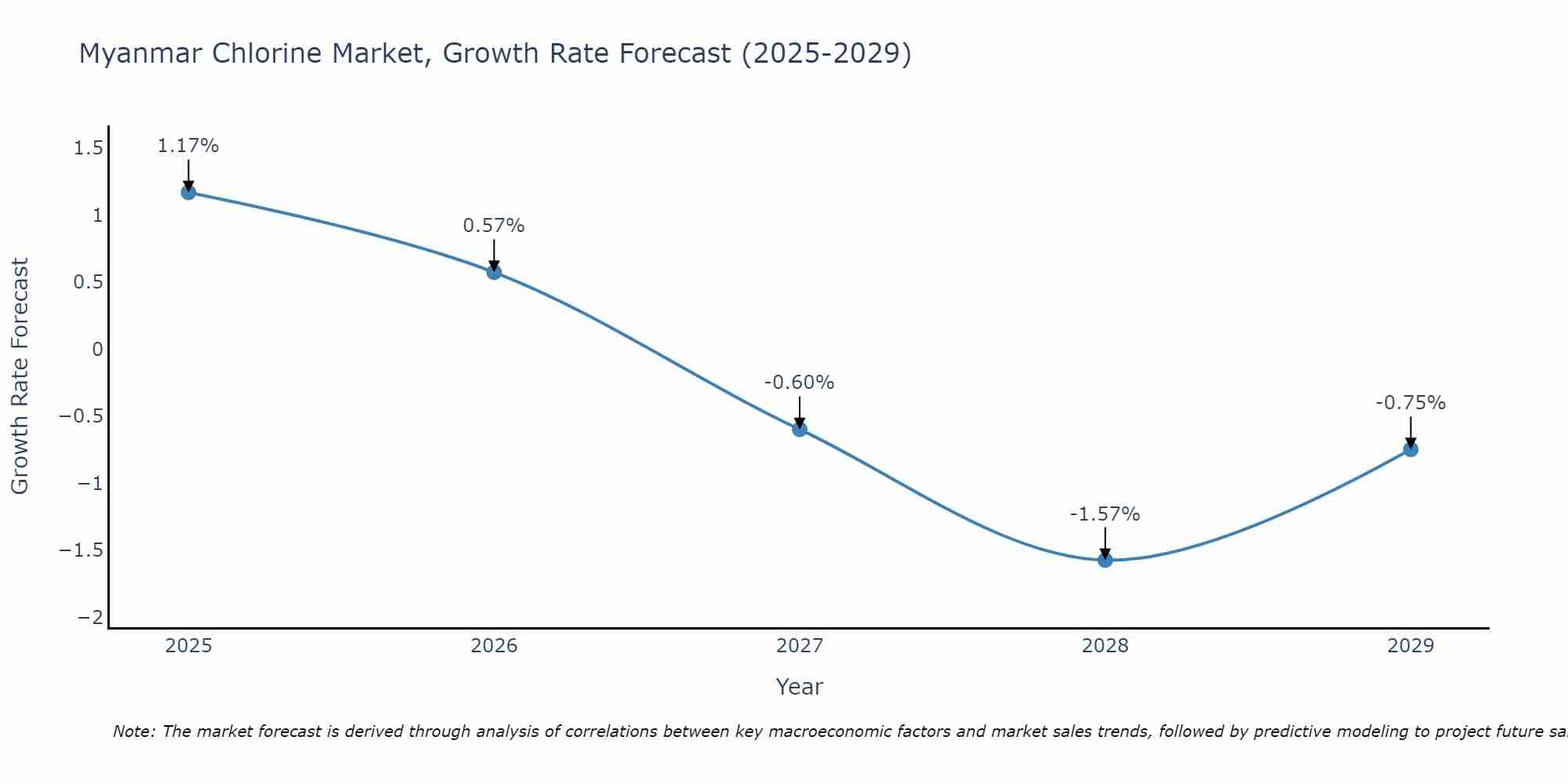
The Myanmar Chlorine Market is projected to witness mixed growth rate patterns during 2025 to 2029. Starting high at 1.17% in 2025, the market steadily declines to -0.75% by 2029.
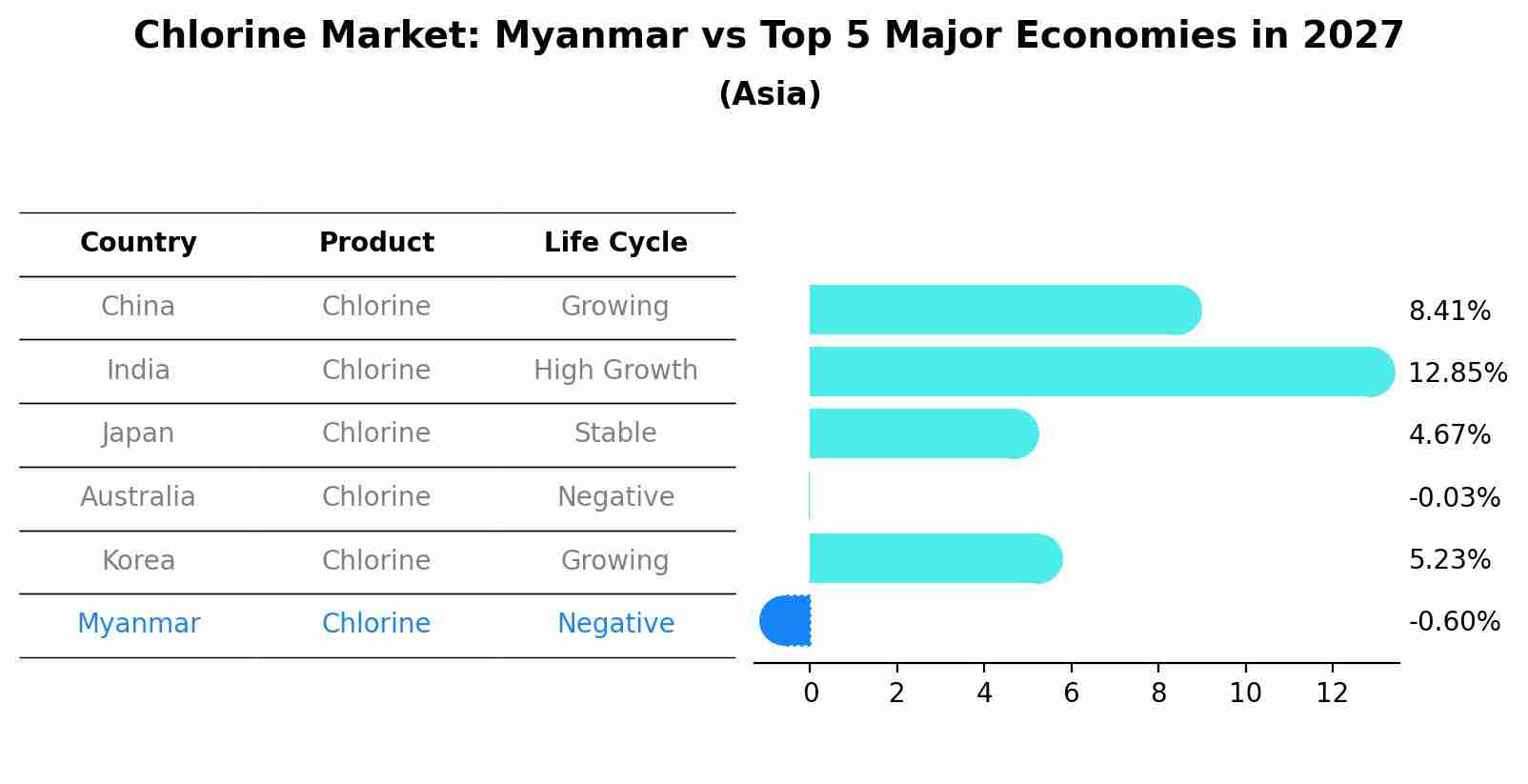
Chlorine Market: Myanmar vs Top 5 Major Economies in 2027 (Asia)
Myanmar's Chlorine market is anticipated to experience a negative growth rate of -0.60% by 2027, reflecting trends observed in the largest economy China, followed by India, Japan, Australia and South Korea.
Myanmar Chlorine Market Overview
Myanmars chlorine market is expanding, driven by its essential role in water purification, disinfection, and chemical synthesis. Chlorine is a key component in producing various chemicals and is critical for ensuring safe drinking water. The market growth is supported by the governments initiatives to improve water infrastructure and the increasing demand from the chemical industry, positioning chlorine as a vital commodity in Myanmars industrial sector.
Drivers of the market
The demand for chlorine in Myanmar is primarily driven by its widespread use in water disinfection, pharmaceutical manufacturing, and chemical production. As the country focuses on improving sanitation infrastructure and water treatment facilities, the demand for chlorine continues to rise. Moreover, the expanding chemical industry and increasing agricultural activities fuel the demand for chlorine-based products such as pesticides and herbicides.
Challenges of the market
Regulatory compliance and environmental sustainability might pose significant challenges in the chlorine market. Balancing the demand for chlorine with environmental stewardship and safety standards could require substantial investment and innovation.
Government Policy of the market
In the Myanmar chlorine market, government policies play a crucial role in regulating the production, import, and use of chlorine gas and chlorine-based chemicals. The government closely monitors chlorine production facilities to ensure compliance with safety and environmental regulations. There are also regulations governing the transportation and storage of chlorine to prevent leaks or spills that could pose risks to public safety and the environment.
Key Highlights of the Report:
- Myanmar Chlorine Market Outlook
- Market Size of Myanmar Chlorine Market, 2024
- Forecast of Myanmar Chlorine Market, 2031
- Historical Data and Forecast of Myanmar Chlorine Revenues & Volume for the Period 2021-2031
- Myanmar Chlorine Market Trend Evolution
- Myanmar Chlorine Market Drivers and Challenges
- Myanmar Chlorine Price Trends
- Myanmar Chlorine Porter's Five Forces
- Myanmar Chlorine Industry Life Cycle
- Historical Data and Forecast of Myanmar Chlorine Market Revenues & Volume By Application for the Period 2021-2031
- Historical Data and Forecast of Myanmar Chlorine Market Revenues & Volume By EDC/PVC for the Period 2021-2031
- Historical Data and Forecast of Myanmar Chlorine Market Revenues & Volume By Isocyanates and Oxygenates for the Period 2021-2031
- Historical Data and Forecast of Myanmar Chlorine Market Revenues & Volume By Chloromethanes for the Period 2021-2031
- Historical Data and Forecast of Myanmar Chlorine Market Revenues & Volume By Solvents and Epichlorohydrin for the Period 2021-2031
- Historical Data and Forecast of Myanmar Chlorine Market Revenues & Volume By Inorganic Chemicals for the Period 2021-2031
- Historical Data and Forecast of Myanmar Chlorine Market Revenues & Volume By Other Applications for the Period 2021-2031
- Historical Data and Forecast of Myanmar Chlorine Market Revenues & Volume By End-user Industry for the Period 2021-2031
- Historical Data and Forecast of Myanmar Chlorine Market Revenues & Volume By Water Treatment for the Period 2021-2031
- Historical Data and Forecast of Myanmar Chlorine Market Revenues & Volume By Pharmaceutical for the Period 2021-2031
- Historical Data and Forecast of Myanmar Chlorine Market Revenues & Volume By Chemicals for the Period 2021-2031
- Historical Data and Forecast of Myanmar Chlorine Market Revenues & Volume By Paper and Pulp for the Period 2021-2031
- Historical Data and Forecast of Myanmar Chlorine Market Revenues & Volume By Plastic for the Period 2021-2031
- Historical Data and Forecast of Myanmar Chlorine Market Revenues & Volume By Pesticides for the Period 2021-2031
- Historical Data and Forecast of Myanmar Chlorine Market Revenues & Volume By Other End-user Industries for the Period 2021-2031
- Myanmar Chlorine Import Export Trade Statistics
- Market Opportunity Assessment By Application
- Market Opportunity Assessment By End-user Industry
- Myanmar Chlorine Top Companies Market Share
- Myanmar Chlorine Competitive Benchmarking By Technical and Operational Parameters
- Myanmar Chlorine Company Profiles
- Myanmar Chlorine Key Strategic Recommendations






































