Switzerland Chlorine Market: Import Trend Analysis
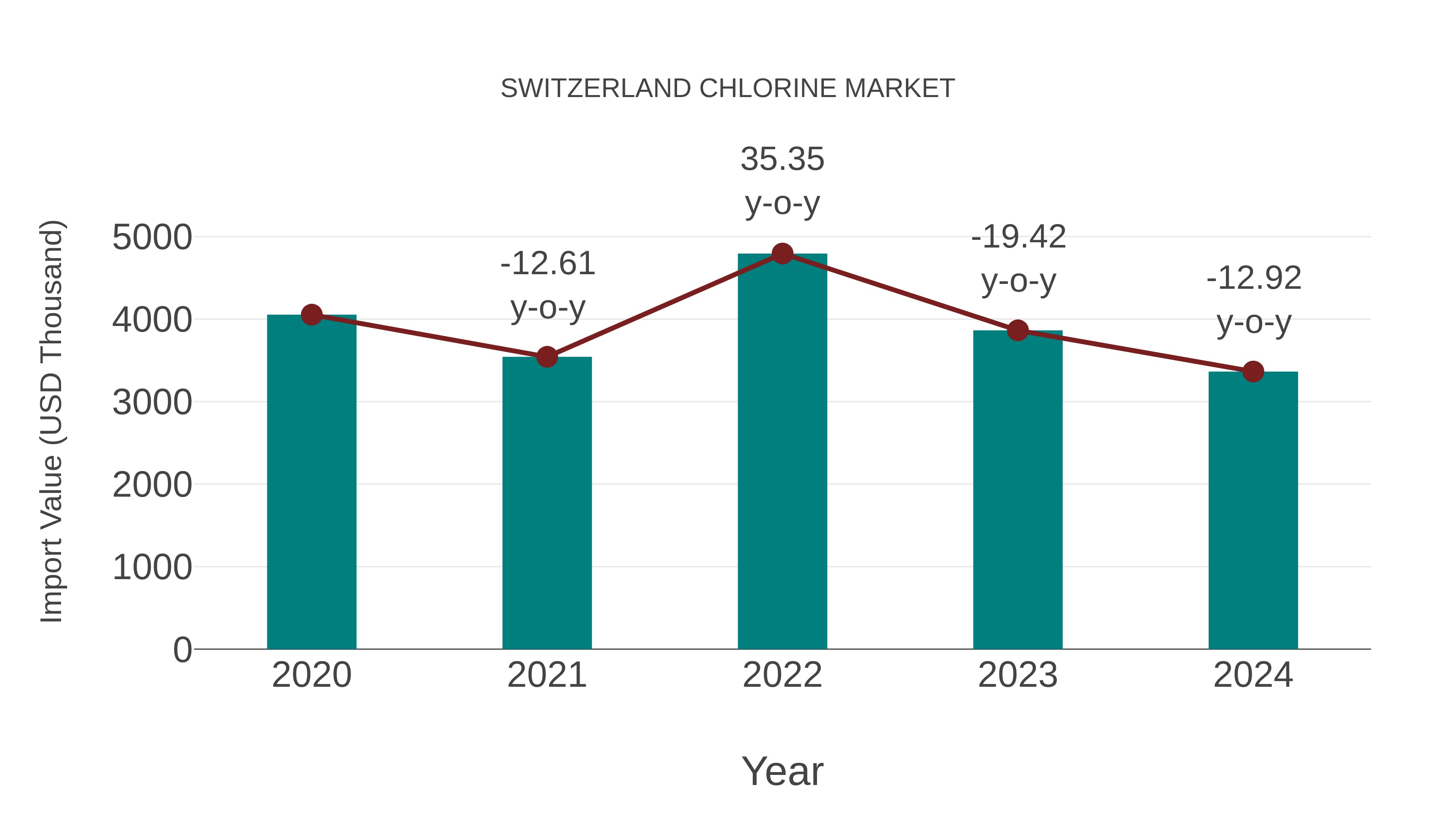
Switzerland chlorine market witnessed a -12.92% decline in imports from 2023 to 2024, with a CAGR of -4.55% from 2020 to 2024. This decline may be attributed to shifts in demand dynamics or changes in trade policies affecting the market.
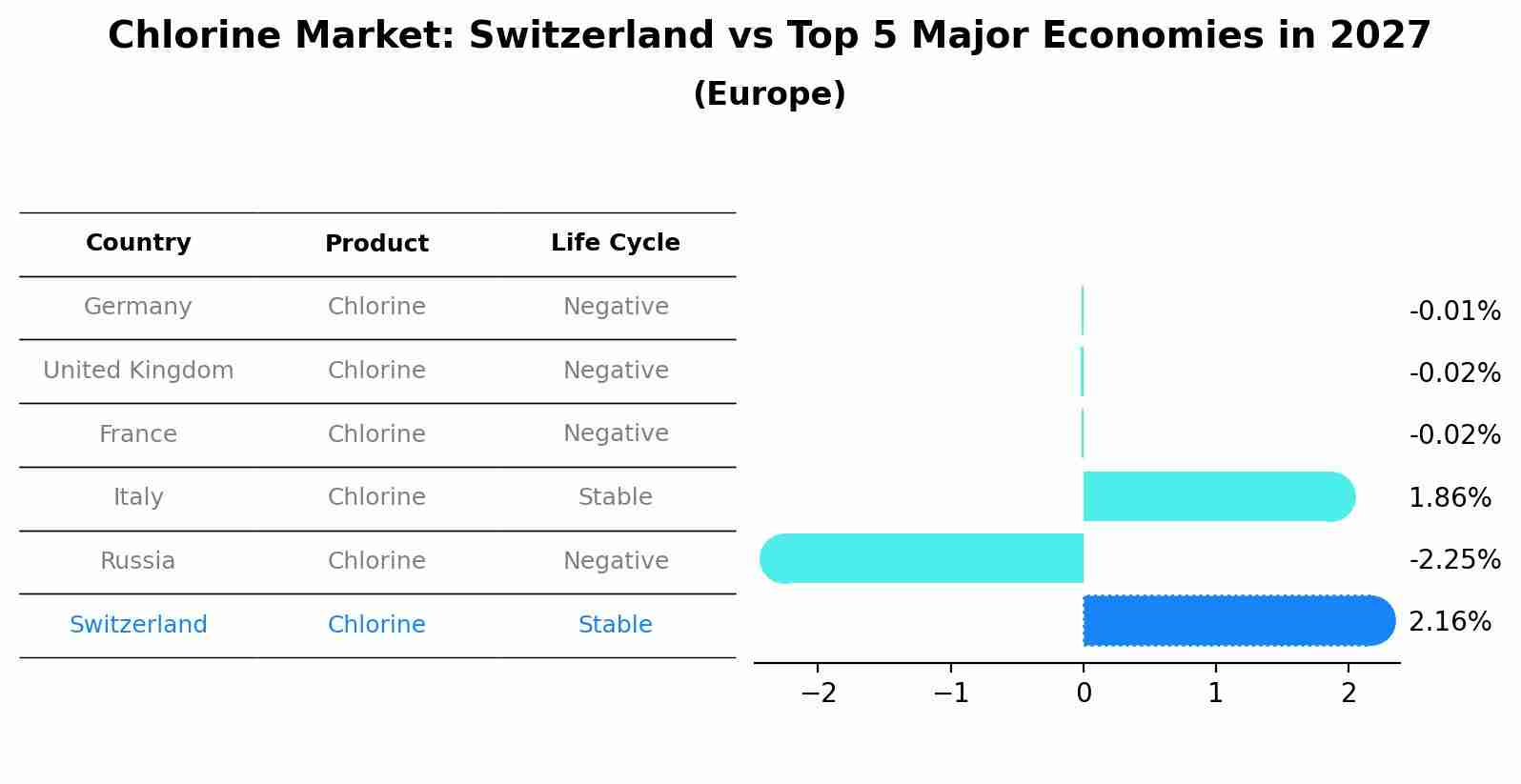
Chlorine Market: Switzerland vs Top 5 Major Economies in 2027 (Europe)
In the Europe region, the Chlorine market in Switzerland is projected to expand at a stable growth rate of 2.16% by 2027. The largest economy is Germany, followed by United Kingdom, France, Italy and Russia.
Switzerland Chlorine Market Overview
The chlorine market in Switzerland is integral to various sectors, including water treatment, chemical synthesis, and pharmaceuticals. Chlorine is essential for disinfection processes, particularly in drinking water and wastewater treatment. The market is characterized by fluctuating demand, influenced by regulatory standards and public health concerns. Additionally, advancements in chlorine production technologies and a shift toward sustainable practices are shaping market trends, with an emphasis on reducing the environmental impact of chlorine production.
Drivers of the market
The chlorine market in Switzerland is influenced by the growing demand for chlorine in disinfection, chemical production, and various industrial applications. The increasing focus on public health and hygiene, particularly in water treatment processes, is a significant driver, as chlorine is a crucial agent in eliminating pathogens from drinking water. Additionally, the chemical industry relies heavily on chlorine for producing various compounds, such as PVC and solvents, which are essential in construction and manufacturing. The shift towards sustainable practices is also promoting the development of more efficient chlorine production methods, further supporting the market`s expansion.
Challenges of the market
The chlorine market in Switzerland faces challenges related to environmental regulations and safety concerns. Chlorine production and handling are heavily regulated due to the chemical`s hazardous nature, which can lead to high compliance costs for manufacturers. Additionally, the market is experiencing pressure to reduce emissions and adopt more sustainable practices, which may require significant changes in production methods. Fluctuations in demand, influenced by industries such as water treatment and chemical manufacturing, can result in market volatility, making it difficult for companies to predict production needs accurately. Furthermore, competition from alternative disinfection methods, such as ultraviolet (UV) treatment, is rising, posing a threat to the traditional chlorine market.
Government Policy of the market
The chlorine market in Switzerland is significantly influenced by environmental regulations and safety standards governing chlorine production and use. The Swiss government prioritizes reducing the environmental impact of chemical processes, promoting innovations that minimize chlorine waste and emissions. Moreover, policies that support the development of chlorine derivatives are crucial for expanding its application in various sectors, including water treatment, plastics, and pharmaceuticals.
Key Highlights of the Report:
- Switzerland Chlorine Market Outlook
- Market Size of Switzerland Chlorine Market, 2025
- Forecast of Switzerland Chlorine Market, 2032
- Historical Data and Forecast of Switzerland Chlorine Revenues & Volume for the Period 2022-2032F
- Switzerland Chlorine Market Trend Evolution
- Switzerland Chlorine Market Drivers and Challenges
- Switzerland Chlorine Price Trends
- Switzerland Chlorine Porter`s Five Forces
- Switzerland Chlorine Industry Life Cycle
- Historical Data and Forecast of Switzerland Chlorine Market Revenues & Volume By Application for the Period 2022-2032F
- Historical Data and Forecast of Switzerland Chlorine Market Revenues & Volume By EDC/PVC for the Period 2022-2032F
- Historical Data and Forecast of Switzerland Chlorine Market Revenues & Volume By Isocyanates and Oxygenates for the Period 2022-2032F
- Historical Data and Forecast of Switzerland Chlorine Market Revenues & Volume By Chloromethanes for the Period 2022-2032F
- Historical Data and Forecast of Switzerland Chlorine Market Revenues & Volume By Solvents and Epichlorohydrin for the Period 2022-2032F
- Historical Data and Forecast of Switzerland Chlorine Market Revenues & Volume By Inorganic Chemicals for the Period 2022-2032F
- Historical Data and Forecast of Switzerland Chlorine Market Revenues & Volume By Other Applications for the Period 2022-2032F
- Historical Data and Forecast of Switzerland Chlorine Market Revenues & Volume By End-user Industry for the Period 2022-2032F
- Historical Data and Forecast of Switzerland Chlorine Market Revenues & Volume By Water Treatment for the Period 2022-2032F
- Historical Data and Forecast of Switzerland Chlorine Market Revenues & Volume By Pharmaceutical for the Period 2022-2032F
- Historical Data and Forecast of Switzerland Chlorine Market Revenues & Volume By Chemicals for the Period 2022-2032F
- Historical Data and Forecast of Switzerland Chlorine Market Revenues & Volume By Paper and Pulp for the Period 2022-2032F
- Historical Data and Forecast of Switzerland Chlorine Market Revenues & Volume By Plastic for the Period 2022-2032F
- Historical Data and Forecast of Switzerland Chlorine Market Revenues & Volume By Pesticides for the Period 2022-2032F
- Historical Data and Forecast of Switzerland Chlorine Market Revenues & Volume By Other End-user Industries for the Period 2022-2032F
- Switzerland Chlorine Import Export Trade Statistics
- Market Opportunity Assessment By Application
- Market Opportunity Assessment By End-user Industry
- Switzerland Chlorine Top Companies Market Share
- Switzerland Chlorine Competitive Benchmarking By Technical and Operational Parameters
- Switzerland Chlorine Company Profiles
- Switzerland Chlorine Key Strategic Recommendations






































