Myanmar Diamond Market Size, Share & Growth Rate
The Myanmar Diamond Market was estimated at USD 239 Million in 2025 and is projected to reach USD 316 Million by 2032, growing at a CAGR of 4.1% from 2026 to 2032. This growth trajectory is primarily fueled by Myanmar's reputation for high-quality diamonds, particularly from the Mogok region, and an increasing global demand for unique, ethically sourced gemstones. Additionally, as international trade barriers ease, the market is likely to attract more foreign investments, further propelling its expansion.
Myanmar Diamond Market Year-wise Growth Rate and Key Drivers
This graph highlights how the Myanmar Diamond Market has steadily grown over the years, supported by major growth factors.
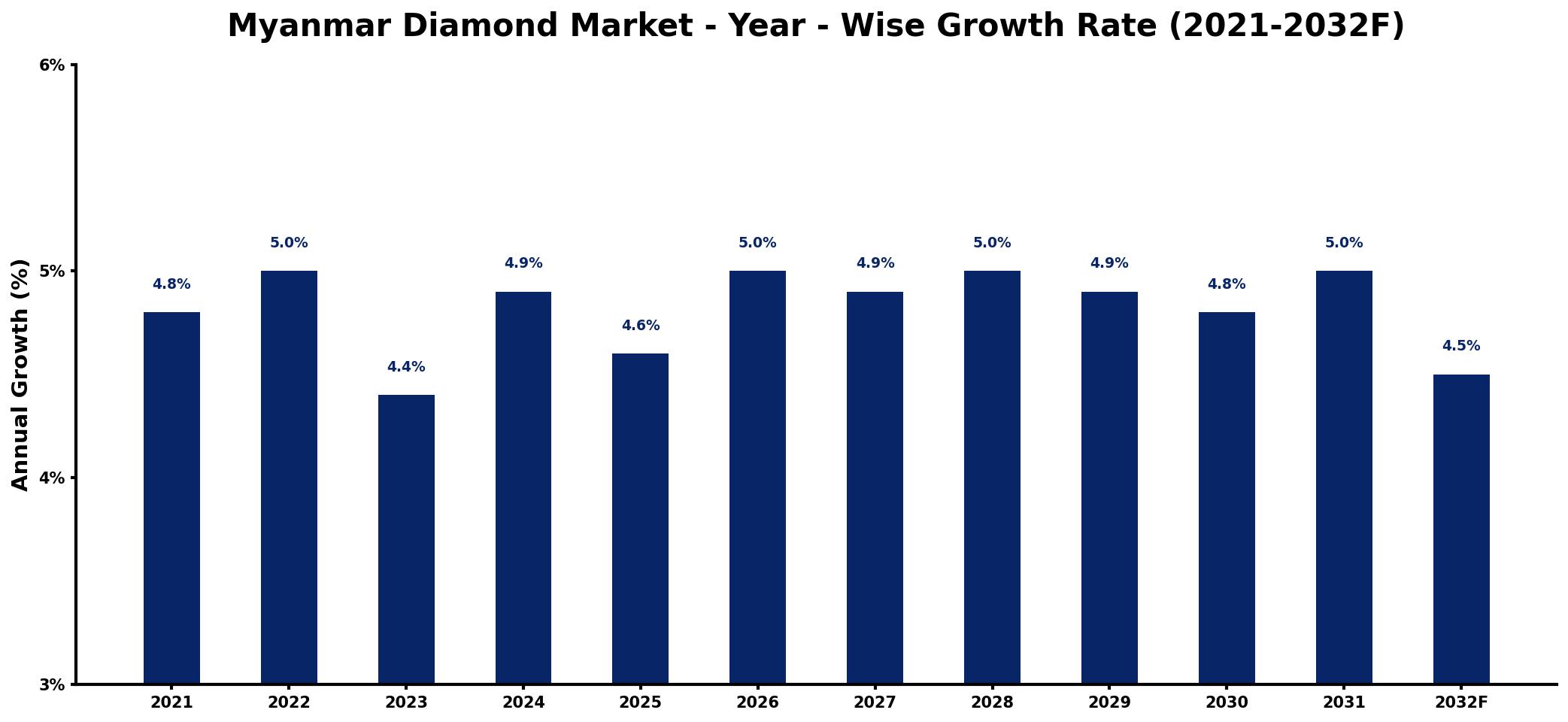
The table below presents the year‑wise growth rates along with the key drivers influencing the market
| Year | Growth Rate | Major Drivers |
| 2021 | 4.8% | Rising consumer spending power |
| 2022 | 5.0% | Increased tourism and luxury spending |
| 2023 | 4.4% | Growing interest in unique investments |
| 2024 | 4.9% | Expansion of retail luxury sector |
| 2025 | 4.6% | Emergence of new online platforms |
| 2026 | 5.0% | Strengthening local craftsmanship initiatives |
| 2027 | 4.9% | Increased focus on ethical sourcing |
| 2028 | 5.0% | Growing demand for luxury gifts |
| 2029 | 4.9% | Strengthened international trade agreements |
| 2030 | 4.8% | Heightened marketing campaigns effectiveness |
| 2031 | 5.0% | Increased collaborations with influencers |
| 2032 | 4.5% | Diversification of product offerings |
Note: Market size estimations and growth projections presented in this report are based on 6Wresearch's proprietary forecasting methodology, utilizing the latest available industry data, government publications, and primary research inputs.
Myanmar Diamond Market Synopsis
Myanmar is recognized for its exceptional diamond quality, with the Mogok region often referred to as the "Valley of Rubies." This reputation not only enhances the allure of Myanmar diamonds but also sets a solid foundation for premium pricing in both domestic and international markets. Artisanal mining practices dominate the landscape, with traditional methods preserving the cultural heritage while producing exquisite gemstones.
However, the diamond market in Myanmar faces significant scrutiny concerning ethical sourcing and transparency. There are ongoing efforts to address these issues, aligning the sector more closely with international ethical standards, which could bolster market integrity and drive international interest.
Myanmar Diamond Market Key Takeaways
- The market is driven by high-quality gemstones from the Mogok region.
- Artisanal mining practices remain predominant, highlighting traditional extraction methods.
- Challenges related to transparency and ethical sourcing continue to affect market dynamics.
- Increasing global demand for ethically sourced diamonds presents new opportunities.
- Political and economic reforms are fostering a more favorable business environment.
Evaluation of Restraints in Myanmar Diamond Market
Despite its potential, the Myanmar Diamond Market is constrained by several critical factors. The lack of clear regulations and enforcement has historically created an environment ripe for smuggling and illegal mining. This undermines the credibility of the market and raises significant ethical concerns among international buyers. Furthermore, infrastructure deficits hinder efficient trading operations and affect overall market competitiveness. Political instability also poses risks, impacting investor confidence and the ability to forge enduring international partnerships.
Myanmar Diamond Market Trends
A noticeable trend in the Myanmar Diamond Market is the growing interest in ethically sourced and lab-grown diamonds. As consumers become increasingly aware of the environmental and social implications of traditional mining, demand for sustainable alternatives is rising. Additionally, customization in diamond jewelry is gaining traction, reflecting consumers' desires for unique, personal expression. The shift towards e-commerce is another significant trend, making diamond purchases more accessible and convenient for consumers, enabling a broader selection of products.
Myanmar Diamond Market Opportunities
The Myanmar Diamond Market offers a promising landscape for investment, particularly in light of the country's vast natural resources. The potential for increased global demand, especially for high-quality diamonds, presents significant opportunities for mining companies and investors. Recent government efforts to enhance transparency and regulation create a more favorable environment for ethical investment. With strategic planning and local partnerships, stakeholders can leverage Myanmar's diamond resources for substantial returns as the market evolves.
Government Initiatives in the Myanmar Diamond Market
The Myanmar government has instituted several policies aimed at regulating the diamond market, notably through the Mines Law, which outlines the guidelines for exploration, extraction, and sale. This legislation mandates that all diamond traders obtain licenses and comply with strict reporting requirements to combat illegal activities in the sector. Additionally, the government has implemented export restrictions to ensure proper documentation and taxation of diamonds before international sale. These initiatives aim to promote sustainable practices while maximizing revenue from the diamond industry.
Future Insights of the Myanmar Diamond Market
Looking towards the future, the Myanmar Diamond Market is set to experience notable growth driven by both international demand and local production capabilities. The high quality and distinct characteristics of Myanmar diamonds will likely appeal to collectors and luxury markets globally. Political reforms and the lifting of international sanctions will further create opportunities for market expansion and greater foreign investment. However, addressing transparency issues and ensuring ethical practices will be crucial for the market's long-term success and competitiveness.
Myanmar Diamond Market Latest Developments (2025 - 2026)
Recent developments in the Myanmar Diamond Market indicate a shift towards greater transparency and improved regulations. Stakeholders are increasingly focusing on ethical sourcing, with initiatives aimed at ensuring that diamonds are mined and traded responsibly. Furthermore, new partnerships are emerging between local miners and international buyers, enhancing market access for unique products. As the market adapts to changing consumer preferences, online sales channels are also gaining traction, enabling a wider reach for Myanmar's diamond offerings.
Myanmar Diamond Market - Key Attractiveness of the Report
- 10 Years of Market Numbers
- Historical Data Starting from 2022 to 2025
- Base Year: 2025
- Forecast Data until 2032
- Key Performance Indicators Impacting the Market
- Major Upcoming Developments and Projects
Key Highlights of the Report:
- Myanmar Diamond Market Outlook
- Market Size of Myanmar Diamond Market, 2025
- Forecast of Myanmar Diamond Market, 2032
- Historical Data and Forecast of Myanmar Diamond Revenues & Volume for the Period 2022-2032F
- Myanmar Diamond Market Trend Evolution
- Myanmar Diamond Market Drivers and Challenges
- Myanmar Diamond Price Trends
- Myanmar Diamond Porter's Five Forces
- Myanmar Diamond Industry Life Cycle
- Historical Data and Forecast of Myanmar Diamond Market Revenues & Volume By Product for the Period 2022-2032F
- Historical Data and Forecast of Myanmar Diamond Market Revenues & Volume By Natural for the Period 2022-2032F
- Historical Data and Forecast of Myanmar Diamond Market Revenues & Volume By Synthetic for the Period 2022-2032F
- Historical Data and Forecast of Myanmar Diamond Market Revenues & Volume By Application for the Period 2022-2032F
- Historical Data and Forecast of Myanmar Diamond Market Revenues & Volume By Jewelry for the Period 2022-2032F
- Historical Data and Forecast of Myanmar Diamond Market Revenues & Volume By Industrial for the Period 2022-2032F
- Myanmar Diamond Import Export Trade Statistics
- Market Opportunity Assessment By Product
- Market Opportunity Assessment By Application
- Myanmar Diamond Top Companies Market Share
- Myanmar Diamond Competitive Benchmarking By Technical and Operational Parameters
- Myanmar Diamond Company Profiles
- Myanmar Diamond Key Strategic Recommendations






































