Myanmar Functional Apparel Market Size, Share & Growth Rate
The Myanmar Functional Apparel Market was estimated at USD 245 Million in 2025 and is projected to reach USD 331 Million by 2032, growing at a CAGR of 4.4% from 2026 to 2032. This growth trajectory is largely driven by an increasing consumer awareness surrounding health and wellness, alongside a rising demand for apparel that enhances performance in various activities. The demand for moisture-wicking, UV-protective, and antimicrobial fabrics—particularly in segments such as sportswear, outdoor gear, and workwear—will play a pivotal role in shaping the market's future.
Myanmar Functional Apparel Market Year-wise Growth Rate and Key Drivers
This graph highlights how the Myanmar Functional Apparel Market has steadily grown over the years, supported by major growth factors.
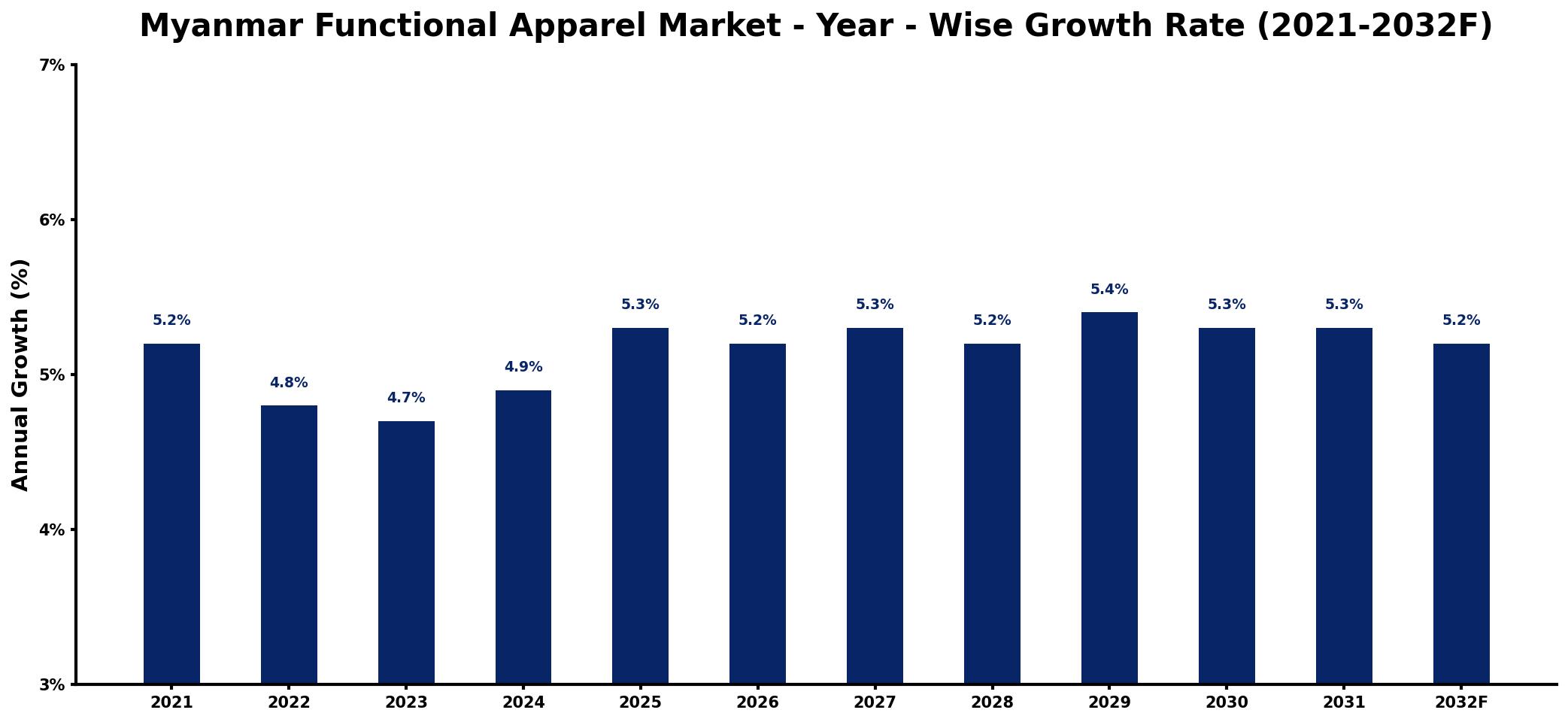
The table below presents the year‑wise growth rates along with the key drivers influencing the market
| Year | Growth Rate | Major Drivers |
| 2021 | 5.2% | Increased health awareness initiatives |
| 2022 | 4.8% | Rising outdoor activity participation |
| 2023 | 4.7% | Growing e-commerce distribution channels |
| 2024 | 4.9% | Expansion of fitness industry investments |
| 2025 | 5.3% | Emergence of sustainable manufacturing practices |
| 2026 | 5.2% | Increased urban lifestyle trends |
| 2027 | 5.3% | Development of advanced textile technology |
| 2028 | 5.2% | Rising demand for versatile clothing |
| 2029 | 5.4% | Growth in wellness tourism sector |
| 2030 | 5.3% | Increase in youth fitness programs |
| 2031 | 5.3% | strengthening underlying market demand |
| 2032 | 5.2% | Growing influence of social media |
Note: Market size estimations and growth projections presented in this report are based on 6Wresearch's proprietary forecasting methodology, utilizing the latest available industry data, government publications, and primary research inputs.
Myanmar Functional Apparel Market Synopsis
The Myanmar Functional Apparel Market has experienced recent momentum, fueled by evolving consumer preferences and a heightened focus on health-conscious lifestyles. However, as the market progresses, it is poised for further evolution, driven by innovation in fabric technologies and a broader acceptance of functional clothing across diverse demographics.
While the current demand reflects a growing interest in performance-oriented clothing, challenges such as consumer education and access to quality materials remain. As manufacturers address these issues and emphasize the benefits of functional apparel, the market is set to expand, catering to a more informed and diverse consumer base.
Myanmar Functional Apparel Market Key Takeaways
- The market is projected to grow from USD 245 Million in 2025 to USD 331 Million by 2032.
- Health and wellness trends are significantly influencing consumer choices in apparel.
- Functional fabrics are gaining traction across various categories, including sports, outdoor, and workwear.
- Consumer education is essential for increasing adoption rates of functional apparel.
- Government policies are in place to support the growth and competitiveness of the functional apparel sector.
Evaluation of Restraints in Myanmar Functional Apparel Market
Despite the potential for growth, the Myanmar Functional Apparel Market faces certain restraints that could impede its progress. A notable challenge is the limited consumer awareness regarding the specific advantages of functional apparel, which may lead to hesitance in adopting these products. Additionally, sourcing high-quality, specialized fabrics presents logistical challenges for manufacturers, potentially affecting the production capabilities and overall market supply. Furthermore, competitive pricing from traditional apparel may detract consumers from exploring functional options, necessitating strategic initiatives to elevate market penetration.
Myanmar Functional Apparel Market Trends
Current trends in the Myanmar Functional Apparel Market highlight a growing preference for sustainable and eco-friendly materials. Consumers are increasingly seeking apparel that not only meets performance standards but also aligns with environmentally responsible practices. Furthermore, advancements in textile technology are leading to the development of more efficient, durable, and versatile fabrics that enhance the functional properties of clothing.
Additionally, the rise of athleisure—a blending of athletic and leisurewear—is reshaping the landscape, prompting brands to innovate and cater to consumers who desire functionality without sacrificing style. This convergence of fashion and function is reshaping purchasing decisions and driving the demand for multi-purpose apparel.
Myanmar Functional Apparel Market Opportunities
Opportunities within the Myanmar Functional Apparel Market abound, particularly for brands that can effectively communicate the benefits of their products. As the trend toward health-conscious lifestyles continues to rise, companies that innovate in the realm of functional textiles stand to capture significant market share. Additionally, expanding into niche markets such as specific sports or outdoor activities offers potential for growth, as consumers seek tailored solutions that meet their unique needs.
Moreover, forging strategic partnerships with retailers and e-commerce platforms can facilitate better market reach and consumer engagement. The focus on educating consumers through marketing campaigns that highlight the practical benefits of functional apparel could further drive adoption and elevate brand loyalty.
Government Initiatives in the Myanmar Functional Apparel Market
To stimulate growth in the functional apparel sector, the Myanmar government has implemented supportive policies aimed at advancing the textile industry. These initiatives include development programs tailored for textile manufacturing, as well as research and development grants aimed at fostering innovation in apparel technology. Furthermore, efforts to promote the local manufacturing of functional garments are underway, enhancing both market competitiveness and export potential.
Future Insights of the Myanmar Functional Apparel Market
Looking ahead to 2026-2032, the Myanmar Functional Apparel Market is anticipated to undergo significant transformation. The increasing fusion of technology and textiles will likely lead to the introduction of smart fabrics that offer advanced functionalities such as temperature regulation and enhanced moisture management. As consumer education improves and awareness of the benefits of functional apparel rises, market penetration is expected to increase, paving the way for a more competitive landscape.
Myanmar Functional Apparel Market Latest Developments (2025 - 2026)
Recent developments in the Myanmar Functional Apparel Market have focused on enhancing supply chain efficiencies and improving the quality of functional textiles available. Initiatives aimed at bolstering local production capacities are being explored, with an emphasis on sustainability and performance. Industry stakeholders are also collaborating to share knowledge and best practices, thus fostering an environment conducive to innovation and growth in the functional apparel segment.
Myanmar Functional Apparel Market - Key Attractiveness of the Report
- 10 Years of Market Numbers
- Historical Data Starting from 2022 to 2025
- Base Year: 2025
- Forecast Data until 2032
- Key Performance Indicators Impacting the Market
- Major Upcoming Developments and Projects
Key Highlights of the Report:
- Myanmar Functional Apparel Market Outlook
- Market Size of Myanmar Functional Apparel Market, 2025
- Forecast of Myanmar Functional Apparel Market, 2032
- Historical Data and Forecast of Myanmar Functional Apparel Revenues & Volume for the Period 2022-2032F
- Myanmar Functional Apparel Market Trend Evolution
- Myanmar Functional Apparel Market Drivers and Challenges
- Myanmar Functional Apparel Price Trends
- Myanmar Functional Apparel Porter's Five Forces
- Myanmar Functional Apparel Industry Life Cycle
- Historical Data and Forecast of Myanmar Functional Apparel Market Revenues & Volume By Product Type for the Period 2022-2032F
- Historical Data and Forecast of Myanmar Functional Apparel Market Revenues & Volume By Sportswear for the Period 2022-2032F
- Historical Data and Forecast of Myanmar Functional Apparel Market Revenues & Volume By Activewear for the Period 2022-2032F
- Historical Data and Forecast of Myanmar Functional Apparel Market Revenues & Volume By Protective Clothing for the Period 2022-2032F
- Historical Data and Forecast of Myanmar Functional Apparel Market Revenues & Volume By Others for the Period 2022-2032F
- Historical Data and Forecast of Myanmar Functional Apparel Market Revenues & Volume By Application for the Period 2022-2032F
- Historical Data and Forecast of Myanmar Functional Apparel Market Revenues & Volume By Sports Industry for the Period 2022-2032F
- Historical Data and Forecast of Myanmar Functional Apparel Market Revenues & Volume By Outdoor Clothing for the Period 2022-2032F
- Historical Data and Forecast of Myanmar Functional Apparel Market Revenues & Volume By Healthcare sector for the Period 2022-2032F
- Historical Data and Forecast of Myanmar Functional Apparel Market Revenues & Volume By Distribution Channel for the Period 2022-2032F
- Historical Data and Forecast of Myanmar Functional Apparel Market Revenues & Volume By Offline Store for the Period 2022-2032F
- Historical Data and Forecast of Myanmar Functional Apparel Market Revenues & Volume By Online Store for the Period 2022-2032F
- Myanmar Functional Apparel Import Export Trade Statistics
- Market Opportunity Assessment By Product Type
- Market Opportunity Assessment By Application
- Market Opportunity Assessment By Distribution Channel
- Myanmar Functional Apparel Top Companies Market Share
- Myanmar Functional Apparel Competitive Benchmarking By Technical and Operational Parameters
- Myanmar Functional Apparel Company Profiles
- Myanmar Functional Apparel Key Strategic Recommendations






































