Myanmar Gas Sensors Market Size, Share & Growth Rate
The Myanmar Gas Sensors Market was estimated at USD 483 Million in 2025 and is projected to reach USD 674 Million by 2032, growing at a CAGR of 4.9% from 2026 to 2032. This growth trajectory is fueled by heightened awareness of air quality and safety in sectors such as oil & gas, chemicals, and automotive. As industries increasingly prioritize regulatory compliance and workplace safety, the demand for advanced gas sensing technologies is surging, promising a vibrant market landscape.
Myanmar Gas Sensors Market Year-wise Growth Rate and Key Drivers
This graph highlights how the Myanmar Gas Sensors Market has steadily grown over the years, supported by major growth factors.
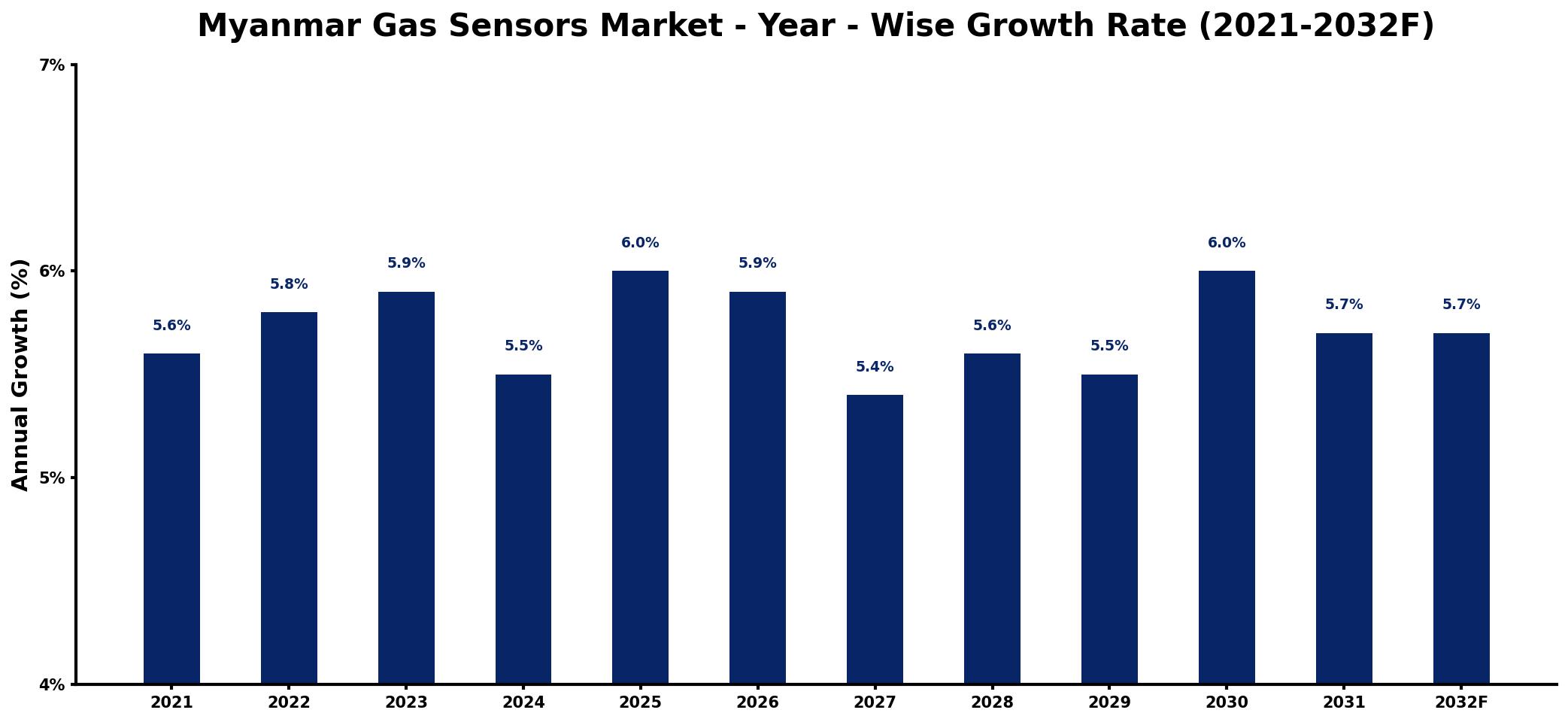
The table below presents the year‑wise growth rates along with the key drivers influencing the market
| Year | Growth Rate | Major Drivers |
| 2021 | 5.6% | Increase in industrial safety regulations |
| 2022 | 5.8% | Rising environmental protection initiatives |
| 2023 | 5.9% | Growth in energy sector investments |
| 2024 | 5.5% | Expansion of urban infrastructure projects |
| 2025 | 6.0% | Advancements in monitoring technologies |
| 2026 | 5.9% | Increased public health awareness campaigns |
| 2027 | 5.4% | Surge in renewable energy adoption |
| 2028 | 5.6% | Growth of manufacturing sector demand |
| 2029 | 5.5% | rising end-use demand growth |
| 2030 | 6.0% | Rising demand for workplace safety |
| 2031 | 5.7% | Increased focus on pollution control |
| 2032 | 5.7% | growing automotive sector requirements |
Note: Market size estimations and growth projections presented in this report are based on 6Wresearch's proprietary forecasting methodology, utilizing the latest available industry data, government publications, and primary research inputs.
Myanmar Gas Sensors Market Synopsis
In Myanmar, the rising focus on environmental concerns and workplace safety has catalyzed the demand for gas sensors across various sectors. Industries such as oil & gas and automotive are particularly pushing for real-time air quality monitoring and toxic gas detection systems to mitigate risks associated with hazardous substances.
As the government strengthens regulations around air quality and safety standards, manufacturers and industrial players are investing in advanced sensor technologies. This includes IoT-enabled devices that facilitate remote monitoring and enhanced data analytics, positioning them to respond swiftly to potential environmental hazards.
Myanmar Gas Sensors Market Key Takeaways
- The Myanmar gas sensors market is driven by increasing safety regulations and environmental awareness across multiple industries.
- Technological advancements, particularly in IoT integration, are enhancing the capabilities of gas sensors for real-time monitoring.
- Government initiatives are aimed at promoting advanced gas sensing technologies, encouraging investment and infrastructure development.
- While challenges remain, such as infrastructure limitations and awareness, the market is set for substantial growth with emerging opportunities.
- Investment in tailored solutions for specific industrial applications is becoming a key focus for stakeholders in the market.
Evaluation of Restraints in Myanmar Gas Sensors Market
Despite the optimistic outlook, the Myanmar gas sensors market grapples with significant hurdles. A prevalent lack of awareness among end-users about the benefits and functionalities of advanced gas sensing technologies hampers adoption rates. Furthermore, inadequate infrastructure for sensor calibration and maintenance limits the effectiveness of these devices. Coupled with the presence of low-cost alternatives, this environment poses a challenge for companies looking to establish themselves in a burgeoning market. Political instability and economic uncertainties also play a role in curtailing investment and innovation, creating a cautious landscape for market players.
Myanmar Gas Sensors Market Trends
Key trends influencing the Myanmar gas sensors market include the integration of smart technologies and a significant push towards compliance with environmental standards. Industries are increasingly leaning towards IoT-enabled sensors, which offer real-time monitoring capabilities and data-driven insights. This shift not only improves safety but also enhances operational efficiency. Moreover, partnerships between local enterprises and international technology providers are becoming more common, aiming to leverage expertise and foster innovation.
Myanmar Gas Sensors Market Opportunities
Opportunities for investment within the Myanmar gas sensors market abound, particularly in response to the country's increasing focus on industrial safety and environmental compliance. With a growing demand for sophisticated monitoring solutions in sectors such as mining and manufacturing, investments in advanced sensor technologies that provide accurate, real-time data are likely to yield considerable returns. Additionally, the governments initiatives to attract foreign investment and develop necessary infrastructure underscore the potential for a robust market ecosystem.
Government Initiatives in the Myanmar Gas Sensors Market
The Myanmar government is actively working to bolster the gas sensors market by implementing policies that support the development of advanced technologies. These initiatives include providing incentives for local businesses to adopt innovative solutions aimed at improving air quality and ensuring industrial safety. Regulatory frameworks are also being established to ensure the reliability of gas sensor products, promoting collaboration between local and international stakeholders to enhance the capabilities of the domestic industry.
Future Insights of the Myanmar Gas Sensors Market
Looking ahead to 2026-2032, the Myanmar gas sensors market is anticipated to witness substantial growth, driven by ongoing industrialization and heightened awareness of safety and environmental standards. The expansion of gas sensors in sectors such as oil and gas, chemicals, and automotive is expected to accelerate as companies prioritize compliance and worker safety. Innovations in sensor technology, including miniaturization and IoT integration, are likely to open new avenues for market expansion, paving the way for a more secure and sustainable industrial landscape.
Myanmar Gas Sensors Market Latest Developments (2025 - 2026)
Recent developments within the Myanmar gas sensors market indicate a trend toward increased collaboration between local manufacturers and international technology firms. Such partnerships are fostering innovation and improving access to advanced sensor technologies. Additionally, a number of workshops and training sessions aimed at enhancing technical expertise in gas sensing have been initiated, addressing the skills gap within the sector and encouraging wider adoption of state-of-the-art technologies.
Myanmar Gas Sensors Market - Key Attractiveness of the Report
- 10 Years of Market Numbers
- Historical Data Starting from 2022 to 2025
- Base Year: 2025
- Forecast Data until 2032
- Key Performance Indicators Impacting the Market
- Major Upcoming Developments and Projects
Key Highlights of the Report:
- Myanmar Gas Sensors Market Outlook
- Market Size of Myanmar Gas Sensors Market, 2025
- Forecast of Myanmar Gas Sensors Market, 2032
- Historical Data and Forecast of Myanmar Gas Sensors Revenues & Volume for the Period 2022-2032F
- Myanmar Gas Sensors Market Trend Evolution
- Myanmar Gas Sensors Market Drivers and Challenges
- Myanmar Gas Sensors Price Trends
- Myanmar Gas Sensors Porter's Five Forces
- Myanmar Gas Sensors Industry Life Cycle
- Historical Data and Forecast of Myanmar Gas Sensors Market Revenues & Volume By Product for the Period 2022-2032F
- Historical Data and Forecast of Myanmar Gas Sensors Market Revenues & Volume By Hydrogen for the Period 2022-2032F
- Historical Data and Forecast of Myanmar Gas Sensors Market Revenues & Volume By Ammonia for the Period 2022-2032F
- Historical Data and Forecast of Myanmar Gas Sensors Market Revenues & Volume By Hydrogen Sulfide for the Period 2022-2032F
- Historical Data and Forecast of Myanmar Gas Sensors Market Revenues & Volume By Methyl Mercaptan Sensor for the Period 2022-2032F
- Historical Data and Forecast of Myanmar Gas Sensors Market Revenues & Volume By NOx Sensor for the Period 2022-2032F
- Historical Data and Forecast of Myanmar Gas Sensors Market Revenues & Volume By Carbon Monoxide Sensor for the Period 2022-2032F
- Historical Data and Forecast of Myanmar Gas Sensors Market Revenues & Volume By Carbon Dioxide Sensor for the Period 2022-2032F
- Historical Data and Forecast of Myanmar Hydrogen Gas Sensors Market Revenues & Volume By Oxygen/Lambda Sensor for the Period 2022-2032F
- Historical Data and Forecast of Myanmar Gas Sensors Market Revenues & Volume By Technology for the Period 2022-2032F
- Historical Data and Forecast of Myanmar Gas Sensors Market Revenues & Volume By Infrared for the Period 2022-2032F
- Historical Data and Forecast of Myanmar Gas Sensors Market Revenues & Volume By Catalytic for the Period 2022-2032F
- Historical Data and Forecast of Myanmar Gas Sensors Market Revenues & Volume By Photo-Ionization Detector for the Period 2022-2032F
- Historical Data and Forecast of Myanmar Gas Sensors Market Revenues & Volume By Solid State/MOS for the Period 2022-2032F
- Historical Data and Forecast of Myanmar Gas Sensors Market Revenues & Volume By Semiconductor for the Period 2022-2032F
- Historical Data and Forecast of Myanmar Gas Sensors Market Revenues & Volume By Electrochemical for the Period 2022-2032F
- Myanmar Gas Sensors Import Export Trade Statistics
- Market Opportunity Assessment By Product
- Market Opportunity Assessment By Technology
- Myanmar Gas Sensors Top Companies Market Share
- Myanmar Gas Sensors Competitive Benchmarking By Technical and Operational Parameters
- Myanmar Gas Sensors Company Profiles
- Myanmar Gas Sensors Key Strategic Recommendations






































