Myanmar Generator Market Size Growth Rate
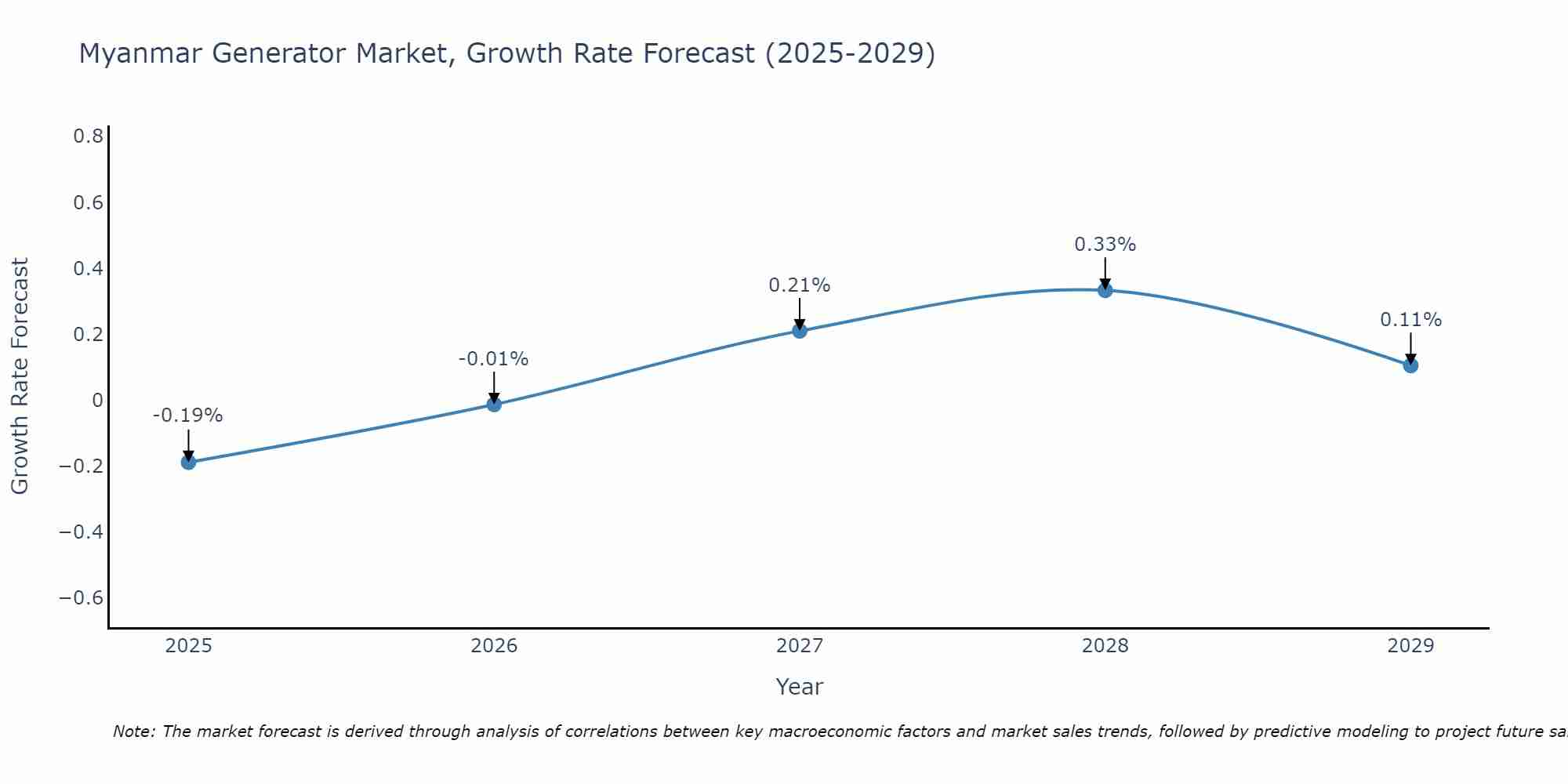
The Myanmar Generator Market is projected to witness mixed growth rate patterns during 2025 to 2029. Growth accelerates to 0.33% in 2028, following an initial rate of -0.19%, before easing to 0.11% at the end of the period.
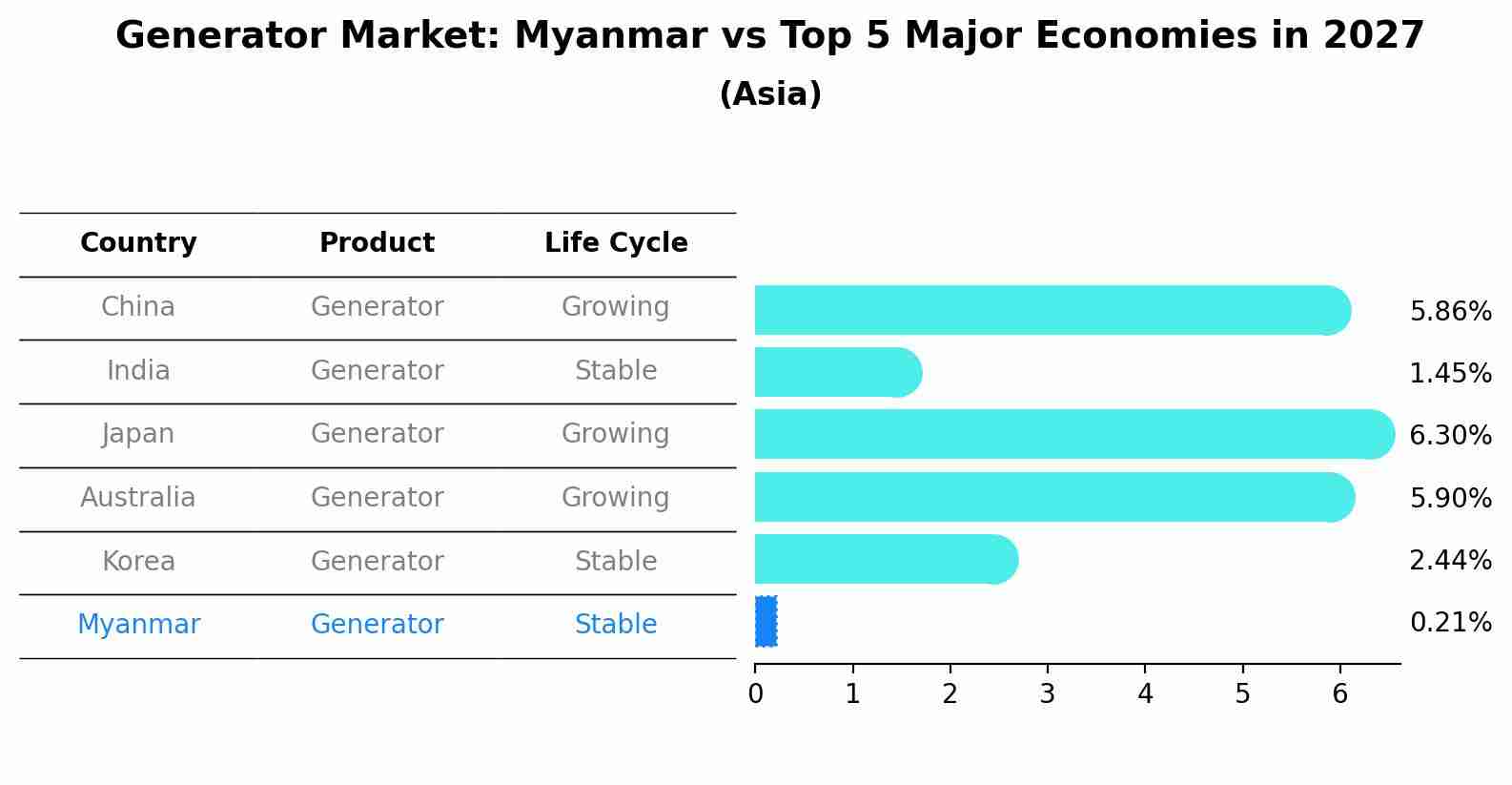
Generator Market: Myanmar vs Top 5 Major Economies in 2027 (Asia)
The Generator market in Myanmar is projected to grow at a stable growth rate of 0.21% by 2027, highlighting the country's increasing focus on advanced technologies within the Asia region, where China holds the dominant position, followed closely by India, Japan, Australia and South Korea, shaping overall regional demand.
Myanmar Generator Market Synopsis
The Myanmar generator market is experiencing steady growth driven by factors such as unreliable grid infrastructure, frequent power outages, and increasing demand for electricity in both urban and rural areas. Diesel generators are the most commonly used type due to their affordability and ease of maintenance. The market is characterized by a mix of local and international players offering a range of generator capacities to cater to various customer needs. Key trends in the market include a shift towards more environmentally friendly options such as hybrid and solar-powered generators. Government initiatives to improve power supply and infrastructure development projects are expected to further boost the generator market in Myanmar in the coming years.
Myanmar Generator Market Trends
The Myanmar generator market is experiencing growth due to increasing demand for reliable power sources in the face of frequent power outages. Key trends in the market include a shift towards more environmentally friendly generators such as solar-powered and hybrid models, driven by a growing awareness of sustainability and renewable energy sources. Additionally, there is a growing preference for portable and compact generators in Myanmar, especially in rural areas where access to electricity is limited. The market is also witnessing a rise in the adoption of digital monitoring and remote control features in generators, enhancing convenience and efficiency for users. Overall, the Myanmar generator market is evolving towards more sustainable and innovative solutions to meet the country`s diverse power needs.
Myanmar Generator Market Challenges
In the Myanmar generator market, one of the key challenges is the unreliable power grid infrastructure, leading to frequent power outages and voltage fluctuations. This creates a strong demand for backup power solutions, such as generators, but also poses challenges in terms of supply chain disruptions and high operating costs for businesses and consumers. Additionally, the lack of consistent government policies and regulations related to the generator market can create uncertainty for investors and hinder market growth. Furthermore, the availability of low-quality and counterfeit generator products in the market poses a risk to consumers in terms of performance and safety. Overall, improving grid reliability, implementing effective regulations, and ensuring product quality control are crucial steps to address these challenges in the Myanmar generator market.
Myanmar Generator Market Investment Opportunities
In the Myanmar generator market, there are promising investment opportunities due to the country`s growing demand for reliable power supply in both urban and rural areas. With frequent power outages and an expanding economy, there is a need for backup power solutions, creating a potential market for generators of various sizes and types. Investing in distributing and servicing generators, especially those powered by diesel or renewable energy sources, could be lucrative. Additionally, exploring opportunities in providing rental services for generators to businesses and events could be a profitable venture. Partnering with local businesses or government agencies to address the power supply challenges in Myanmar could also lead to long-term investment returns in the generator market.
Jordan Agar Market Government Policies
The Myanmar government has implemented policies aimed at promoting the use of renewable energy sources, including solar and hydropower, to reduce reliance on traditional generators in the market. The government has also introduced incentives and subsidies for businesses and households to transition to cleaner energy options, with a focus on improving access to electricity in rural areas. Additionally, there are regulations in place to ensure the safety and efficiency of generators being used in the market, with an emphasis on environmental sustainability. Overall, the government`s policies aim to drive the adoption of more sustainable and efficient energy solutions in Myanmar`s generator market.
Myanmar Generator Market Future Outlook
The future outlook for the Myanmar Generator Market appears promising due to increasing demand for reliable power supply in the country. Factors such as rapid urbanization, industrial growth, and the expansion of the telecommunications sector are expected to drive the market growth. Additionally, the government`s initiatives to improve infrastructure and electrification in rural areas will further boost the demand for generators. The market is likely to witness a shift towards more fuel-efficient and environmentally friendly generator solutions, such as solar-powered and hybrid generators. Overall, the Myanmar Generator Market is anticipated to experience steady growth in the coming years as businesses and households continue to invest in backup power solutions to mitigate the impact of frequent power outages in the country.
Key Highlights of the Report:
- Myanmar Generator Market Outlook
- Market Size of Myanmar Generator Market, 2021
- Forecast of Myanmar Generator Market, 2031
- Historical Data and Forecast of Myanmar Generator Revenues & Volume for the Period 2018 - 2031
- Myanmar Generator Market Trend Evolution
- Myanmar Generator Market Drivers and Challenges
- Myanmar Generator Price Trends
- Myanmar Generator Porter's Five Forces
- Myanmar Generator Industry Life Cycle
- Historical Data and Forecast of Myanmar Generator Market Revenues & Volume By Application for the Period 2018 - 2031
- Historical Data and Forecast of Myanmar Generator Market Revenues & Volume By Stationary Generators for the Period 2018 - 2031
- Historical Data and Forecast of Myanmar Generator Market Revenues & Volume By Portable Generators for the Period 2018 - 2031
- Historical Data and Forecast of Myanmar Generator Market Revenues & Volume By Fuel for the Period 2018 - 2031
- Historical Data and Forecast of Myanmar Generator Market Revenues & Volume By Diesel Generators for the Period 2018 - 2031
- Historical Data and Forecast of Myanmar Generator Market Revenues & Volume By Gas Generators for the Period 2018 - 2031
- Historical Data and Forecast of Myanmar Generator Market Revenues & Volume By End Use for the Period 2018 - 2031
- Historical Data and Forecast of Myanmar Generator Market Revenues & Volume By Residential Generators for the Period 2018 - 2031
- Historical Data and Forecast of Myanmar Generator Market Revenues & Volume By Commercial Generators for the Period 2018 - 2031
- Historical Data and Forecast of Myanmar Generator Market Revenues & Volume By Industrial Generators for the Period 2018 - 2031
- Historical Data and Forecast of Myanmar Generator Market Revenues & Volume By Others for the Period 2018 - 2031
- Historical Data and Forecast of Myanmar Generator Market Revenues & Volume By Capacity for the Period 2018 - 2031
- Historical Data and Forecast of Myanmar Generator Market Revenues & Volume By 0-100 kVA for the Period 2018 - 2031
- Historical Data and Forecast of Myanmar Generator Market Revenues & Volume By 100-350 kVA for the Period 2018 - 2031
- Historical Data and Forecast of Myanmar Generator Market Revenues & Volume By 350-1000kVA for the Period 2018 - 2031
- Historical Data and Forecast of Myanmar Generator Market Revenues & Volume By Above 1000kVA for the Period 2018 - 2031
- Myanmar Generator Import Export Trade Statistics
- Market Opportunity Assessment By Application
- Market Opportunity Assessment By Fuel
- Market Opportunity Assessment By End Use
- Market Opportunity Assessment By Capacity
- Myanmar Generator Top Companies Market Share
- Myanmar Generator Competitive Benchmarking By Technical and Operational Parameters
- Myanmar Generator Company Profiles
- Myanmar Generator Key Strategic Recommendations






































