Myanmar IPTV Market Size, Share & Growth Rate
The Myanmar IPTV Market was estimated at USD 487 Million in 2025 and is projected to reach USD 684 Million by 2032, growing at a CAGR of 5.0% from 2026 to 2032. This growth trajectory reflects an increasing appetite for diverse multimedia content, spurred by the expanding broadband infrastructure and a growing preference for internet-based television services among consumers. As disposable incomes rise and internet penetration deepens, more households and businesses are turning to IPTV solutions, further catalyzing market expansion.
Myanmar IPTV Market Year-wise Growth Rate and Key Drivers
This graph highlights how the Myanmar IPTV Market has steadily grown over the years, supported by major growth factors.
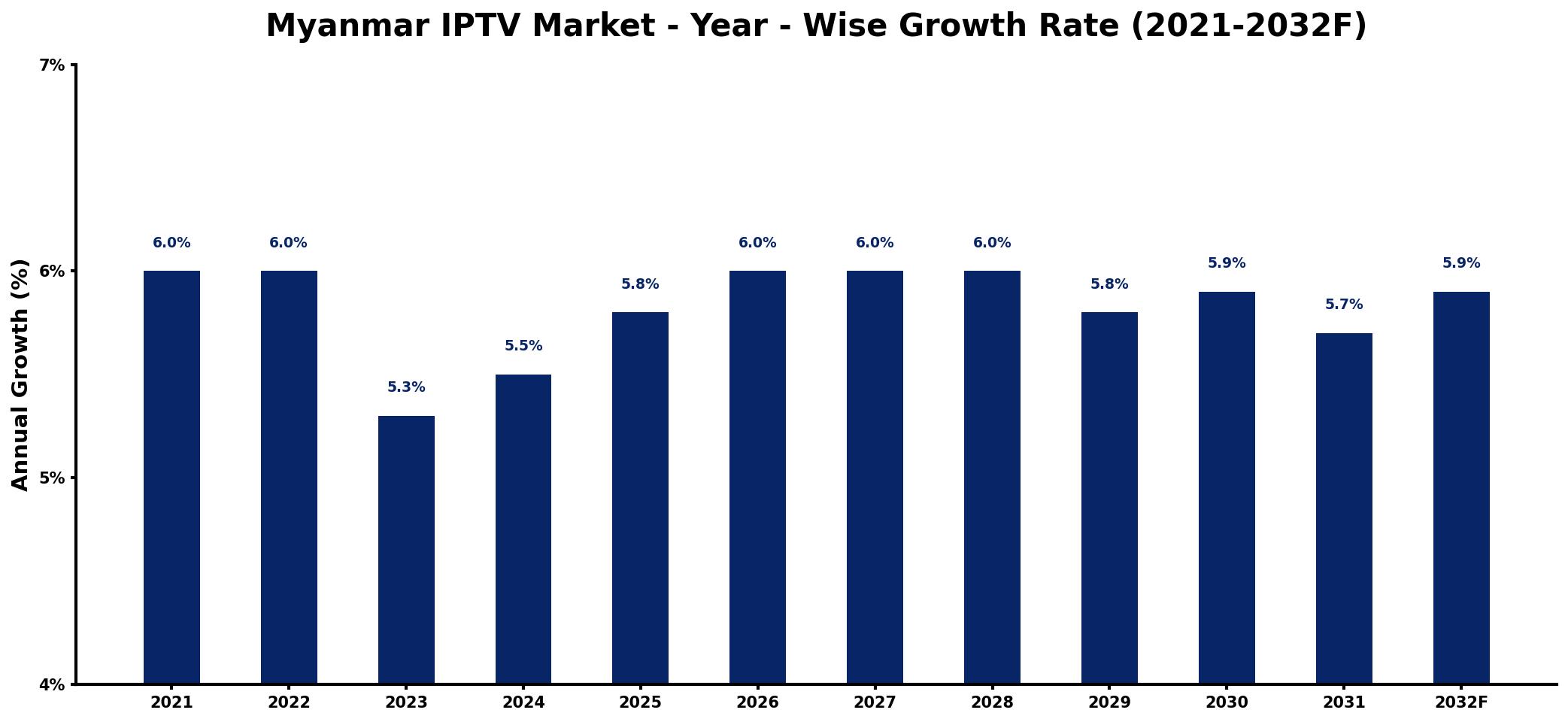
The table below presents the year‑wise growth rates along with the key drivers influencing the market
| Year | Growth Rate | Major Drivers |
| 2021 | 6.0% | Rise in digital content consumption |
| 2022 | 6.0% | Increased smartphone penetration rates |
| 2023 | 5.3% | Growth of internet infrastructure investments |
| 2024 | 5.5% | Expansion of local content production |
| 2025 | 5.8% | Higher disposable income levels |
| 2026 | 6.0% | Emergence of competitive pricing models |
| 2027 | 6.0% | Adoption of advanced streaming technologies |
| 2028 | 6.0% | Diversification of content offerings |
| 2029 | 5.8% | Increase in subscription-based services |
| 2030 | 5.9% | Rising demand for live streaming |
| 2031 | 5.7% | Boost in regional partnerships collaborations |
| 2032 | 5.9% | Enhanced user experience innovations |
Note: Market size estimations and growth projections presented in this report are based on 6Wresearch's proprietary forecasting methodology, utilizing the latest available industry data, government publications, and primary research inputs.
Myanmar IPTV Market Synopsis
The Myanmar IPTV market is currently experiencing significant momentum, with an increasing number of providers stepping in to meet the evolving needs of consumers. However, the trajectory is not without its challenges as the market transitions from traditional television models to more dynamic IPTV offerings.
Looking ahead, the market is set for a transformational period, driven by technological advancements and innovative content solutions. The ongoing shift in consumer preferences towards on-demand and personalized viewing experiences will undoubtedly shape the landscape of IPTV services in Myanmar.
Myanmar IPTV Market Key Takeaways
- IPTV services are becoming increasingly popular, driven by rising internet penetration and changing consumer preferences.
- Strategic partnerships between telecom operators and content providers are fostering innovation within the market.
- The market faces technological infrastructure challenges, impacting growth in less connected regions.
- Government policies are favorable, promoting competition and accessibility in the IPTV sector.
- Ongoing investments in digital rights management are necessary to address content piracy and enhance service compliance.
Evaluation of Restraints in Myanmar IPTV Market
Despite the positive growth outlook, the Myanmar IPTV market grapples with significant constraints. Chief among these are the technological infrastructure limitations, particularly in rural and underserved areas where high-speed internet access remains sporadic. These gaps hinder broader market penetration and subscriber growth. Additionally, issues surrounding content licensing and copyright compliance add another layer of complexity, as providers must navigate a landscape fraught with regulatory scrutiny and potential legal challenges. The need for robust digital rights management solutions also weighs heavily on operators seeking to expand their service offerings effectively.
Myanmar IPTV Market Trends
Several current trends are shaping the Myanmar IPTV landscape. The increasing popularity of video-on-demand services underscores a shift towards personalized viewing experiences. Additionally, advancements in streaming technologies are enhancing the quality and reliability of IPTV services, leading to higher customer satisfaction. Social media integration and interactive features are gaining traction, further enriching the user experience. As more consumers embrace mobile devices for content consumption, there is a notable trend towards mobile-friendly IPTV solutions.
Myanmar IPTV Market Opportunities
The Myanmar IPTV market presents several compelling opportunities for investment and growth. As broadband infrastructure continues to develop, particularly in rural areas, operators can tap into new customer bases eager for reliable entertainment solutions. There is also a substantial opportunity to create localized content that resonates with diverse cultural demographics within the country. Furthermore, as regulatory frameworks evolve, collaborations with content creators and technology vendors can yield innovative solutions that address current challenges while enhancing service offerings.
Government Initiatives in the Myanmar IPTV Market
The Myanmar government is actively working to bolster the IPTV market through supportive policies aimed at enhancing digital access. Initiatives focus on fostering competition within the sector and incentivizing investments in infrastructure development. Measures are being implemented to encourage local content creation and distribution, ensuring that diverse media is readily available to the public. These government efforts are crucial in creating a robust framework for the growth and sustainability of IPTV services throughout the country.
Future Insights of the Myanmar IPTV Market
Between 2026 and 2032, the Myanmar IPTV market is anticipated to evolve significantly. A combination of increased internet access, technological innovations, and changing consumer habits will define this period. As providers strive to meet the demand for high-quality, personalized content, we expect to see a rise in user engagement and service diversification. Investments in infrastructure will play a pivotal role in shaping market dynamics, while content licensing and regulatory compliance will remain central to operational strategies.
Myanmar IPTV Market Latest Developments (2025 - 2026)
The Myanmar IPTV market is witnessing an array of dynamic developments aimed at improving service offerings and subscriber acquisition. New entrants are launching innovative packages designed to attract a diverse customer base, while established players are enhancing their content libraries to include a wider range of local and international programming. Advances in technology are enabling smoother streaming experiences and higher quality video delivery, further bolstering user satisfaction and retention rates.
Myanmar IPTV Market - Key Attractiveness of the Report
- 10 Years of Market Numbers
- Historical Data Starting from 2022 to 2025
- Base Year: 2025
- Forecast Data until 2032
- Key Performance Indicators Impacting the Market
- Major Upcoming Developments and Projects
Key Highlights of the Report:
- Myanmar IPTV Market Outlook
- Market Size of Myanmar IPTV Market, 2025
- Forecast of Myanmar IPTV Market, 2032
- Historical Data and Forecast of Myanmar IPTV Revenues & Volume for the Period 2022-2032F
- Myanmar IPTV Market Trend Evolution
- Myanmar IPTV Market Drivers and Challenges
- Myanmar IPTV Price Trends
- Myanmar IPTV Porter's Five Forces
- Myanmar IPTV Industry Life Cycle
- Historical Data and Forecast of Myanmar IPTV Market Revenues & Volume By Component for the Period 2022-2032F
- Historical Data and Forecast of Myanmar IPTV Market Revenues & Volume By Hardware (Router, Set-top Box, Receiver, Encoder) for the Period 2022-2032F
- Historical Data and Forecast of Myanmar IPTV Market Revenues & Volume By Services (In-house services, Managed services) for the Period 2022-2032F
- Historical Data and Forecast of Myanmar IPTV Market Revenues & Volume By Software for the Period 2022-2032F
- Historical Data and Forecast of Myanmar IPTV Market Revenues & Volume By Transmission Type for the Period 2022-2032F
- Historical Data and Forecast of Myanmar IPTV Market Revenues & Volume By Wired for the Period 2022-2032F
- Historical Data and Forecast of Myanmar IPTV Market Revenues & Volume By Wireless for the Period 2022-2032F
- Historical Data and Forecast of Myanmar IPTV Market Revenues & Volume By Streaming Type for the Period 2022-2032F
- Historical Data and Forecast of Myanmar IPTV Market Revenues & Volume By Non-Video Television for the Period 2022-2032F
- Historical Data and Forecast of Myanmar IPTV Market Revenues & Volume By Video Television for the Period 2022-2032F
- Historical Data and Forecast of Myanmar IPTV Market Revenues & Volume By Subscription Type for the Period 2022-2032F
- Historical Data and Forecast of Myanmar IPTV Market Revenues & Volume By Subscription-based IPTV for the Period 2022-2032F
- Historical Data and Forecast of Myanmar IPTV Market Revenues & Volume By Subscription free IPTV for the Period 2022-2032F
- Historical Data and Forecast of Myanmar IPTV Market Revenues & Volume By Device Type for the Period 2022-2032F
- Historical Data and Forecast of Myanmar IPTV Market Revenues & Volume By Smartphones and tablets for the Period 2022-2032F
- Historical Data and Forecast of Myanmar IPTV Market Revenues & Volume By Smart TVs for the Period 2022-2032F
- Historical Data and Forecast of Myanmar IPTV Market Revenues & Volume By Desktops and laptops for the Period 2022-2032F
- Historical Data and Forecast of Myanmar IPTV Market Revenues & Volume By Application for the Period 2022-2032F
- Historical Data and Forecast of Myanmar IPTV Market Revenues & Volume By Linear Television for the Period 2022-2032F
- Historical Data and Forecast of Myanmar IPTV Market Revenues & Volume By Non-linear Television for the Period 2022-2032F
- Historical Data and Forecast of Myanmar IPTV Market Revenues & Volume By End User for the Period 2022-2032F
- Historical Data and Forecast of Myanmar IPTV Market Revenues & Volume By SMEs for the Period 2022-2032F
- Historical Data and Forecast of Myanmar IPTV Market Revenues & Volume By Large Enterprises for the Period 2022-2032F
- Historical Data and Forecast of Myanmar IPTV Market Revenues & Volume By Residential customers for the Period 2022-2032F
- Historical Data and Forecast of Myanmar IPTV Market Revenues & Volume By Vertical for the Period 2022-2032F
- Historical Data and Forecast of Myanmar IPTV Market Revenues & Volume By Advertising and marketing for the Period 2022-2032F
- Historical Data and Forecast of Myanmar IPTV Market Revenues & Volume By Media and entertainment for the Period 2022-2032F
- Historical Data and Forecast of Myanmar IPTV Market Revenues & Volume By Gaming for the Period 2022-2032F
- Historical Data and Forecast of Myanmar IPTV Market Revenues & Volume By Online stores for the Period 2022-2032F
- Historical Data and Forecast of Myanmar IPTV Market Revenues & Volume By Telecom and IT for the Period 2022-2032F
- Historical Data and Forecast of Myanmar IPTV Market Revenues & Volume By Healthcare and medical for the Period 2022-2032F
- Historical Data and Forecast of Myanmar IPTV Market Revenues & Volume By Other Verticals (education and manufacturing). for the Period 2022-2032F
- Myanmar IPTV Import Export Trade Statistics
- Market Opportunity Assessment By Component
- Market Opportunity Assessment By Transmission Type
- Market Opportunity Assessment By Streaming Type
- Market Opportunity Assessment By Subscription Type
- Market Opportunity Assessment By Device Type
- Market Opportunity Assessment By Application
- Market Opportunity Assessment By End User
- Market Opportunity Assessment By Vertical
- Myanmar IPTV Top Companies Market Share
- Myanmar IPTV Competitive Benchmarking By Technical and Operational Parameters
- Myanmar IPTV Company Profiles
- Myanmar IPTV Key Strategic Recommendations






































