Myanmar Kegs Market Size Growth Rate
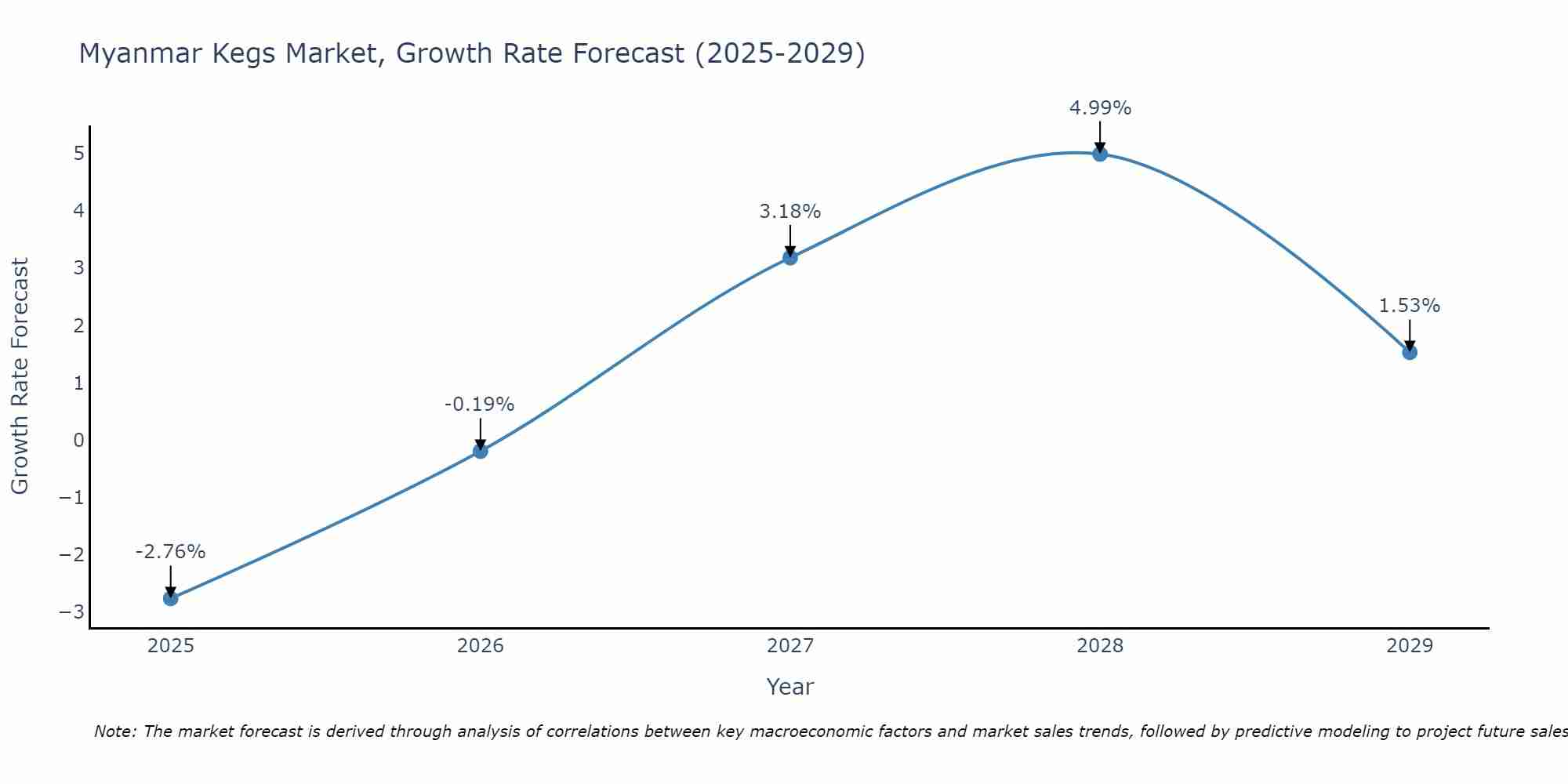
The Myanmar Kegs Market is projected to witness mixed growth rate patterns during 2025 to 2029. Starting at -2.76% in 2025, the market peaks at 4.99% in 2028, and settles at 1.53% by 2029.
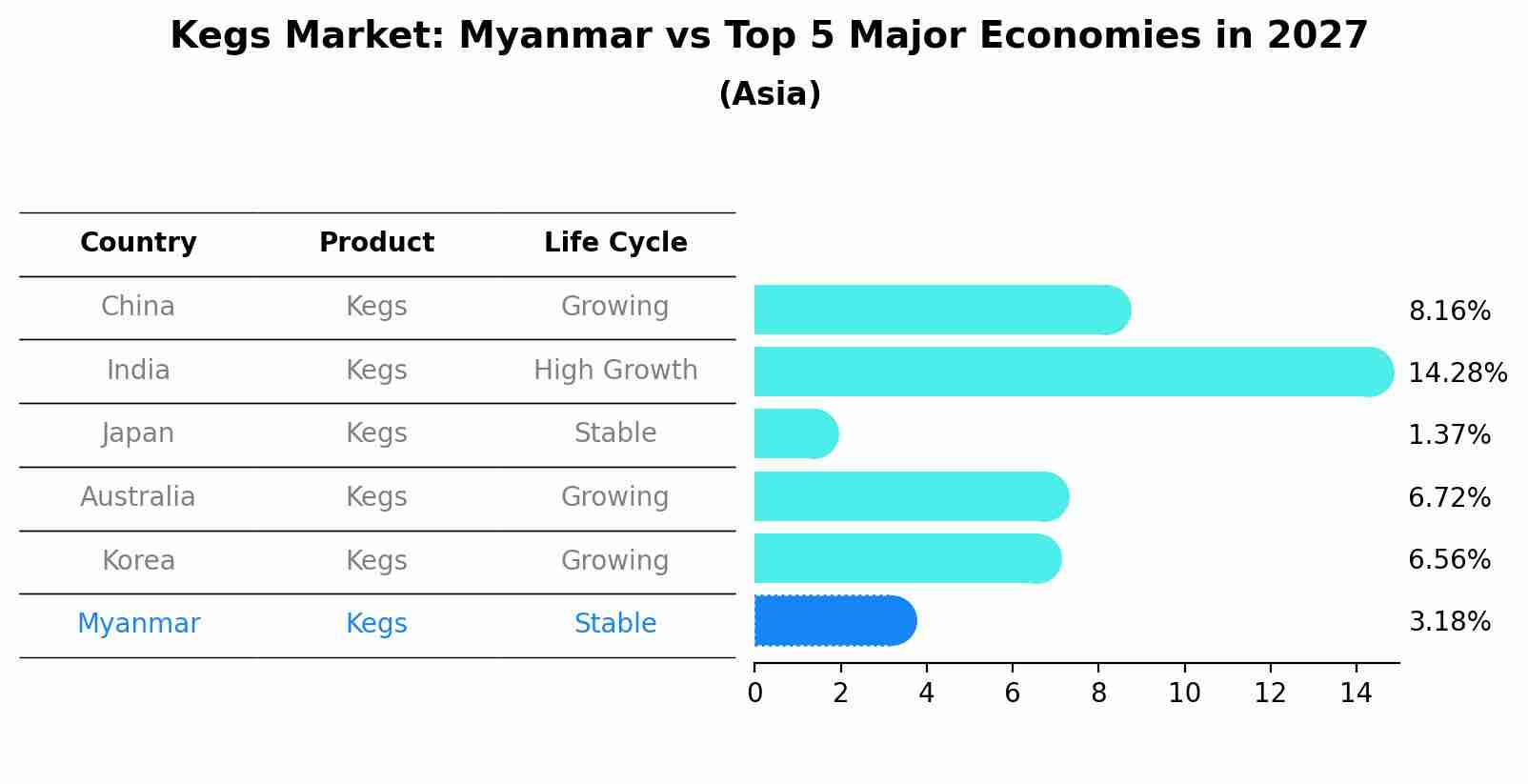
Kegs Market: Myanmar vs Top 5 Major Economies in 2027 (Asia)
Myanmar's Kegs market is anticipated to experience a stable growth rate of 3.18% by 2027, reflecting trends observed in the largest economy China, followed by India, Japan, Australia and South Korea.
Myanmar Kegs Market Overview
The market for kegs in Myanmar is growing, driven by the expanding beverage industry, particularly beer and other alcoholic drinks. Kegs are essential for the storage and transportation of beverages, ensuring freshness and quality. The rise in local breweries and the growing consumption of draft beer are significant contributors to the keg market`s expansion.
Drivers of the market
The beverage industry in Myanmar, particularly the beer and cider segments, fuels the demand for kegs as a packaging solution for bulk distribution and dispensing of alcoholic beverages. Kegs offer advantages such as product freshness, cost efficiency, and reduced environmental impact compared to traditional packaging formats like bottles and cans. Moreover, the growing popularity of craft breweries and the increasing consumption of draft beer in bars, restaurants, and entertainment venues drive the demand for kegs in Myanmar. Additionally, the rise of homebrewing culture and the emergence of beer festivals and events contribute to the expansion of the kegs market in the country.
Challenges of the market
Challenges in the kegs market in Myanmar include limited adoption of kegging technology, concerns over hygiene and sanitation standards, and regulatory constraints on alcohol packaging. Moreover, the dominance of traditional packaging formats like bottles and cans poses obstacles to market penetration.
Government Policy of the market
In line with efforts to promote the beverage industry and reduce environmental impact, the government has implemented policies to support the growth of the kegs market in Myanmar. These policies include incentives for beverage producers to use reusable kegs, regulations to promote recycling and waste management practices, and measures to promote market access and competitiveness for keg manufacturers.
Key Highlights of the Report:
- Myanmar Kegs Market Outlook
- Market Size of Myanmar Kegs Market, 2024
- Forecast of Myanmar Kegs Market, 2031
- Historical Data and Forecast of Myanmar Kegs Revenues & Volume for the Period 2018 - 2031
- Myanmar Kegs Market Trend Evolution
- Myanmar Kegs Market Drivers and Challenges
- Myanmar Kegs Price Trends
- Myanmar Kegs Porter's Five Forces
- Myanmar Kegs Industry Life Cycle
- Historical Data and Forecast of Myanmar Kegs Market Revenues & Volume By Material for the Period 2018 - 2031
- Historical Data and Forecast of Myanmar Kegs Market Revenues & Volume By Plastic for the Period 2018 - 2031
- Historical Data and Forecast of Myanmar Kegs Market Revenues & Volume By Tin for the Period 2018 - 2031
- Historical Data and Forecast of Myanmar Kegs Market Revenues & Volume By Stainless Steel for the Period 2018 - 2031
- Historical Data and Forecast of Myanmar Kegs Market Revenues & Volume By Capacity for the Period 2018 - 2031
- Historical Data and Forecast of Myanmar Kegs Market Revenues & Volume By Up to 20 Liter for the Period 2018 - 2031
- Historical Data and Forecast of Myanmar Kegs Market Revenues & Volume By 20 Liter to 40 Liter for the Period 2018 - 2031
- Historical Data and Forecast of Myanmar Kegs Market Revenues & Volume By 40 Liter to 60 Liter for the Period 2018 - 2031
- Historical Data and Forecast of Myanmar Kegs Market Revenues & Volume By Above 60 Liter for the Period 2018 - 2031
- Historical Data and Forecast of Myanmar Kegs Market Revenues & Volume By End Use for the Period 2018 - 2031
- Historical Data and Forecast of Myanmar Kegs Market Revenues & Volume By Alcoholic Beverages for the Period 2018 - 2031
- Historical Data and Forecast of Myanmar Kegs Market Revenues & Volume By Non-Alcoholic Beverages for the Period 2018 - 2031
- Historical Data and Forecast of Myanmar Kegs Market Revenues & Volume By Cooking Oil for the Period 2018 - 2031
- Historical Data and Forecast of Myanmar Kegs Market Revenues & Volume By Chemicals for the Period 2018 - 2031
- Historical Data and Forecast of Myanmar Kegs Market Revenues & Volume By Others for the Period 2018 - 2031
- Historical Data and Forecast of Myanmar Kegs Market Revenues & Volume By Distribution Channel for the Period 2018 - 2031
- Historical Data and Forecast of Myanmar Kegs Market Revenues & Volume By Supermarket/Hypermarket for the Period 2018 - 2031
- Historical Data and Forecast of Myanmar Kegs Market Revenues & Volume By Commercial Liquor Store for the Period 2018 - 2031
- Historical Data and Forecast of Myanmar Kegs Market Revenues & Volume By Others for the Period 2018 - 2031
- Myanmar Kegs Import Export Trade Statistics
- Market Opportunity Assessment By Material
- Market Opportunity Assessment By Capacity
- Market Opportunity Assessment By End Use
- Market Opportunity Assessment By Distribution Channel
- Myanmar Kegs Top Companies Market Share
- Myanmar Kegs Competitive Benchmarking By Technical and Operational Parameters
- Myanmar Kegs Company Profiles
- Myanmar Kegs Key Strategic Recommendations






































