Myanmar Lithium Fluoride Market Size, Share & Growth Rate
The Myanmar Lithium Fluoride Market was estimated at USD 313 Million in 2025 and is projected to reach USD 416 Million by 2032, growing at a CAGR of 4.1% from 2026 to 2032. This growth trajectory is largely propelled by the increasing adoption of lithium-ion batteries across various sectors, including automotive and renewable energy storage. Additionally, government initiatives aimed at promoting clean energy solutions are providing a substantial boost to investments in this burgeoning market.
Myanmar Lithium Fluoride Market Year-wise Growth Rate and Key Drivers
This graph highlights how the Myanmar Lithium Fluoride Market has steadily grown over the years, supported by major growth factors.
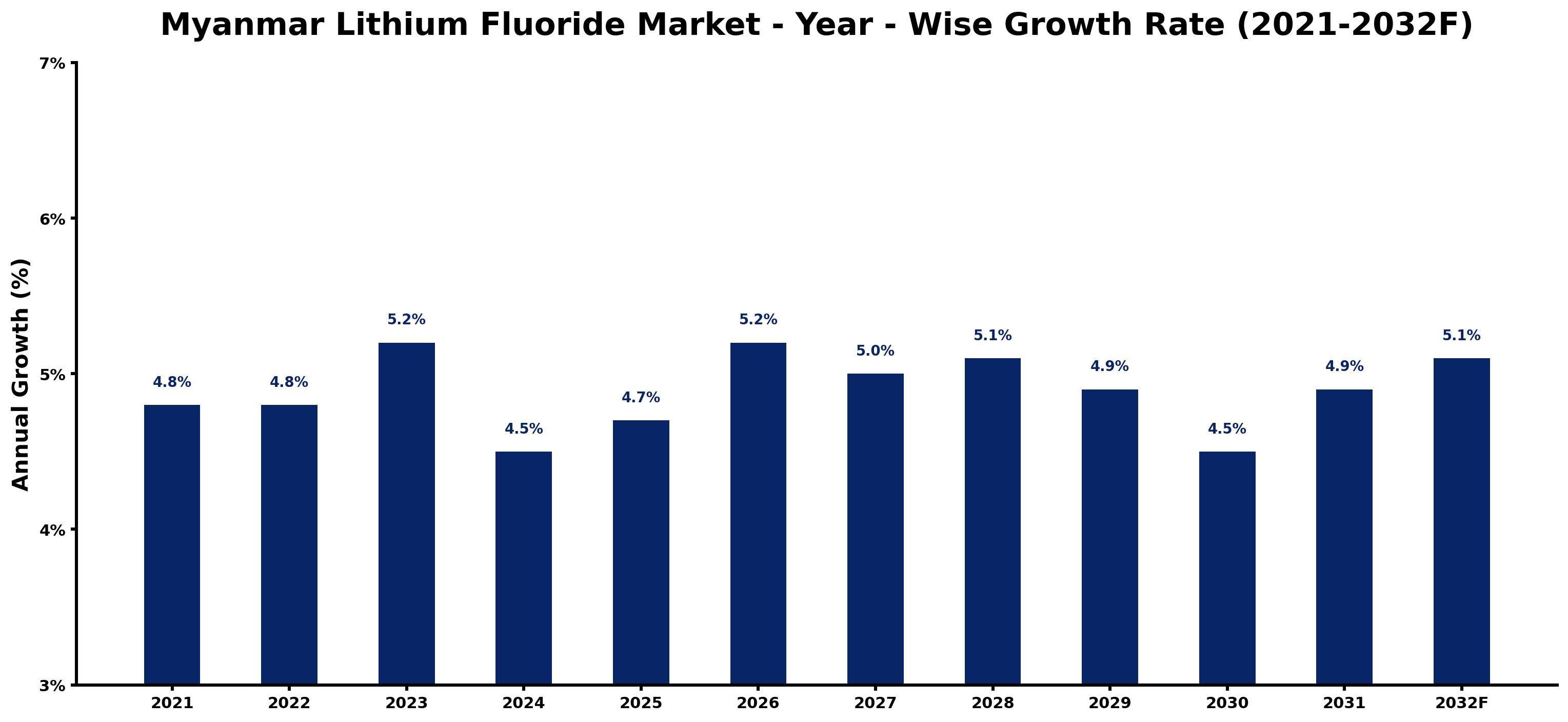
The table below presents the year‑wise growth rates along with the key drivers influencing the market
| Year | Growth Rate | Major Drivers |
| 2021 | 4.8% | Rising demand from battery sector |
| 2022 | 4.8% | Increased investments in renewable energy |
| 2023 | 5.2% | Expansion of electric vehicle market |
| 2024 | 4.5% | Growing consumer electronics production |
| 2025 | 4.7% | Enhanced supply chain capabilities |
| 2026 | 5.2% | Technological advancements in manufacturing |
| 2027 | 5.0% | Higher production capacity announcements |
| 2028 | 5.1% | Emerging markets adopting technologies |
| 2029 | 4.9% | Sustainability initiatives gaining traction |
| 2030 | 4.5% | Government support for innovation |
| 2031 | 4.9% | Strengthened global trade partnerships |
| 2032 | 5.1% | Rising interest in energy storage |
Note: Market size estimations and growth projections presented in this report are based on 6Wresearch's proprietary forecasting methodology, utilizing the latest available industry data, government publications, and primary research inputs.
Myanmar Lithium Fluoride Market Synopsis
In recent years, the Myanmar lithium fluoride market has gained momentum due to heightened demand for lithium-ion batteries. As industries pivot towards sustainability, there is a growing reliance on lithium fluoride for battery production. The future, however, presents both opportunities and challenges as the market prepares for further expansion driven by technological advancements and regulatory support.
As the market moves forward, a combination of local resource advantages and global demand fluctuations will shape its dynamics. While production capabilities are being bolstered, competition and supply chain vulnerabilities will need to be addressed to fully leverage Myanmars lithium resources in the global market.
Myanmar Lithium Fluoride Market Key Takeaways
- The market is on an upward trajectory, driven by increased demand in the electric vehicle and energy storage sectors.
- Government policies are fostering a favorable environment for investments in lithium fluoride production.
- Myanmar is well-positioned with abundant lithium resources to support global battery supply chains.
- Key trends include a focus on sustainability and advancements in lithium processing technologies.
- Investment opportunities abound in mining, processing, and research initiatives aimed at enhancing product efficiency.
Evaluation of Restraints in Myanmar Lithium Fluoride Market
Despite the promising outlook, the Myanmar lithium fluoride market faces several restraints. Limited domestic production capacity creates dependency on international suppliers, leading to vulnerabilities in the supply chain. Furthermore, the fluctuating global prices of lithium and the lack of advanced technological capabilities for extraction and processing present significant hurdles. Addressing these challenges requires strategic investments and partnerships that can enhance local production and technological expertise.
Myanmar Lithium Fluoride Market Trends
Several emerging trends are shaping the Myanmar Lithium Fluoride Market. The rising adoption of electric vehicles and the expansion of renewable energy sources are primary drivers of demand for lithium-ion batteries. In parallel, consumers and industries are increasingly prioritizing sustainable energy solutions, which further fuels the shift toward lithium fluoride. Research and development initiatives are also underway, aimed at improving the efficiency and performance of lithium fluoride products, thereby enhancing their competitiveness in the global marketplace.
Myanmar Lithium Fluoride Market Opportunities
The Myanmar Lithium Fluoride Market is brimming with investment opportunities as the demand for lithium-ion batteries continues to surge. Opportunities exist in mining and extraction, where local resources can be harnessed to cater to both domestic and international markets. Establishing partnerships with local companies for processing and distribution can also unlock significant growth potential. Additionally, focusing on research and development could lead to innovative production processes that enhance efficiency and sustainability, yielding considerable returns for investors.
Government Initiatives in the Myanmar Lithium Fluoride Market
The Myanmar government has been proactive in promoting the growth of the lithium fluoride market through various initiatives. These include tax incentives and subsidies aimed at encouraging domestic production and investment in lithium fluoride facilities. Furthermore, efforts to establish partnerships with international organizations are underway, aimed at enhancing technological capabilities and market access. Such government policies are designed to create a robust and sustainable framework for the lithium fluoride industry in Myanmar.
Future Insights of the Myanmar Lithium Fluoride Market
Looking ahead to the period from 2026 to 2032, the Myanmar Lithium Fluoride Market is expected to thrive, bolstered by increasing global demand for lithium-ion batteries in various applications. The countrys rich reserves of lithium and fluorite, combined with government strategies to attract foreign investments in mining and production, position it well for future growth. As the emphasis on sustainability continues to rise globally, the market is set to benefit from an ongoing shift toward cleaner energy solutions.
Myanmar Lithium Fluoride Market Latest Developments (2025 - 2026)
In the latest developments, there has been an increased interest from international investors looking to tap into Myanmar's lithium resources. Initiatives aimed at improving mining infrastructure and processing capabilities have gained traction, fostering a more robust market environment. Additionally, collaborative projects focusing on sustainable extraction practices are emerging, emphasizing the importance of environmental stewardship in the industry.
Myanmar Lithium Fluoride Market - Key Attractiveness of the Report
- 10 Years of Market Numbers
- Historical Data Starting from 2022 to 2025
- Base Year: 2025
- Forecast Data until 2032
- Key Performance Indicators Impacting the Market
- Major Upcoming Developments and Projects
Key Highlights of the Report:
- Myanmar Lithium Fluoride Market Outlook
- Market Size of Myanmar Lithium Fluoride Market, 2025
- Forecast of Myanmar Lithium Fluoride Market, 2032
- Historical Data and Forecast of Myanmar Lithium Fluoride Revenues & Volume for the Period 2022-2032F
- Myanmar Lithium Fluoride Market Trend Evolution
- Myanmar Lithium Fluoride Market Drivers and Challenges
- Myanmar Lithium Fluoride Price Trends
- Myanmar Lithium Fluoride Porter's Five Forces
- Myanmar Lithium Fluoride Industry Life Cycle
- Historical Data and Forecast of Myanmar Lithium Fluoride Market Revenues & Volume By Grade for the Period 2022-2032F
- Historical Data and Forecast of Myanmar Lithium Fluoride Market Revenues & Volume By Technical for the Period 2022-2032F
- Historical Data and Forecast of Myanmar Lithium Fluoride Market Revenues & Volume By Battery for the Period 2022-2032F
- Historical Data and Forecast of Myanmar Lithium Fluoride Market Revenues & Volume By Application for the Period 2022-2032F
- Historical Data and Forecast of Myanmar Lithium Fluoride Market Revenues & Volume By Glass for the Period 2022-2032F
- Historical Data and Forecast of Myanmar Lithium Fluoride Market Revenues & Volume By Nuclear Power Generation for the Period 2022-2032F
- Historical Data and Forecast of Myanmar Lithium Fluoride Market Revenues & Volume By Ceramics for the Period 2022-2032F
- Historical Data and Forecast of Myanmar Lithium Fluoride Market Revenues & Volume By Optics for the Period 2022-2032F
- Historical Data and Forecast of Myanmar Lithium Fluoride Market Revenues & Volume By Metallurgy Processes for the Period 2022-2032F
- Historical Data and Forecast of Myanmar Lithium Fluoride Market Revenues & Volume By Pharmaceuticals for the Period 2022-2032F
- Historical Data and Forecast of Myanmar Lithium Fluoride Market Revenues & Volume By Others for the Period 2022-2032F
- Myanmar Lithium Fluoride Import Export Trade Statistics
- Market Opportunity Assessment By Grade
- Market Opportunity Assessment By Application
- Myanmar Lithium Fluoride Top Companies Market Share
- Myanmar Lithium Fluoride Competitive Benchmarking By Technical and Operational Parameters
- Myanmar Lithium Fluoride Company Profiles
- Myanmar Lithium Fluoride Key Strategic Recommendations






































