Myanmar Prefabricated Building Market Size Growth Rate
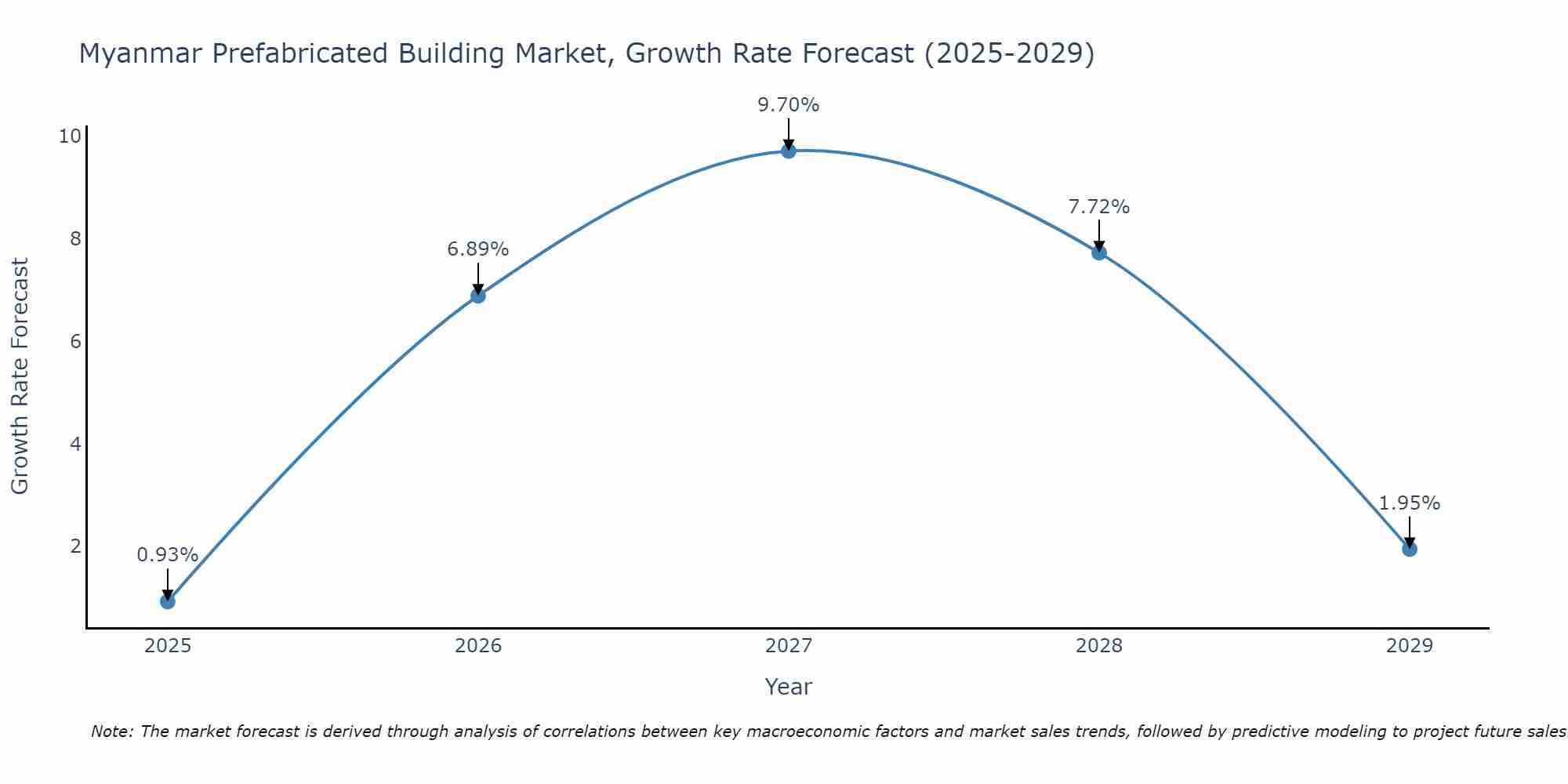
The Myanmar Prefabricated Building Market is projected to witness mixed growth rate patterns during 2025 to 2029. Starting at 0.93% in 2025, the market peaks at 9.70% in 2027, and settles at 1.95% by 2029.
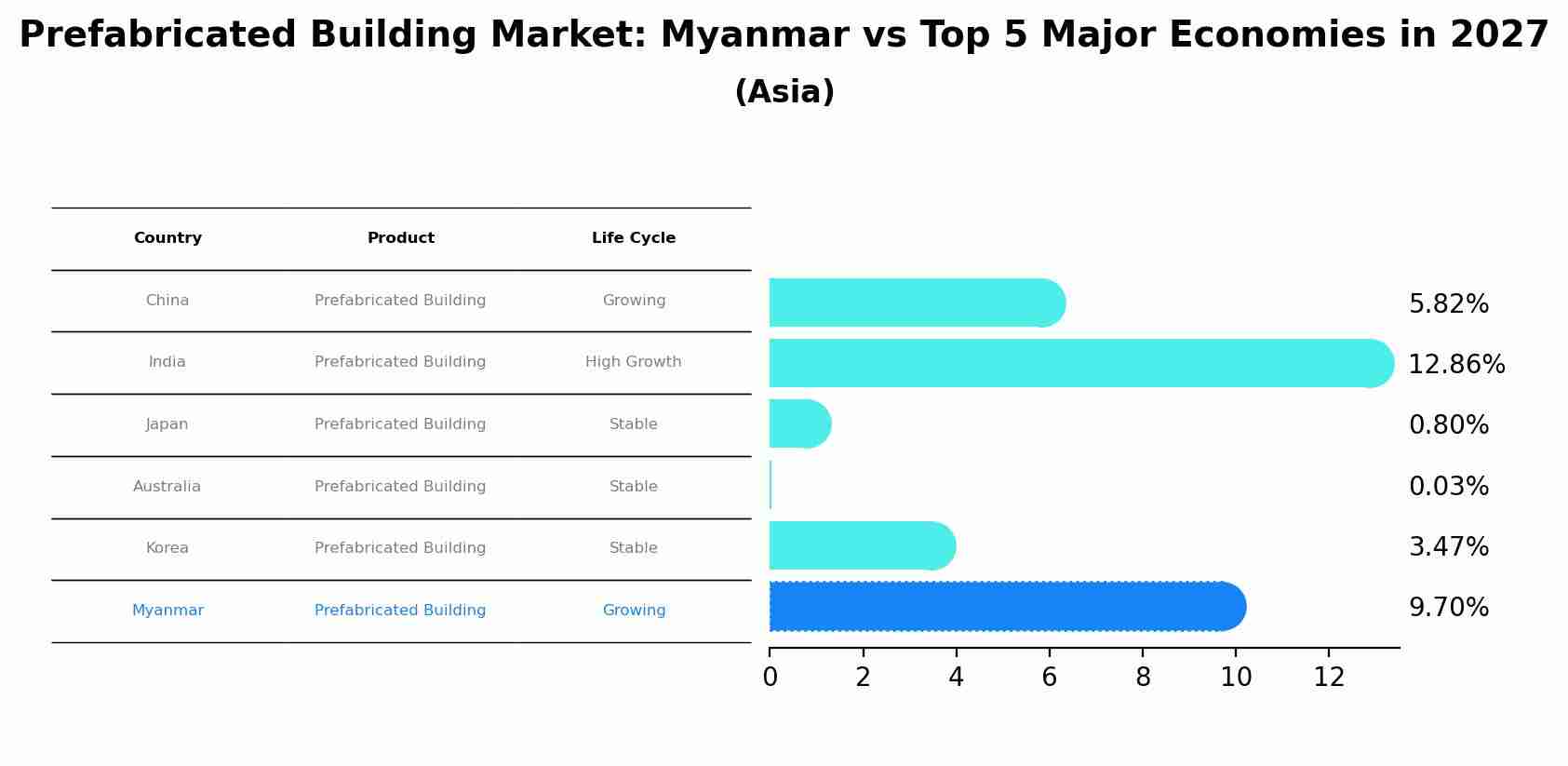
Prefabricated Building Market: Myanmar vs Top 5 Major Economies in 2027 (Asia)
By 2027, Myanmar's Prefabricated Building market is forecasted to achieve a growing growth rate of 9.70%, with China leading the Asia region, followed by India, Japan, Australia and South Korea.
Myanmar Prefabricated Building Market Overview
The Myanmar prefabricated building market is witnessing growth driven by factors such as rapid urbanization, infrastructure development, and a growing demand for cost-effective and sustainable construction solutions. The market offers a range of prefabricated building options including modular homes, precast concrete structures, and steel frame buildings. Key players in the market are focusing on innovation, customization, and efficient construction techniques to meet the diverse needs of residential, commercial, and industrial sectors. Government initiatives to promote affordable housing and investments in infrastructure projects are also driving the demand for prefabricated buildings in Myanmar. With increasing awareness about the benefits of prefabricated construction such as reduced construction time, waste minimization, and energy efficiency, the market is expected to continue its growth trajectory in the coming years.
Myanmar Prefabricated Building Market Trends
The Myanmar Prefabricated Building Market is experiencing growth driven by factors such as rapid urbanization, increased infrastructure development, and the demand for cost-effective and sustainable construction solutions. Modular construction techniques are gaining popularity due to their efficiency in time and labor savings. The market is witnessing a rise in demand for prefabricated materials such as steel, concrete, and wood, as they offer durability and flexibility in design. Additionally, the government`s initiatives to promote affordable housing and the growing awareness of the benefits of prefabricated buildings among consumers are contributing to the market`s expansion. With a focus on addressing housing shortages and improving construction efficiency, the Myanmar Prefabricated Building Market is poised for further growth in the coming years.
Myanmar Prefabricated Building Market Challenges
The Myanmar Prefabricated Building Market faces various challenges such as limited awareness and acceptance of prefabricated construction methods among traditional developers and contractors, lack of skilled labor and technical expertise in prefabrication techniques, inadequate regulatory framework and standards for prefabricated buildings, and limited access to financing options for prefabricated projects. Additionally, the market also struggles with inconsistent quality control and assurance processes, logistical challenges in transporting prefabricated components to remote areas, and the need for infrastructure improvements to support prefabricated construction. Overcoming these challenges will require collaboration between industry stakeholders, government support in developing relevant policies and regulations, and increased awareness and education on the benefits of prefabricated construction in Myanmar.
Myanmar Prefabricated Building Market Investment Opportunities
The Myanmar prefabricated building market presents promising investment opportunities due to the country`s rapid urbanization and growing demand for affordable and sustainable construction solutions. Investors can capitalize on the increasing need for residential housing, commercial spaces, and infrastructure development by providing prefabricated building solutions that offer cost-effectiveness, speed of construction, and environmental benefits. With Myanmar`s government focusing on infrastructure development and foreign investment incentives, the prefabricated building market is poised for growth. By leveraging innovative technologies and sustainable practices, investors can tap into this emerging market to meet the rising demand for efficient and modern construction solutions in Myanmar.
Myanmar Prefabricated Building Market Government Policy
The government of Myanmar has introduced various policies to promote the growth of the Prefabricated Building Market in the country. These policies include incentives for developers to use prefabricated building materials, streamlined regulations for obtaining permits for prefabricated construction projects, and initiatives to increase awareness and adoption of prefabricated building techniques. Additionally, the government has invested in infrastructure development to support the prefabricated building industry and has encouraged partnerships with international companies to bring in expertise and technology. Overall, these policies aim to address the growing demand for affordable and sustainable housing solutions in Myanmar while promoting innovation and efficiency in the construction sector.
Myanmar Prefabricated Building Market Future Outlook
The future outlook for the Myanmar Prefabricated Building Market appears promising, driven by factors such as rapid urbanization, increasing demand for affordable housing, and the government`s focus on infrastructure development. The market is expected to experience steady growth due to the benefits offered by prefabricated buildings, including cost-effectiveness, reduced construction time, and sustainability. Additionally, the rising awareness about the advantages of prefabricated construction methods among developers and consumers is likely to boost market growth. However, challenges such as limited awareness, technological constraints, and regulatory hurdles may hinder the market`s full potential. Overall, with supportive government initiatives and a growing construction sector, the Myanmar Prefabricated Building Market is expected to expand in the coming years.
Key Highlights of the Report:
- Myanmar Prefabricated Building Market Outlook
- Market Size of Myanmar Prefabricated Building Market, 2021
- Forecast of Myanmar Prefabricated Building Market, 2031
- Historical Data and Forecast of Myanmar Prefabricated Building Revenues & Volume for the Period 2018 - 2031
- Myanmar Prefabricated Building Market Trend Evolution
- Myanmar Prefabricated Building Market Drivers and Challenges
- Myanmar Prefabricated Building Price Trends
- Myanmar Prefabricated Building Porter's Five Forces
- Myanmar Prefabricated Building Industry Life Cycle
- Historical Data and Forecast of Myanmar Prefabricated Building Market Revenues & Volume By Dimensions for the Period 2018 - 2031
- Historical Data and Forecast of Myanmar Prefabricated Building Market Revenues & Volume By Skeleton System for the Period 2018 - 2031
- Historical Data and Forecast of Myanmar Prefabricated Building Market Revenues & Volume By Panel System for the Period 2018 - 2031
- Historical Data and Forecast of Myanmar Prefabricated Building Market Revenues & Volume By Cellular System for the Period 2018 - 2031
- Historical Data and Forecast of Myanmar Prefabricated Building Market Revenues & Volume By Combined System for the Period 2018 - 2031
- Historical Data and Forecast of Myanmar Prefabricated Building Market Revenues & Volume By Application for the Period 2018 - 2031
- Historical Data and Forecast of Myanmar Prefabricated Building Market Revenues & Volume By Residential for the Period 2018 - 2031
- Historical Data and Forecast of Myanmar Prefabricated Building Market Revenues & Volume By Non-Residential for the Period 2018 - 2031
- Myanmar Prefabricated Building Import Export Trade Statistics
- Market Opportunity Assessment By Dimensions
- Market Opportunity Assessment By Application
- Myanmar Prefabricated Building Top Companies Market Share
- Myanmar Prefabricated Building Competitive Benchmarking By Technical and Operational Parameters
- Myanmar Prefabricated Building Company Profiles
- Myanmar Prefabricated Building Key Strategic Recommendations






































