Myanmar Window Covering Market Size, Share & Growth Rate
The Myanmar Window Covering Market was estimated at USD 480 Million in 2025 and is projected to reach USD 678 Million by 2032, growing at a CAGR of 5.1% from 2026 to 2032. This growth trajectory is fueled by the surge in urbanization and a thriving construction industry, leading to heightened demand for both functional and decorative window treatments. As the populace becomes increasingly discerning about aesthetics and energy efficiency in their living and working spaces, manufacturers are poised to cater to these evolving preferences.
Myanmar Window Covering Market Year-wise Growth Rate and Key Drivers
This graph highlights how the Myanmar Window Covering Market has steadily grown over the years, supported by major growth factors.
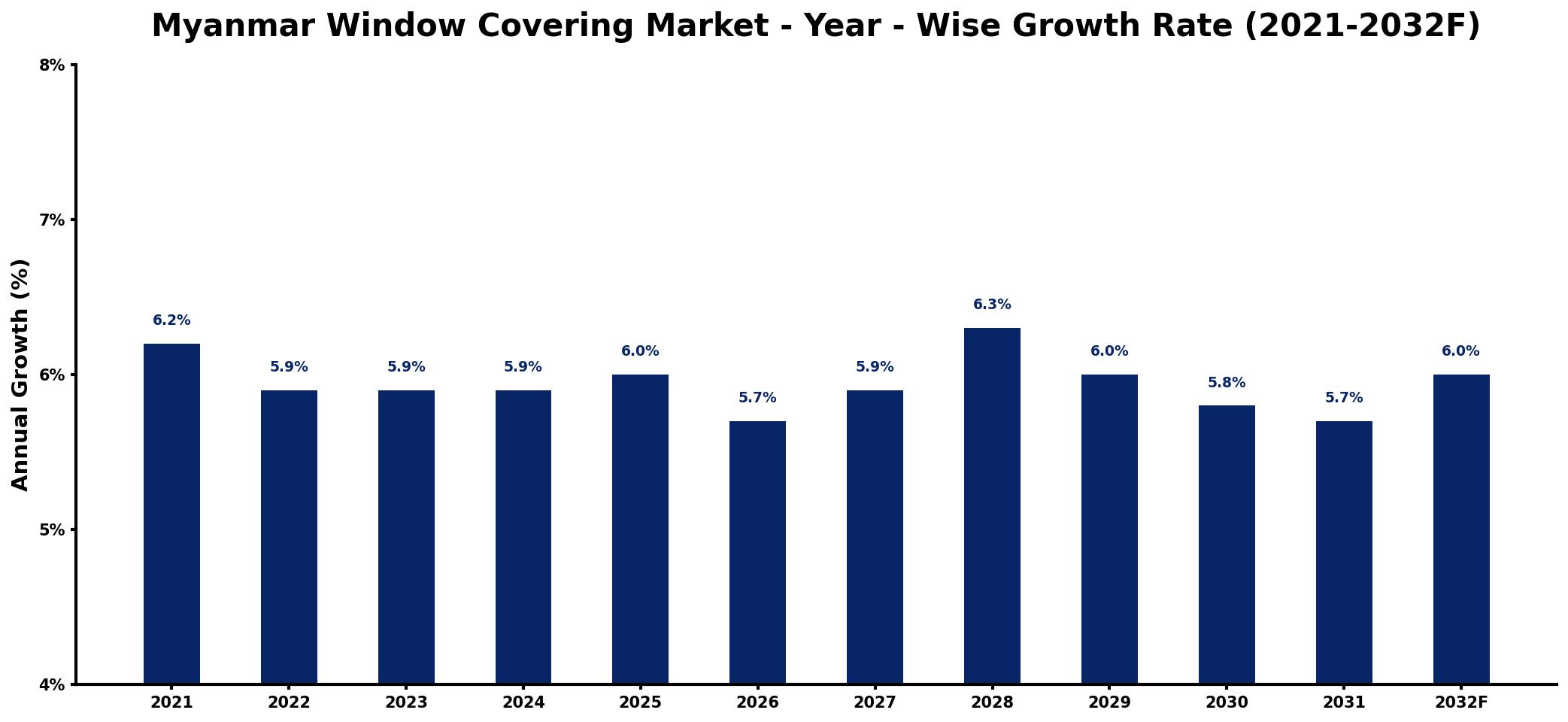
The table below presents the year‑wise growth rates along with the key drivers influencing the market
| Year | Growth Rate | Major Drivers |
| 2021 | 6.2% | Rising urbanization driving demand |
| 2022 | 5.9% | Increased construction projects underway |
| 2023 | 5.9% | Growing disposable income levels |
| 2024 | 5.9% | Surge in interior design popularity |
| 2025 | 6.0% | Expansion of real estate sector |
| 2026 | 5.7% | Investment in home renovations rising |
| 2027 | 5.9% | Boost in hospitality industry growth |
| 2028 | 6.3% | Emergence of eco-friendly materials |
| 2029 | 6.0% | Technological advancements in production |
| 2030 | 5.8% | Enhanced focus on energy efficiency |
| 2031 | 5.7% | Shift towards premium home aesthetics |
| 2032 | 6.0% | Demand for smart home solutions |
Note: Market size estimations and growth projections presented in this report are based on 6Wresearch's proprietary forecasting methodology, utilizing the latest available industry data, government publications, and primary research inputs.
Myanmar Window Covering Market Synopsis
The primary force currently shaping the Myanmar Window Covering Market is the burgeoning construction sector, which is evolving in response to a rapidly urbanizing populace. As residential and commercial projects increase, so too does the demand for stylish and functional window coverings that enhance living spaces while offering practical benefits.
In addition to aesthetic considerations, there is a notable shift towards energy-efficient solutions that promote climate control. Consumers are becoming more environmentally conscious, prompting a growing interest in window coverings that not only beautify spaces but also contribute to energy savings and sustainability.
Myanmar Window Covering Market Key Takeaways
- The market is experiencing significant growth due to rapid urbanization and construction activities.
- Consumer demand is shifting towards energy-efficient and aesthetically pleasing window treatment solutions.
- Challenges persist regarding the availability of quality materials and advanced manufacturing technologies.
- Government initiatives are fostering a supportive environment for sustainable window covering products.
- Marketing and distribution strategies are vital for reaching a broader consumer base in this emerging market.
Evaluation of Restraints in Myanmar Window Covering Market
While the prospects for the Myanmar Window Covering Market appear robust, several restraints impede its full potential. A significant challenge is the accessibility and affordability of high-quality materials necessary for producing durable and appealing window treatments. Furthermore, the market grapples with the need for advanced manufacturing technologies that can enhance product quality and production efficiency. Competition from alternative solutions also poses a threat, as does the fluctuating demand influenced by the ups and downs in the construction and home improvement sectors. These factors necessitate strategic marketing and distribution approaches to engage a wider consumer demographic.
Myanmar Window Covering Market Trends
Current trends indicate a growing preference for smart window coverings equipped with automation and energy management features. Consumers are increasingly attracted to solutions that offer convenience and control, such as motorized blinds and shades that can be adjusted remotely. Additionally, the integration of eco-friendly materials in production is gaining traction, reflecting a shift towards sustainability in the design and manufacturing process.
Moreover, urban design philosophies that emphasize open spaces and natural light are influencing the types of window coverings that are in demand. As architects and interior designers focus on creating harmonious environments, there is an upward trend towards bespoke solutions that cater to unique aesthetic preferences and functional needs.
Myanmar Window Covering Market Opportunities
Significant growth opportunities lie within the residential segment as new housing developments continue to rise. This creates an ideal market for innovative window covering solutions that combine style, energy efficiency, and user-friendliness. Additionally, the commercial sector is ripe for investment, particularly in office spaces seeking to enhance employee productivity through improved light control and comfort. Manufacturers that can leverage new technologies, such as sustainable materials and smart functionality, will find themselves well-positioned to meet emerging consumer demands.
Government Initiatives in the Myanmar Window Covering Market
The Myanmar government has instituted several policies to support the Window Covering Market, focusing on promoting energy efficiency and enhancing interior design aesthetics. Initiatives include incentives for the production and installation of energy-efficient window coverings and the establishment of safety and performance standards. Public awareness campaigns are also underway to educate consumers about the benefits of window coverings for climate control, privacy, and energy conservation.
Future Insights of the Myanmar Window Covering Market
Looking ahead to the years 2026-2032, the Myanmar Window Covering Market is expected to experience dynamic changes driven by innovation and evolving consumer preferences. The integration of smart technologies and sustainable practices will continue to gain momentum, fostering a new landscape for window treatment solutions. As economic growth persists, coupled with increasing urbanization, the market is likely to expand, presenting rich opportunities for stakeholders who adapt to the changing demands of consumers.
Myanmar Window Covering Market Latest Developments (2025 - 2026)
Recent developments in the Myanmar Window Covering Market reveal a trend towards increased customization, with manufacturers offering tailored solutions to meet specific consumer needs. In addition, there has been a noticeable increase in collaboration between local companies and international suppliers to enhance product offerings and technological capabilities. These partnerships aim to elevate the quality of window coverings available in the market and promote sustainable practices across the industry.
Myanmar Window Covering Market - Key Attractiveness of the Report
- 10 Years of Market Numbers
- Historical Data Starting from 2022 to 2025
- Base Year: 2025
- Forecast Data until 2032
- Key Performance Indicators Impacting the Market
- Major Upcoming Developments and Projects
Key Highlights of the Report:
- Myanmar Window Covering Market Outlook
- Market Size of Myanmar Window Covering Market, 2025
- Forecast of Myanmar Window Covering Market, 2032
- Historical Data and Forecast of Myanmar Window Covering Revenues & Volume for the Period 2022-2032F
- Myanmar Window Covering Market Trend Evolution
- Myanmar Window Covering Market Drivers and Challenges
- Myanmar Window Covering Price Trends
- Myanmar Window Covering Porter's Five Forces
- Myanmar Window Covering Industry Life Cycle
- Historical Data and Forecast of Myanmar Window Covering Market Revenues & Volume By Type for the Period 2022-2032F
- Historical Data and Forecast of Myanmar Window Covering Market Revenues & Volume By Blinds & Shades for the Period 2022-2032F
- Historical Data and Forecast of Myanmar Window Covering Market Revenues & Volume By Curtains for the Period 2022-2032F
- Historical Data and Forecast of Myanmar Window Covering Market Revenues & Volume By Shutters for the Period 2022-2032F
- Historical Data and Forecast of Myanmar Window Covering Market Revenues & Volume By Others for the Period 2022-2032F
- Historical Data and Forecast of Myanmar Window Covering Market Revenues & Volume By Application for the Period 2022-2032F
- Historical Data and Forecast of Myanmar Window Covering Market Revenues & Volume By Residential for the Period 2022-2032F
- Historical Data and Forecast of Myanmar Window Covering Market Revenues & Volume By Commercial for the Period 2022-2032F
- Historical Data and Forecast of Myanmar Window Covering Market Revenues & Volume By Distribution Channel for the Period 2022-2032F
- Historical Data and Forecast of Myanmar Window Covering Market Revenues & Volume By Online for the Period 2022-2032F
- Historical Data and Forecast of Myanmar Window Covering Market Revenues & Volume By Offline for the Period 2022-2032F
- Historical Data and Forecast of Myanmar Window Covering Market Revenues & Volume By Supermarkets/Hypermarkets for the Period 2022-2032F
- Historical Data and Forecast of Myanmar Window Covering Market Revenues & Volume By Specialty Stores for the Period 2022-2032F
- Historical Data and Forecast of Myanmar Window Covering Market Revenues & Volume By Multi Brand Stores for the Period 2022-2032F
- Myanmar Window Covering Import Export Trade Statistics
- Market Opportunity Assessment By Type
- Market Opportunity Assessment By Application
- Market Opportunity Assessment By Distribution Channel
- Myanmar Window Covering Top Companies Market Share
- Myanmar Window Covering Competitive Benchmarking By Technical and Operational Parameters
- Myanmar Window Covering Company Profiles
- Myanmar Window Covering Key Strategic Recommendations






































