Nepal Asphalt Market Summary
The nepal asphalt market was estimated at USD 374 Million in 2025 and is projected to reach USD 503 Million by 2032, growing at a CAGR of 4.9% from 2026 to 2032.
Nepal Asphalt Market Year-wise Growth Rate and Key Drivers
This graph highlights how the Nepal Asphalt Market has steadily grown over the past five years, supported by major growth factors.
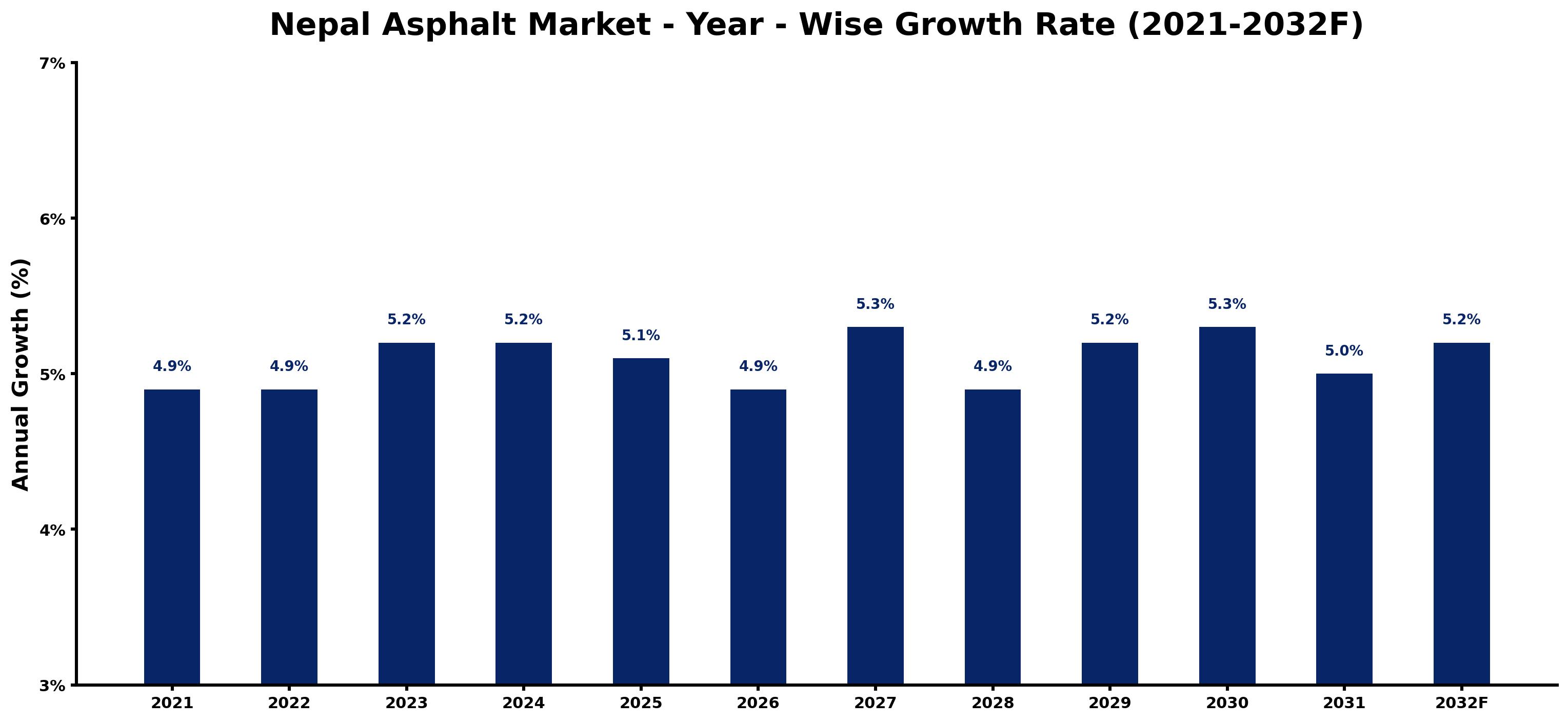
The table below presents the year wise growth rates along with the key drivers influencing the market
| Year | Growth Rate | Major Drivers |
| 2021 | 4.9% | Post-lockdown infrastructure projects gained momentum, stimulating asphalt consumption across Nepal. |
| 2022 | 4.9% | Increased urbanization trends fueled demand for road expansion and asphalt paving. |
| 2023 | 5.2% | Construction sector recovery post-pandemic led to enhanced asphalt utilization in projects. |
| 2024 | 5.2% | Government focus on rural connectivity resulted in more asphalt road initiatives nationwide. |
| 2025 | 5.1% | Public-private partnerships emerged, boosting investment in sustainable asphalt technologies. |
| 2026 | 4.9% | Enhanced logistics networks required robust asphalt solutions for efficient transportation. |
| 2027 | 5.3% | Demand for durable road surfaces grew as vehicle ownership rates continued to climb. |
| 2028 | 4.9% | Emerging tourism infrastructure projects necessitated high-quality asphalt for access roads. |
| 2029 | 5.2% | Technological innovations in asphalt recycling gained traction, reducing environmental impact. |
| 2030 | 5.3% | Increased focus on climate resilience prompted demand for sustainable asphalt practices. |
| 2031 | 5.0% | Shift towards smart city planning influenced asphalt designs for integrated transport systems. |
| 2032 | 5.2% | Economic recovery post-global events ushered in significant investments in asphalt infrastructure. |
Note - Market size estimations and growth projections presented in this report are based on 6Wresearch's advanced forecasting approach, validated with industry datasets as of June 2026.
Nepal Asphalt Market Synopsis
The Nepal Asphalt Market is projected to reach 4.9% and witness significant growth during the forecast period (2026-2032). This growth is primarily driven by the escalating infrastructural developments across the country, including the construction of roads, bridges, and airports. The use of asphalt, known for its durability and economic advantages in road construction, has positioned it as a favored material in these projects. With escalating government investments, increased urbanization, and a rising demand for enhanced transportation networks, the market is poised for substantial advancement.
Nepal Asphalt Market Growth Drivers
A multitude of factors are fueling the expansion of the Nepal Asphalt Market. The ongoing infrastructure projects, driven by government initiatives, play a pivotal role in this growth. Key drivers include:
- The Nepal government has prioritized road construction projects to improve connectivity and support economic development, directly increasing asphalt demand.
- Urbanization trends are increasing as more people migrate to cities, necessitating the development of new road networks and maintenance of existing ones.
- There is growing awareness of the advantages of asphalt, such as its longevity, cost-effectiveness, and ability to be recycled, thus appealing to both governmental and private entities.
- Technological advancements in asphalt production are enhancing product quality and performance, leading to increased adoption in various construction applications.
- Government incentives aimed at promoting sustainable construction practices are encouraging the use of innovative asphalt technologies, fostering market growth.
Nepal Asphalt Market Trends and Opportunities
The Nepal Asphalt Market is evolving rapidly, with several trends shaping its future. Noteworthy trends include:
- The rising focus on sustainable construction practices is leading to a higher demand for warm mix asphalt, which consumes less energy during production and reduces emissions.
- Investment in research and development is on the rise, with manufacturers keen to develop innovative asphalt solutions that cater to unique infrastructural requirements.
- Increased collaboration among manufacturers, local construction companies, and governmental agencies is enhancing market intelligence and fostering a competitive landscape.
- There is a noticeable shift towards using recycled materials in asphalt production, aligning with global sustainability initiatives and reducing environmental impact.
- Technological integration in asphalt production processes is improving efficiency and consistency, reducing costs, and enhancing the overall quality of asphalt products.
Nepal Asphalt Market Challenges and Restraints
Despite its growth potential, the Nepal Asphalt Market faces several challenges that could impede progress. Key challenges include:
- The infrastructure remains inadequate in many regions, hindering the efficient transportation and distribution of asphalt products.
- Quality control in asphalt production is often lacking, leading to inconsistencies that affect the durability and effectiveness of asphalt used in projects.
- The industry grapples with a shortage of skilled workforce capable of ensuring high-quality asphalt production and installation.
- Fluctuating raw material prices present a significant challenge for manufacturers, affecting overall cost structures and profitability.
- Regulatory compliance and environmental concerns require stringent adherence to standards, complicating operations for market players.
Nepal Asphalt Market Government Investment and Initiatives
The government of Nepal has been actively engaged in fostering the growth of the asphalt market through various investments and initiatives. Key actions include:
- Establishing quality standards for asphalt production to ensure that materials meet necessary safety and durability criteria.
- Implementing environmental regulations aimed at reducing the carbon footprint of asphalt production and promoting sustainable practices within the industry.
- Providing incentives for projects incorporating eco-friendly materials, thereby encouraging manufacturers to adopt innovative and sustainable technologies.
- Supporting infrastructure development plans that prioritize transportation connectivity, thereby boosting demand for asphalt products.
- Encouraging public-private partnerships to enhance investment in infrastructure projects, resulting in broader opportunities for asphalt production and use.
Nepal Asphalt Market Latest Developments (May 2025 - June 2026)
In recent months, the Nepal Asphalt Market has witnessed several notable developments. There has been a pronounced push towards increasing asphalt production capabilities to meet the rising demand linked to extensive road construction and maintenance projects. Moreover, advancements in production technology have allowed manufacturers to improve the quality and performance of asphalt products. The government has continued to emphasize sustainable practices, encouraging the use of warm mix asphalt and recycled materials. Furthermore, collaborative efforts among various stakeholders have been observed, aimed at optimizing supply chains and ensuring smoother project execution. These dynamics are expected to shape the market landscape significantly in the near future.
Nepal Asphalt Market Future Outlook
Looking ahead, the Nepal Asphalt Market is anticipated to maintain a strong growth trajectory supported by ongoing infrastructure projects and urbanization. The demand for asphalt will likely soar as the focus on developing highways, airports, and residential areas intensifies. Additionally, the shift towards sustainable construction methodologies is expected to bolster the use of asphalt as a primary material. Despite potential challenges such as fluctuating oil prices and competition from alternative materials, the overall outlook remains positive. The market is well-positioned for expansion, presenting numerous opportunities for innovation and adaptation to the evolving needs of the construction sector.
Nepal Asphalt Market - Key Attractiveness of the Report
- 10 Years of Market Numbers
- Historical Data Starting from 2022 to 2025
- Base Year: 2025
- Forecast Data until 2032
- Key Performance Indicators Impacting the Market
- Major Upcoming Developments and Projects
Key Highlights of the Report:
- Nepal Asphalt Market Outlook
- Market Size of Nepal Asphalt Market, 2025
- Forecast of Nepal Asphalt Market, 2032F
- Historical Data and Forecast of Nepal Asphalt Revenues & Volume for the Period 2022-2032F
- Nepal Asphalt Market Trend Evolution
- Nepal Asphalt Market Drivers and Challenges
- Nepal Asphalt Price Trends
- Nepal Asphalt Porter's Five Forces
- Nepal Asphalt Industry Life Cycle
- Historical Data and Forecast of Nepal Asphalt Market Revenues & Volume By Type for the Period 2022-2032F
- Historical Data and Forecast of Nepal Asphalt Market Revenues & Volume By Paving Petroleum Asphalt for the Period 2022-2032F
- Historical Data and Forecast of Nepal Asphalt Market Revenues & Volume By Industrial Petroleum Asphalt for the Period 2022-2032F
- Historical Data and Forecast of Nepal Asphalt Market Revenues & Volume By Others for the Period 2022-2032F
- Historical Data and Forecast of Nepal Asphalt Market Revenues & Volume By Application for the Period 2022-2032F
- Historical Data and Forecast of Nepal Asphalt Market Revenues & Volume By Paving for the Period 2022-2032F
- Historical Data and Forecast of Nepal Asphalt Market Revenues & Volume By Roofing for the Period 2022-2032F
- Historical Data and Forecast of Nepal Asphalt Market Revenues & Volume By Others for the Period 2022-2032F
- Nepal Asphalt Import Export Trade Statistics
- Market Opportunity Assessment By Type
- Market Opportunity Assessment By Application
- Nepal Asphalt Top Companies Market Share
- Nepal Asphalt Competitive Benchmarking By Technical and Operational Parameters
- Nepal Asphalt Company Profiles
- Nepal Asphalt Key Strategic Recommendations






































