Nepal Data Center Market Size & Growth Rate (2026-2032)
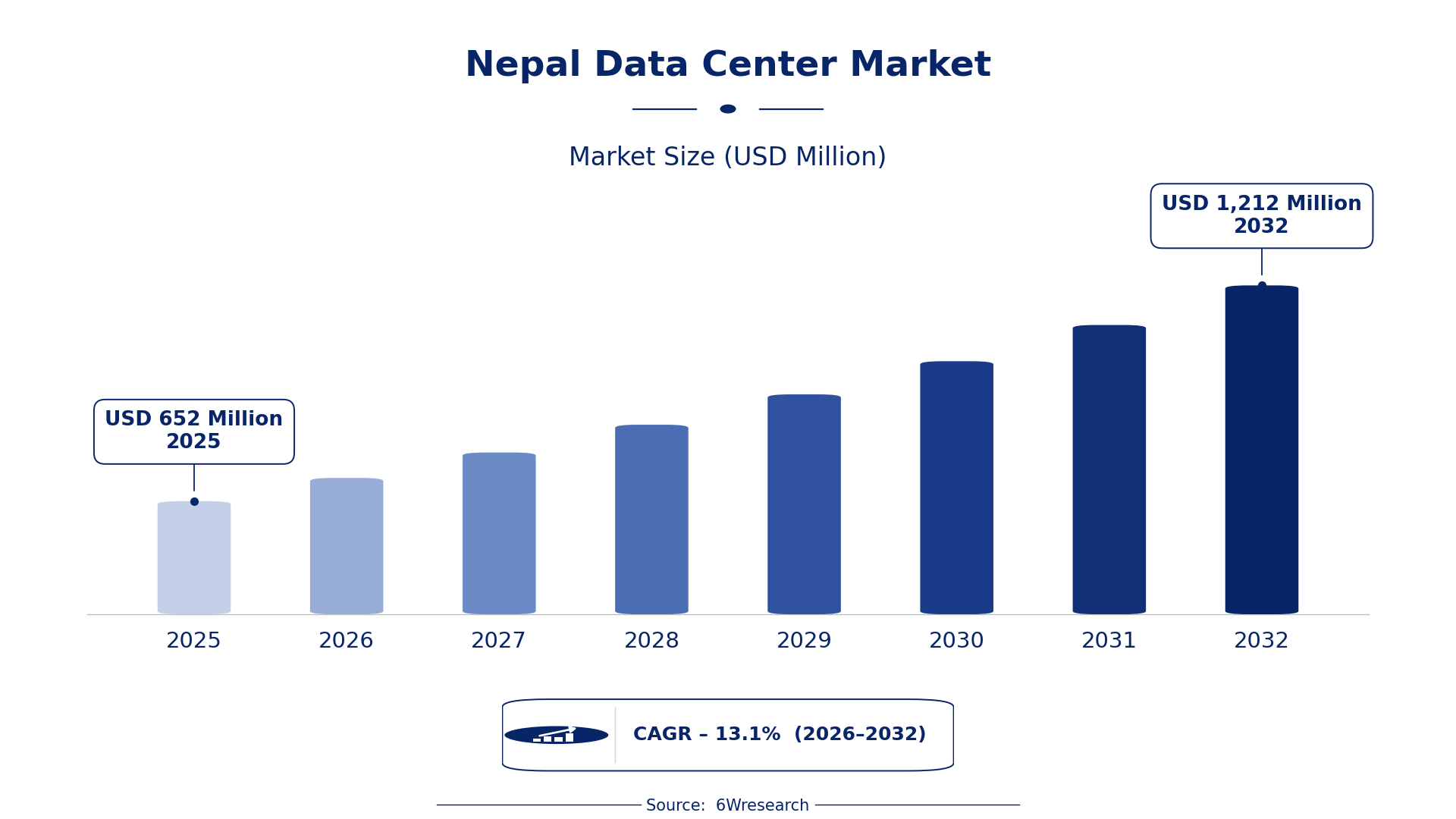
The Nepal Data Center Market was estimated at USD 652 Million in 2025 and is projected to reach USD 1212 Million by 2032, growing at a CAGR of 13.1% from 2026 to 2032.
Nepal Data Center Market Synopsis
The primary force driving the Nepal Data Center Market is the rapid increase in digitalization across various sectors. As businesses transition to online platforms and adopt cloud-based solutions, the demand for reliable data storage and processing capabilities has surged.
In addition to growing local demand, international data center providers are recognizing Nepal's strategic position for disaster recovery services. This geographical advantage, combined with government initiatives to enhance digital infrastructure, is catalyzing significant investments in the market.
Nepal Data Center Market Year-wise Growth Rate and Key Drivers
This graph illustrates the annual growth rates of the Nepal Data Center Market from 2021 to 2032, highlighting a steady upward trajectory and projected expansion over the forecast period.
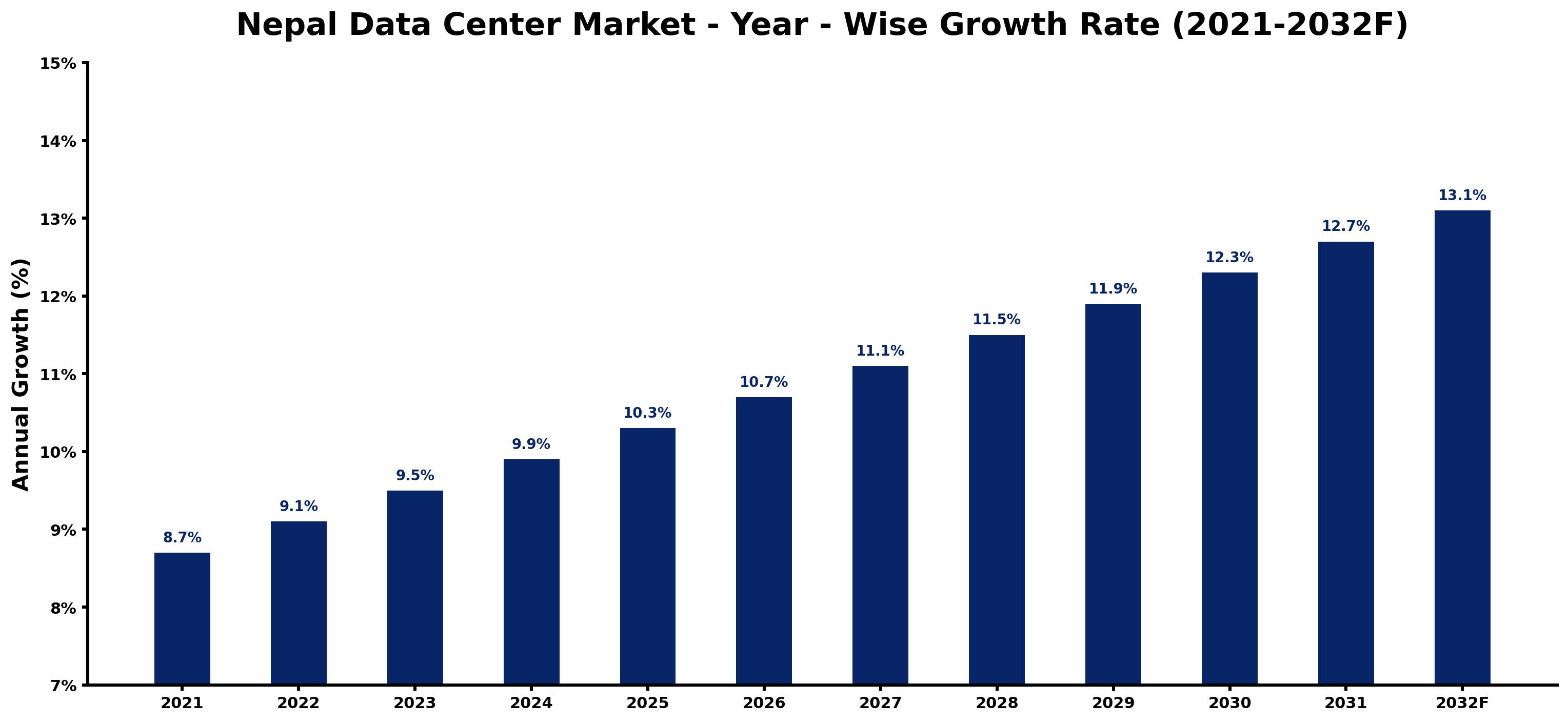
The table below presents the year‑wise growth rates along with the key drivers influencing the market
| Year | Growth Rate | Major Drivers |
| 2021 | 8.7% | Nepal's National Digital Payment Strategy boosts data security needs. |
| 2022 | 9.1% | Government initiatives promoting digital transformation in education sector. |
| 2023 | 9.5% | Rise in e-commerce driving data storage requirements. |
| 2024 | 9.9% | Regulatory changes enhancing consumer protection in data privacy. |
| 2025 | 10.3% | Increased mobile internet penetration facilitating data center utilization. |
| 2026 | 10.7% | Local tech incubators nurturing innovation in data services. |
| 2027 | 11.1% | Government mandates for local data hosting security compliance. |
| 2028 | 11.5% | Growing outsourcing trend for IT services spurring data usage. |
| 2029 | 11.9% | Emergence of remote work culture enhancing data center demand. |
| 2030 | 12.3% | National policies incentivizing green data center technologies. |
| 2031 | 12.7% | Local businesses adopting AI increasing data processing needs. |
| 2032 | 13.1% | Demographics shifting towards tech-savvy youth boosting data consumption. |
Note: Market size estimations and growth projections presented in this report are based on 6Wresearch's proprietary forecasting methodology, utilizing the latest available industry data, government publications, and primary research inputs.
Nepal Data Center Market Key Takeaways
Below are some of the specific key takeaways from the market, including:
- The market is experiencing a notable shift towards hybrid cloud solutions as businesses seek flexibility and security.
- Colocation services are gaining traction, allowing organizations to optimize costs while improving operational efficiency.
- Green data centers are emerging as a priority, driven by the need to reduce energy consumption and environmental impact.
- Investment opportunities abound, especially in infrastructure development and partnerships with local telecom providers.
- Government policies are actively promoting data center growth through incentives and improved regulatory frameworks.
Evaluation of Restraints in Nepal Data Center Market
Despite the promising outlook, the Nepal Data Center Market faces several restraints that may hinder its growth. A significant challenge is the limited pool of skilled IT professionals, which impacts the operational capabilities of data centers. Additionally, frequent power supply issues can lead to potential downtimes, posing risks to business continuity. High initial setup costs related to infrastructure limitations further complicate the landscape. on top of that, the regulatory environment concerning data protection and privacy remains inadequate, potentially deterring investment. Addressing these challenges is essential for the sustainable development of this market.
Nepal Data Center Market Trends
Current trends in the Nepal Data Center Market indicate a strong shift towards edge computing to support low-latency applications. This technology is crucial for industries requiring real-time data processing. Additionally, as businesses increasingly adopt cloud services, the hybrid cloud model is gaining popularity, offering a balance between on-premises and cloud solutions. The push for sustainable operations is driving the development of energy-efficient data centers, which are seen as essential for future growth.
Nepal Data Center Market Opportunities
The landscape is ripe for investment, particularly in the construction and modernization of data centers. Opportunities lie in forming partnerships with local telecom companies to provide colocation and managed services. As the digital economy expands, there is a pressing need for reliable data storage solutions, making it an attractive market for both local and international investors.
Government Initiatives in the Nepal Data Center Market
The Nepalese government is actively involved in fostering a conducive environment for the data center market. Recent policy initiatives aim to attract foreign investment and enhance the overall digital infrastructure. By focusing on public-private partnerships, the government is laying the groundwork for a robust digital ecosystem that is crucial for the growth of data centers in the country.
- A national digital infrastructure upgrade programme launched in early 2023 aims to improve internet connectivity across urban and rural areas.
- The Data Center Policy introduced in 2020 provides tax incentives and subsidies for land and electricity to encourage data center investments.
- Current initiatives are underway to enhance regulatory frameworks focused on data protection and privacy, expected to conclude by mid-2026.
- A planned public-private partnership program is anticipated to expand telecom infrastructure access by 2028, further supporting data center operations.
Future Insights of the Nepal Data Center Market
Looking ahead to 2026-2032, the Nepal Data Center Market is expected to experience substantial growth driven by increasing cloud adoption and digital transformation initiatives. The government's commitment to improving digital infrastructure will continue to stimulate demand for data center services. With businesses increasingly relying on data analytics and emerging technologies like IoT and AI, the need for secure and efficient data storage facilities will become even more pronounced.
Nepal Data Center Market Latest Developments
In the past year, the Nepal Data Center Market has seen a surge in activity, reflecting the growing interest from both local and international players. Key initiatives have been launched to enhance infrastructure and improve service delivery, positioning the market for future growth. Companies are exploring innovative solutions to address the challenges faced by the sector.
- A major technology vendor completed the rollout of a new data management solution in Q2 2023, aimed at enhancing operational efficiency for local businesses.
- An ongoing initiative began in early 2023 focused on building energy-efficient data centers, expected to be completed by late 2024.
- A leading regional operator is planning to launch a new colocation service by mid-2025 to meet rising demand.
- A partnership between local tech firms and international investors was announced in late 2023 to develop a state-of-the-art data center facility, with construction slated to begin in early 2025.
Nepal Data Center Market - Key Attractiveness of the Report
- 10 Years of Market Numbers
- Historical Data Starting from 2022 to 2025
- Base Year: 2025
- Forecast Data until 2032
- Key Performance Indicators Impacting the Market
- Major Upcoming Developments and Projects
Key Highlights of the Report:
- Nepal Data Center Market Outlook
- Market Size of Nepal Data Center Market, 2025
- Forecast of Nepal Data Center Market, 2032
- Historical Data and Forecast of Nepal Data Center Revenues & Volume for the Period 2022-2032F
- Nepal Data Center Market Trend Evolution
- Nepal Data Center Market Drivers and Challenges
- Nepal Data Center Price Trends
- Nepal Data Center Porter's Five Forces
- Nepal Data Center Industry Life Cycle
- Historical Data and Forecast of Nepal Data Center Market Revenues & Volume By Component for the Period 2022-2032F
- Historical Data and Forecast of Nepal Data Center Market Revenues & Volume By Electrical for the Period 2022-2032F
- Historical Data and Forecast of Nepal Data Center Market Revenues & Volume By Mechanical for the Period 2022-2032F
- Historical Data and Forecast of Nepal Data Center Market Revenues & Volume By Networking for the Period 2022-2032F
- Historical Data and Forecast of Nepal Data Center Market Revenues & Volume By Racks for the Period 2022-2032F
- Historical Data and Forecast of Nepal Data Center Market Revenues & Volume By Security Systems for the Period 2022-2032F
- Historical Data and Forecast of Nepal Data Center Market Revenues & Volume By Fire Systems for the Period 2022-2032F
- Historical Data and Forecast of Nepal Data Center Market Revenues & Volume By Vertical for the Period 2022-2032F
- Historical Data and Forecast of Nepal Data Center Market Revenues & Volume By Banking Financial Services & Insurance (BFSI) for the Period 2022-2032F
- Historical Data and Forecast of Nepal Data Center Market Revenues & Volume By Government for the Period 2022-2032F
- Historical Data and Forecast of Nepal Data Center Market Revenues & Volume By IT & Telecom for the Period 2022-2032F
- Historical Data and Forecast of Nepal Data Center Market Revenues & Volume By Media for the Period 2022-2032F
- Historical Data and Forecast of Nepal Data Center Market Revenues & Volume By Retail for the Period 2022-2032F
- Historical Data and Forecast of Nepal Data Center Market Revenues & Volume By Manufacturing for the Period 2022-2032F
- Historical Data and Forecast of Nepal Data Center Market Revenues & Volume By Others for the Period 2022-2032F
- Nepal Data Center Import Export Trade Statistics
- Market Opportunity Assessment By Component
- Market Opportunity Assessment By Vertical
- Nepal Data Center Top Companies Market Share
- Nepal Data Center Competitive Benchmarking By Technical and Operational Parameters
- Nepal Data Center Company Profiles
- Nepal Data Center Key Strategic Recommendations






































