Nepal Facade Market Size, Share & Growth Rate
The Nepal Facade Market was estimated at USD 417 Million in 2025 and is projected to reach USD 549 Million by 2032, growing at a CAGR of 4.0% from 2026 to 2032. This upward trajectory is predominantly driven by the surge in construction activities fueled by urbanization and a heightened demand for energy-efficient building solutions. A growing interest in modern architectural designs is further stimulating the adoption of innovative facade materials, making this an exciting time for the sector.
Nepal Facade Market Year-wise Growth Rate and Key Drivers
This graph highlights how the Nepal Facade Market has steadily grown over the years, supported by major growth factors.
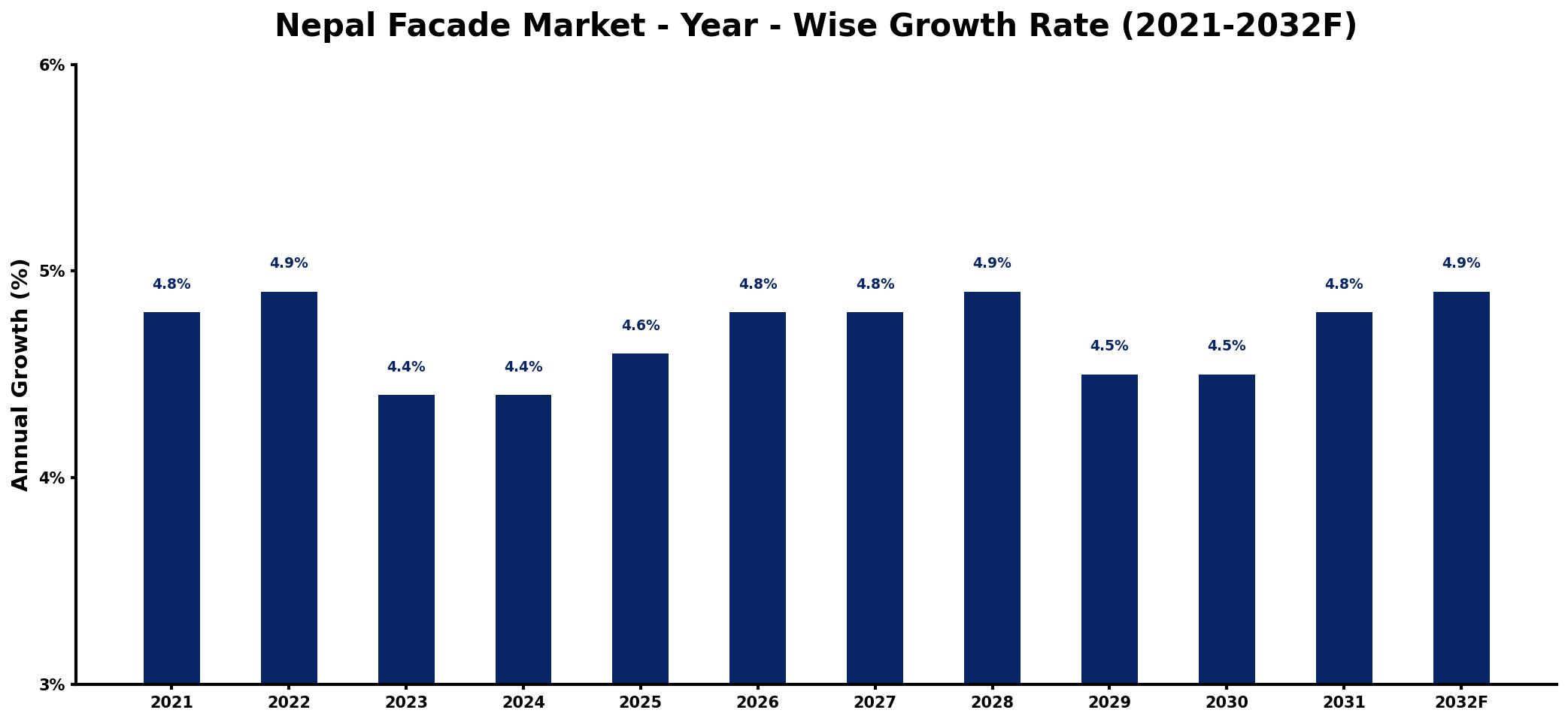
The table below presents the year‑wise growth rates along with the key drivers influencing the market
| Year | Growth Rate | Major Drivers |
| 2021 | 4.8% | Rising construction sector investments |
| 2022 | 4.9% | Increased urban development projects |
| 2023 | 4.4% | Growing demand for aesthetic designs |
| 2024 | 4.4% | Expansion of real estate market |
| 2025 | 4.6% | Higher consumer spending on renovations |
| 2026 | 4.8% | Surge in green building initiatives |
| 2027 | 4.8% | Strengthened infrastructure development plans |
| 2028 | 4.9% | Growing interest in sustainable architecture |
| 2029 | 4.5% | Increased focus on energy efficiency |
| 2030 | 4.5% | Rise in commercial property construction |
| 2031 | 4.8% | Growing trends in modern design |
| 2032 | 4.9% | expanding healthcare application demand |
Note: Market size estimations and growth projections presented in this report are based on 6Wresearch's proprietary forecasting methodology, utilizing the latest available industry data, government publications, and primary research inputs.
Nepal Facade Market Synopsis
The Nepal facade market has witnessed steady growth, propelled by recent construction booms and a shift towards sustainability. However, as the industry evolves, the future seems even more promising, with escalating demands for aesthetically pleasing, energy-efficient facades that align with modern architecture.
Emphasizing innovative facade solutions, the market showcases a robust variety of materials such as glass, aluminum, and stone. The government's commitment to promoting eco-friendly practices further complements the industry's trajectory, laying the groundwork for long-term development and investment opportunities.
Nepal Facade Market Key Takeaways
- Steady growth fueled by urbanization and increased construction activity.
- Rising demand for sustainable and energy-efficient building solutions.
- Increased adoption of modern and innovative facade materials.
- Government incentives promoting eco-friendly construction practices.
- Investment potential in manufacturing and distribution of high-quality facade materials.
Evaluation of Restraints in Nepal Facade Market
Despite its robust growth, the Nepal facade market faces significant challenges. A notable shortage of skilled labor for facade installation hampers project timelines and quality. Fluctuating raw material prices can disrupt budgeting and project viability, while the reliance on imported materials introduces supply chain vulnerabilities. Furthermore, the lack of standardized regulations often leads to quality control issues, making it imperative for stakeholders to collaborate for addressing these critical challenges effectively.
Nepal Facade Market Trends
Several key trends are shaping the Nepal facade market, most prominently the shift towards sustainable building designs. The increasing awareness of environmental issues is prompting more builders to seek eco-friendly facade solutions. Modern architectural demands are also driving interest in innovative materials that enhance aesthetic appeal while ensuring durability. Additionally, the integration of digital tools for facade design is on the rise, enabling more precise simulations and greater customization in projects.
Nepal Facade Market Opportunities
The evolving landscape of the Nepal facade market presents numerous investment opportunities. With the construction sector booming, there is a pressing need for innovative facade solutions. Prospective investors can benefit from manufacturing high-quality materials, such as aluminum composite panels and curtain walls, which are increasingly sought after. Furthermore, the rising interest in green building initiatives opens avenues for eco-friendly facade systems, including solar-integrated designs and living walls, appealing to a growing eco-conscious client base.
Government Initiatives in the Nepal Facade Market
The Nepalese government has taken significant steps to support the facade market, primarily through policies aimed at promoting sustainable construction practices. Incentives such as tax breaks and subsidies are offered to developers who prioritize eco-friendly facade solutions in their projects. Compliance with safety standards and encouragement for the use of locally sourced materials is also a focus, aligning with broader goals of enhancing quality and sustainability in the construction sector.
Future Insights of the Nepal Facade Market
Looking ahead to 2026-2032, the Nepal facade market is set for an optimistic outlook. Anticipated growth is tied closely to ongoing infrastructure developments and urbanization trends within the country. A growing appreciation for modern, visually appealing designs, alongside a continued emphasis on energy efficiency, will likely drive market expansion. Additionally, technological advancements in materials and design processes will play a pivotal role in meeting the evolving demands of building owners and developers alike.
Nepal Facade Market Latest Developments (2025 - 2026)
In recent months, the Nepal facade market has seen a notable shift towards integrating advanced technologies in facade design and installation. Many industry players are exploring innovative materials that offer sustainability benefits while enhancing aesthetic value. Additionally, there is a clear increase in partnerships between local construction firms and facade manufacturers, paving the way for customized solutions that cater to the specific needs of the Nepalese market.
Nepal Facade Market - Key Attractiveness of the Report
- 10 Years of Market Numbers
- Historical Data Starting from 2022 to 2025
- Base Year: 2025
- Forecast Data until 2032
- Key Performance Indicators Impacting the Market
- Major Upcoming Developments and Projects
Key Highlights of the Report:
- Nepal Facade Market Outlook
- Market Size of Nepal Facade Market, 2025
- Forecast of Nepal Facade Market, 2032
- Historical Data and Forecast of Nepal Facade Revenues & Volume for the Period 2022-2032F
- Nepal Facade Market Trend Evolution
- Nepal Facade Market Drivers and Challenges
- Nepal Facade Price Trends
- Nepal Facade Porter's Five Forces
- Nepal Facade Industry Life Cycle
- Historical Data and Forecast of Nepal Facade Market Revenues & Volume By Product for the Period 2022-2032F
- Historical Data and Forecast of Nepal Facade Market Revenues & Volume By Ventilated Facades for the Period 2022-2032F
- Historical Data and Forecast of Nepal Facade Market Revenues & Volume By Non-ventilated Facades for the Period 2022-2032F
- Historical Data and Forecast of Nepal Facade Market Revenues & Volume By Others for the Period 2022-2032F
- Historical Data and Forecast of Nepal Facade Market Revenues & Volume By End-use for the Period 2022-2032F
- Historical Data and Forecast of Nepal Facade Market Revenues & Volume By Commercial for the Period 2022-2032F
- Historical Data and Forecast of Nepal Facade Market Revenues & Volume By Residential for the Period 2022-2032F
- Historical Data and Forecast of Nepal Facade Market Revenues & Volume By Industrial for the Period 2022-2032F
- Nepal Facade Import Export Trade Statistics
- Market Opportunity Assessment By Product
- Market Opportunity Assessment By End-use
- Nepal Facade Top Companies Market Share
- Nepal Facade Competitive Benchmarking By Technical and Operational Parameters
- Nepal Facade Company Profiles
- Nepal Facade Key Strategic Recommendations






































