Nepal Frozen Processed Meat Market Size, Share & Growth Rate
The Nepal Frozen Processed Meat Market was estimated at USD 192 Million in 2025 and is projected to reach USD 271 Million by 2032, growing at a CAGR of 5.0% from 2026 to 2032. This growth trajectory is largely fueled by urbanization trends, a burgeoning young population with a preference for convenience, and increasing disposable incomes that allow consumers to explore ready-to-eat options. The demand for diverse products such as sausages, nuggets, and kebabs is indicative of shifting consumer behavior that prioritizes both convenience and variety.
Nepal Frozen Processed Meat Market Year-wise Growth Rate and Key Drivers
This graph highlights how the Nepal Frozen Processed Meat Market has steadily grown over the years, supported by major growth factors.
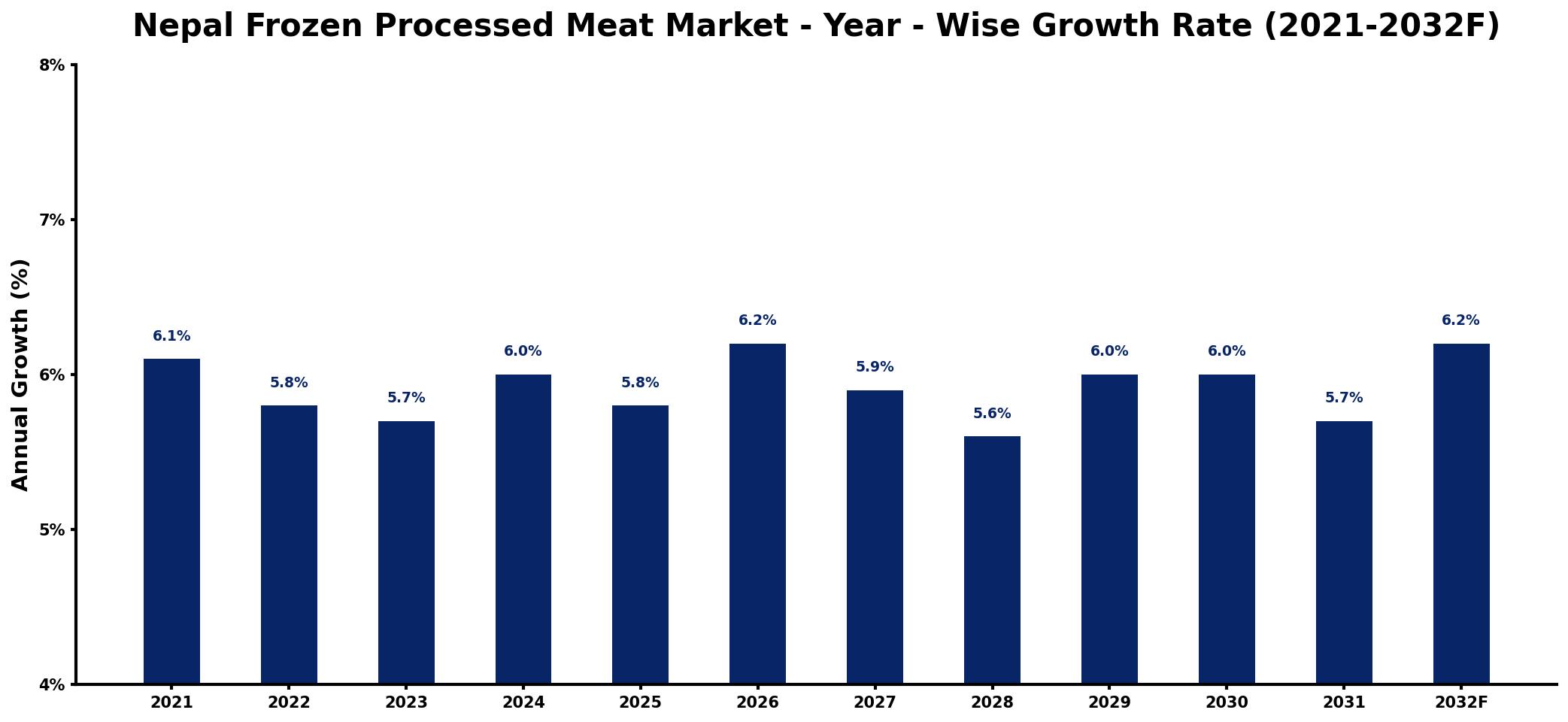
The table below presents the year‑wise growth rates along with the key drivers influencing the market
| Year | Growth Rate | Major Drivers |
| 2021 | 6.1% | Rising consumer health awareness |
| 2022 | 5.8% | Increased demand for convenience foods |
| 2023 | 5.7% | Growth in online retail platforms |
| 2024 | 6.0% | Expansion of cold chain logistics |
| 2025 | 5.8% | Emergence of new food trends |
| 2026 | 6.2% | Investment in food safety technologies |
| 2027 | 5.9% | rising demand from electronics |
| 2028 | 5.6% | Adoption of sustainable sourcing practices |
| 2029 | 6.0% | Rise in export opportunities |
| 2030 | 6.0% | Development of value-added offerings |
| 2031 | 5.7% | Increase in disposable income levels |
| 2032 | 6.2% | strengthening underlying market demand |
Note: Market size estimations and growth projections presented in this report are based on 6Wresearch's proprietary forecasting methodology, utilizing the latest available industry data, government publications, and primary research inputs.
Nepal Frozen Processed Meat Market Synopsis
In recent years, the Nepal Frozen Processed Meat Market has gained momentum, primarily driven by urban lifestyles and growing consumer preferences for convenient meal solutions. As the market evolves, opportunities for product innovation and quality enhancement will play a critical role in its future trajectory.
Looking ahead, the market is expected to continue its upward trajectory. Factors such as improved cold chain logistics and increasing awareness of food safety will enhance the accessibility of frozen processed meat products, allowing companies to cater to a wider consumer base.
Nepal Frozen Processed Meat Market Key Takeaways
- The market is experiencing a significant shift toward ready-to-eat and convenient food options.
- Health-conscious trends are leading to a demand for lower-fat and gourmet frozen meat products.
- Investment in cold chain infrastructure is crucial for distribution efficiency across urban and rural areas.
- Government regulations ensure food safety, impacting market entry for new players.
- Innovation in product variety and packaging can attract a diverse consumer demographic.
Evaluation of Restraints in Nepal Frozen Processed Meat Market
Despite its growth potential, the Nepal Frozen Processed Meat Market faces notable challenges. A lack of consumer awareness regarding frozen processed meats hampers acceptance, as traditional preferences for fresh meat remain strong. Additionally, infrastructural constraints, including inadequate cold storage facilities and distribution logistics, limit the reach of frozen meat products. Regulatory challenges, such as compliance with stringent food safety standards, further complicate market dynamics, compelling companies to adopt robust quality control measures to gain consumer trust.
Nepal Frozen Processed Meat Market Trends
Current trends reflect a rising appetite for health-focused frozen processed meat products. Consumers are increasingly seeking options that are lower in sodium, additives, and unhealthy fats. There is also a growing interest in premium offerings, as consumers are willing to invest in high-quality products that deliver on taste and nutritional value. Furthermore, manufacturers are adopting innovative packaging solutions to improve shelf life and enhance product visibility, effectively catering to the evolving preferences of Nepalese consumers.
Nepal Frozen Processed Meat Market Opportunities
The Nepal Frozen Processed Meat Market presents ample opportunities for growth and investment. With rising consumer demand for ready-to-cook meals, companies can capitalize on this trend by developing modern processing facilities and leveraging technology to enhance product quality. Introducing diverse product lines and flavors tailored to local tastes will be key to engaging consumers. Furthermore, strengthening distribution channels and utilizing digital marketing strategies will facilitate deeper market penetration, ensuring that companies can effectively meet the increasing appetite for convenient food options.
Government Initiatives in the Nepal Frozen Processed Meat Market
Government initiatives play a pivotal role in shaping the Nepal Frozen Processed Meat Market. The Department of Food Technology and Quality Control (DFTQC) enforces strict quality control measures, ensuring that food safety standards are maintained. Regulatory frameworks regarding product labeling and nutritional disclosures enhance transparency for consumers. Additionally, import regulations are designed to monitor the quality of meat products entering the country, thereby protecting local producers and promoting self-sufficiency within the domestic market.
Future Insights of the Nepal Frozen Processed Meat Market
The outlook for the Nepal Frozen Processed Meat Market from 2026 to 2032 is optimistic, with steady growth anticipated. Urbanization and evolving lifestyles will continue to drive demand for convenient food solutions. Moreover, advancements in cold chain infrastructure are expected to improve product accessibility, particularly in previously underserved regions. As disposable incomes rise, consumers will likely explore more premium options, further boosting market expansion. However, companies must remain agile to navigate challenges such as price sensitivity and competition from traditional fresh meat sources.
Nepal Frozen Processed Meat Market Latest Developments (2025 - 2026)
In recent months, the Nepal Frozen Processed Meat Market has seen notable developments focusing on sustainability and quality improvements. Companies are increasingly investing in modern technology to enhance processing techniques, ensuring product freshness and safety. Additionally, marketing efforts are shifting towards educating consumers about the benefits of frozen processed meats, helping to bridge the gap between traditional and modern dietary preferences.
Nepal Frozen Processed Meat Market - Key Attractiveness of the Report
- 10 Years of Market Numbers
- Historical Data Starting from 2022 to 2025
- Base Year: 2025
- Forecast Data until 2032
- Key Performance Indicators Impacting the Market
- Major Upcoming Developments and Projects
Key Highlights of the Report:
- Nepal Frozen Processed Meat Market Outlook
- Market Size of Nepal Frozen Processed Meat Market, 2025
- Forecast of Nepal Frozen Processed Meat Market, 2032
- Historical Data and Forecast of Nepal Frozen Processed Meat Revenues & Volume for the Period 2022-2032F
- Nepal Frozen Processed Meat Market Trend Evolution
- Nepal Frozen Processed Meat Market Drivers and Challenges
- Nepal Frozen Processed Meat Price Trends
- Nepal Frozen Processed Meat Porter's Five Forces
- Nepal Frozen Processed Meat Industry Life Cycle
- Historical Data and Forecast of Nepal Frozen Processed Meat Market Revenues & Volume By Product Type for the Period 2022-2032F
- Historical Data and Forecast of Nepal Frozen Processed Meat Market Revenues & Volume By Beef for the Period 2022-2032F
- Historical Data and Forecast of Nepal Frozen Processed Meat Market Revenues & Volume By Pork for the Period 2022-2032F
- Historical Data and Forecast of Nepal Frozen Processed Meat Market Revenues & Volume By Chicken for the Period 2022-2032F
- Historical Data and Forecast of Nepal Frozen Processed Meat Market Revenues & Volume By Mutton for the Period 2022-2032F
- Historical Data and Forecast of Nepal Frozen Processed Meat Market Revenues & Volume By Others for the Period 2022-2032F
- Historical Data and Forecast of Nepal Frozen Processed Meat Market Revenues & Volume By Application for the Period 2022-2032F
- Historical Data and Forecast of Nepal Frozen Processed Meat Market Revenues & Volume By Retail Store for the Period 2022-2032F
- Historical Data and Forecast of Nepal Frozen Processed Meat Market Revenues & Volume By Online Sale for the Period 2022-2032F
- Nepal Frozen Processed Meat Import Export Trade Statistics
- Market Opportunity Assessment By Product Type
- Market Opportunity Assessment By Application
- Nepal Frozen Processed Meat Top Companies Market Share
- Nepal Frozen Processed Meat Competitive Benchmarking By Technical and Operational Parameters
- Nepal Frozen Processed Meat Company Profiles
- Nepal Frozen Processed Meat Key Strategic Recommendations






































