Nepal Prefabricated Building Market Size Growth Rate
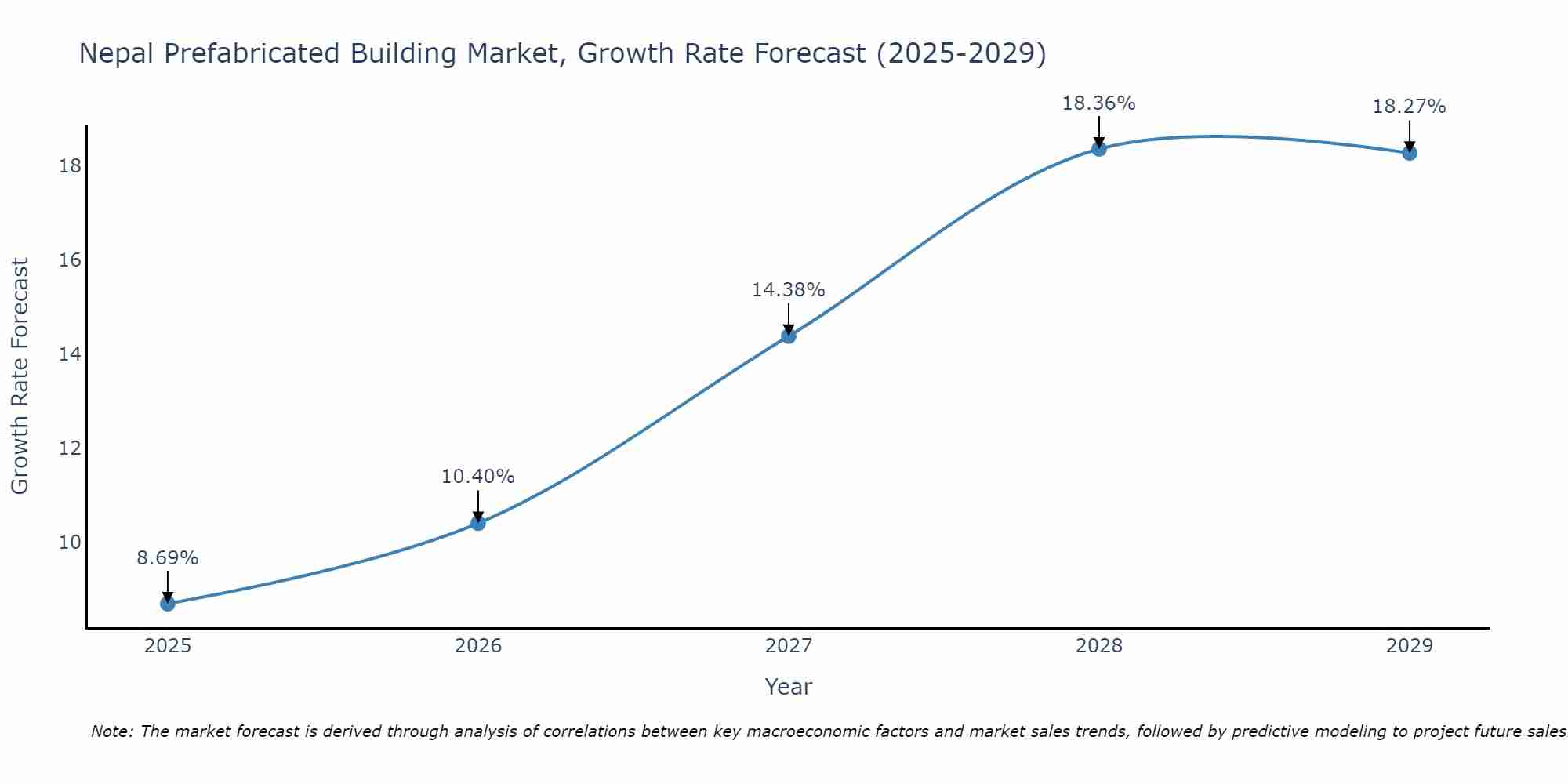
The Nepal Prefabricated Building Market is projected to witness mixed growth rate patterns during 2025 to 2029. Starting at 8.69% in 2025, the market peaks at 18.36% in 2028, and settles at 18.27% by 2029.
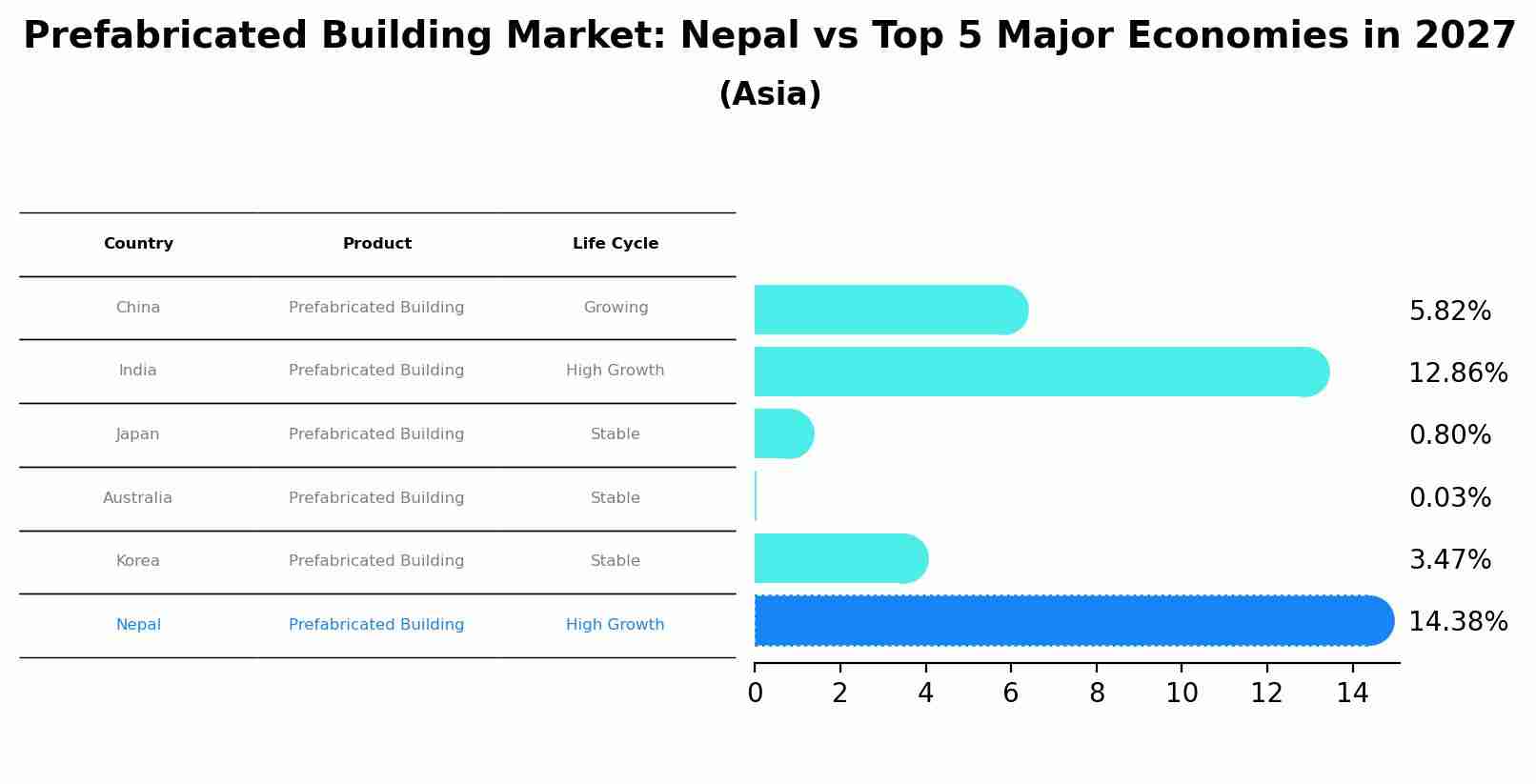
Prefabricated Building Market: Nepal vs Top 5 Major Economies in 2027 (Asia)
By 2027, Nepal's Prefabricated Building market is forecasted to achieve a high growth rate of 14.38%, with China leading the Asia region, followed by India, Japan, Australia and South Korea.
Nepal Prefabricated Building Market Overview
The Nepal prefabricated building market is experiencing significant growth due to factors such as rapid urbanization, population growth, and the need for cost-effective and efficient construction solutions. Prefabricated buildings offer advantages such as shorter construction times, reduced labor costs, and environmental sustainability. The market is driven by a growing demand for residential, commercial, and industrial spaces in urban areas, as well as government initiatives promoting the use of prefabricated construction methods. Key players in the market include local manufacturers and international companies offering a range of prefabricated building solutions. The market is expected to continue expanding as more construction projects embrace prefabrication to meet the country`s infrastructure and housing needs efficiently.
Nepal Prefabricated Building Market Trends
The Nepal prefabricated building market is witnessing growth due to factors such as rapid urbanization, increasing demand for affordable housing solutions, and government initiatives to promote sustainable construction practices. Modular construction techniques are gaining popularity as they offer faster construction timelines, cost-effectiveness, and reduced environmental impact compared to traditional methods. Additionally, the COVID-19 pandemic has further highlighted the importance of off-site construction methods in ensuring safety and efficiency. The market is also seeing a rise in innovative prefabricated designs that cater to diverse needs, including residential, commercial, and institutional buildings. As the construction industry in Nepal continues to evolve, prefabricated buildings are expected to play a significant role in meeting the growing demand for efficient and sustainable construction solutions.
Nepal Prefabricated Building Market Challenges
In the Nepal prefabricated building market, challenges include limited awareness and acceptance of prefabricated construction methods among developers and consumers, as traditional construction methods are more commonly used. Additionally, there may be a lack of skilled labor and expertise in prefabricated construction techniques, leading to concerns about quality and safety standards. Infrastructure constraints, such as transportation difficulties for prefabricated components to remote areas, can also pose challenges. Furthermore, regulatory hurdles and a lack of standardized building codes specific to prefabricated construction may hinder the growth of the market. Overall, overcoming these challenges will require education and promotion of the benefits of prefabricated buildings, as well as investment in training programs and infrastructure improvements to support the industry`s development.
Nepal Prefabricated Building Market Investment Opportunities
The Nepal Prefabricated Building Market presents promising investment opportunities due to the country`s rapid urbanization and the increasing demand for affordable and efficient housing solutions. With a growing population and limited space in urban areas, prefabricated buildings offer a cost-effective and time-efficient construction option. Investors can explore opportunities in manufacturing and supplying prefabricated building materials, partnering with developers to construct prefabricated housing projects, or investing in companies specializing in modular construction technology. Additionally, government initiatives promoting sustainable and earthquake-resistant construction methods further enhance the attractiveness of investing in the Nepal Prefabricated Building Market. Overall, the market`s potential for growth and innovation make it an attractive prospect for investors looking to capitalize on the country`s evolving construction sector.
Nepal Prefabricated Building Market Government Policy
The government of Nepal has implemented several policies to promote the growth of the prefabricated building market in the country. These policies include providing incentives such as tax breaks and subsidies for companies engaged in prefabricated construction, streamlining approval processes for prefabricated building projects, and promoting the use of environmentally friendly and earthquake-resistant materials in prefabricated construction. Additionally, the government has established standards and regulations to ensure the quality and safety of prefabricated buildings. These policies aim to address the housing shortage in Nepal, particularly in urban areas, by encouraging the use of cost-effective and efficient prefabricated construction methods while also promoting sustainable and resilient building practices.
Nepal Prefabricated Building Market Future Outlook
The future outlook for the Nepal Prefabricated Building Market is promising, with significant growth expected in the coming years. Factors such as rapid urbanization, increasing population, and the government`s focus on infrastructure development are driving the demand for prefabricated buildings in Nepal. Additionally, the benefits of cost-effectiveness, time efficiency, and sustainability offered by prefabricated construction methods are attracting developers and investors. As the construction industry continues to evolve and prioritize speed and efficiency, prefabricated buildings are likely to become increasingly popular in Nepal. With advancements in technology and materials, the market is expected to witness innovation and expansion, making prefabricated buildings a key player in the construction sector of Nepal.
Key Highlights of the Report:
- Nepal Prefabricated Building Market Outlook
- Market Size of Nepal Prefabricated Building Market, 2024
- Forecast of Nepal Prefabricated Building Market, 2031
- Historical Data and Forecast of Nepal Prefabricated Building Revenues & Volume for the Period 2021 - 2031
- Nepal Prefabricated Building Market Trend Evolution
- Nepal Prefabricated Building Market Drivers and Challenges
- Nepal Prefabricated Building Price Trends
- Nepal Prefabricated Building Porter's Five Forces
- Nepal Prefabricated Building Industry Life Cycle
- Historical Data and Forecast of Nepal Prefabricated Building Market Revenues & Volume By Dimensions for the Period 2021 - 2031
- Historical Data and Forecast of Nepal Prefabricated Building Market Revenues & Volume By Skeleton System for the Period 2021 - 2031
- Historical Data and Forecast of Nepal Prefabricated Building Market Revenues & Volume By Panel System for the Period 2021 - 2031
- Historical Data and Forecast of Nepal Prefabricated Building Market Revenues & Volume By Cellular System for the Period 2021 - 2031
- Historical Data and Forecast of Nepal Prefabricated Building Market Revenues & Volume By Combined System for the Period 2021 - 2031
- Historical Data and Forecast of Nepal Prefabricated Building Market Revenues & Volume By Application for the Period 2021 - 2031
- Historical Data and Forecast of Nepal Prefabricated Building Market Revenues & Volume By Residential for the Period 2021 - 2031
- Historical Data and Forecast of Nepal Prefabricated Building Market Revenues & Volume By Non-Residential for the Period 2021 - 2031
- Nepal Prefabricated Building Import Export Trade Statistics
- Market Opportunity Assessment By Dimensions
- Market Opportunity Assessment By Application
- Nepal Prefabricated Building Top Companies Market Share
- Nepal Prefabricated Building Competitive Benchmarking By Technical and Operational Parameters
- Nepal Prefabricated Building Company Profiles
- Nepal Prefabricated Building Key Strategic Recommendations






































