Nepal Underwater Concrete Market Size, Share & Growth Rate
The Nepal Underwater Concrete Market was estimated at USD 1141 Million in 2025 and is projected to reach USD 1628 Million by 2032, growing at a CAGR of 5.2% from 2026 to 2032. This growth is primarily fueled by the surge in infrastructure projects, particularly those related to hydropower, transportation, and coastal development. The government's commitment to enhancing national connectivity and resilience against natural disasters plays a pivotal role in driving demand for robust underwater concrete solutions.
Nepal Underwater Concrete Market Year-wise Growth Rate and Key Drivers
This graph highlights how the Nepal Underwater Concrete Market has steadily grown over the years, supported by major growth factors.
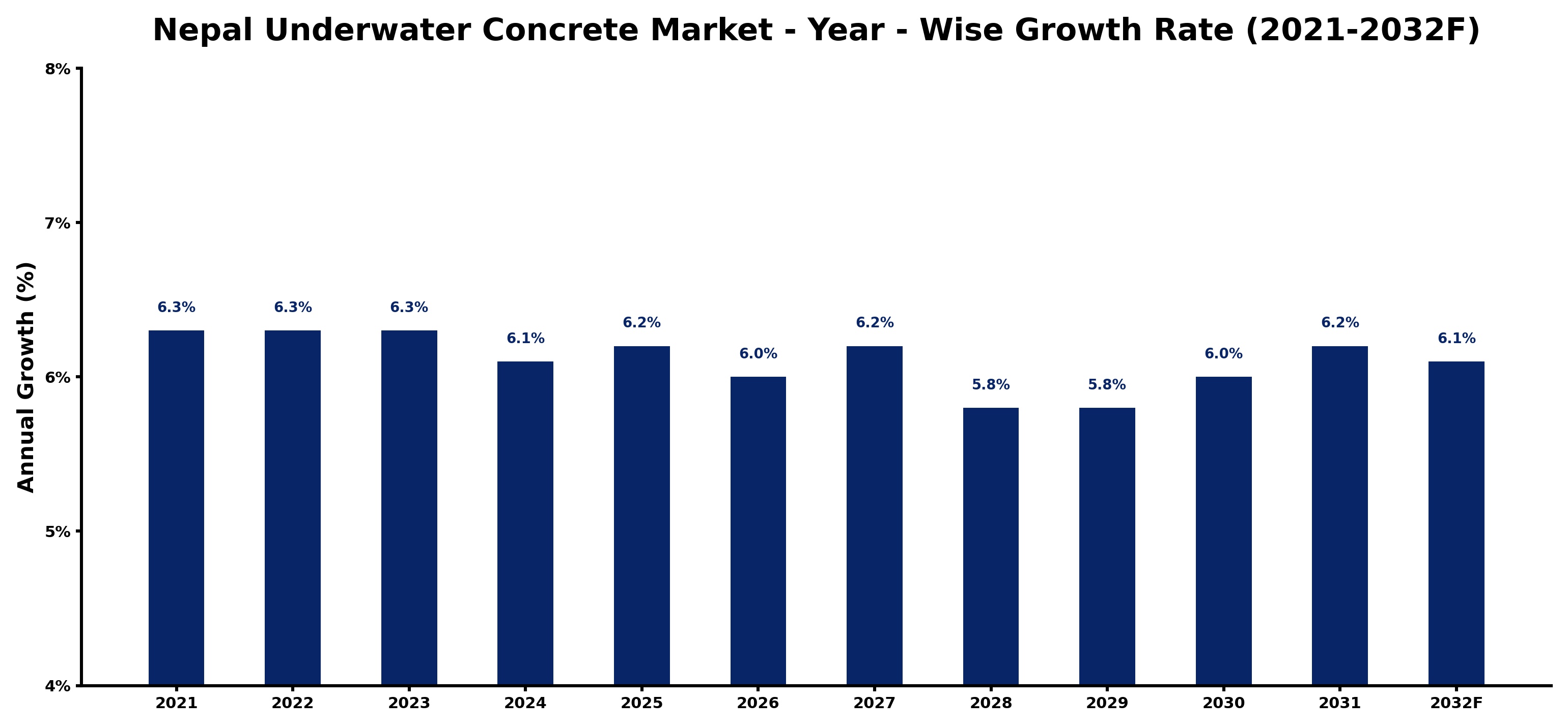
The table below presents the year‑wise growth rates along with the key drivers influencing the market
| Year | Growth Rate | Major Drivers |
| 2021 | 6.3% | Hydropower construction projects boost demand for specialized concrete solutions |
| 2022 | 6.3% | Advanced underwater concrete technologies boost marine infrastructure project feasibility |
| 2023 | 6.3% | Modernized construction techniques boost demand for specialized concrete products |
| 2024 | 6.1% | Hydropower projects demand increased underwater concrete manufacturing capacity |
| 2025 | 6.2% | Infrastructure development projects boosted demand for underwater concrete applications |
| 2026 | 6.0% | Advanced concrete mixing technologies enhance underwater construction project timelines |
| 2027 | 6.2% | Export driven technological adoption boosts underwater concrete application efficiency |
| 2028 | 5.8% | Higher infrastructure development projects boost demand for underwater concrete |
| 2029 | 5.8% | Innovative waterproofing technologies boost demand for underwater concrete solutions |
| 2030 | 6.0% | Export driven infrastructure projects boosted demand for specialized concrete formulations |
| 2031 | 6.2% | Infrastructure development projects boost demand for underwater concrete solutions |
| 2032 | 6.1% | Improved infrastructure projects stimulated demand for specialized underwater concrete |
Note - Market size estimations and growth projections presented in this report are based on 6Wresearch's advanced forecasting approach, validated with industry datasets as of June 2026.
Nepal Underwater Concrete Market Synopsis
The Nepal underwater concrete market is currently navigating a dynamic landscape characterized by increased construction activity across various sectors. The emphasis on durable and sustainable building practices has propelled the adoption of underwater concrete as a vital material for construction projects in challenging aquatic environments.
As Nepal continues to invest significantly in infrastructure, particularly in areas susceptible to flooding, the relevance of underwater concrete is more pronounced than ever. The material's resilience against harsh underwater conditions underpins its critical role in the successful execution of major development projects across the nation.
Nepal Underwater Concrete Market Key Takeaways
- The market is driven by robust infrastructure projects requiring advanced underwater construction methods.
- Government initiatives are fostering a more regulated and environmentally-conscious approach to underwater construction.
- The adoption of advanced technologies and innovative techniques is enhancing the performance of underwater concrete.
- Skilled labor development is increasingly prioritized to meet the specific needs of underwater concrete applications.
- Investment opportunities are emerging in specialized underwater concrete mixes and advanced placement equipment.
Evaluation of Restraints in Nepal Underwater Concrete Market
While the Nepal underwater concrete market exhibits significant growth potential, several constraints hinder its full realization. One of the primary challenges is the limited awareness and understanding of underwater concrete technologies among industry stakeholders, which can lead to suboptimal material usage and construction practices. Additionally, the high initial costs associated with underwater construction methods discourage some investors from fully committing to such projects. The complexities of working in underwater environments, including issues related to curing processes and placement under challenging conditions, further complicate project execution, often resulting in increased costs and extended timelines.
Nepal Underwater Concrete Market Trends
Current trends in the Nepal underwater concrete market are heavily influenced by the need for durability and sustainability. There is a growing inclination toward high-performance admixtures that enhance both workability and strength of underwater concrete. Specialized equipment designed for efficient placement and compaction is also gaining traction, ensuring that concrete achieves its required performance standards even under challenging underwater conditions. Furthermore, training initiatives aimed at upskilling construction professionals in underwater practices are becoming increasingly important, ensuring that safety and quality standards are consistently met.
Nepal Underwater Concrete Market Opportunities
Opportunities within the Nepal underwater concrete market are vast and varied, particularly for those willing to innovate. With the increasing demand for robust and reliable underwater concrete solutions, there are significant prospects for companies specializing in customized concrete mixes tailored for specific aquatic environments. Moreover, advancements in technology present lucrative avenues for investment in new placement methods and equipment. Companies focusing on research and development aimed at enhancing the environmental sustainability of underwater concrete products are also likely to find a receptive market as awareness of eco-friendly practices grows.
Government Initiatives in the Nepal Underwater Concrete Market
The Nepalese government is actively involved in shaping the underwater concrete market through various regulatory measures aimed at promoting responsible and sustainable construction practices. This includes enforcing strict building codes and standards for underwater projects to protect water bodies and ensure ecological balance. Additionally, initiatives aimed at encouraging the use of eco-friendly materials and construction techniques are gaining momentum, further aligning with global sustainability goals. Licensing requirements ensure that only qualified contractors engage in underwater construction, thereby maintaining high safety and quality standards.
Future Insights of the Nepal Underwater Concrete Market
The outlook for the Nepal underwater concrete market appears robust as the demand for specialized construction materials is expected to rise significantly in the coming years. As major infrastructure projects—such as dams, bridges, and ports—continue to progress, the need for effective and durable underwater concrete solutions will remain critical. The anticipated technological advancements in the field will likely enhance the efficiency and effectiveness of underwater construction, facilitating smoother project execution. With a dedicated focus on infrastructure enhancement and disaster resilience, the future trajectory of this market is set for expansion.
Nepal Underwater Concrete Market Latest Developments (May 2025 - June 2026)
Recently, the underwater concrete market in Nepal has seen an uptick in collaborative projects between governmental bodies and private sector entities, aimed at exploring innovative construction practices. Additionally, several training programs have been implemented to educate industry professionals on the latest technologies and techniques in underwater concrete applications. Such initiatives are expected to improve the overall quality and safety of underwater construction projects across the country, setting a precedent for future endeavors.
Nepal Underwater Concrete Market - Key Attractiveness of the Report
- 10 Years of Market Numbers
- Historical Data Starting from 2022 to 2025
- Base Year: 2025
- Forecast Data until 2032
- Key Performance Indicators Impacting the Market
- Major Upcoming Developments and Projects
Key Highlights of the Report:
- Nepal Underwater Concrete Market Outlook
- Market Size of Nepal Underwater Concrete Market, 2025
- Forecast of Nepal Underwater Concrete Market, 2032
- Historical Data and Forecast of Nepal Underwater Concrete Revenues & Volume for the Period 2022-2032F
- Nepal Underwater Concrete Market Trend Evolution
- Nepal Underwater Concrete Market Drivers and Challenges
- Nepal Underwater Concrete Price Trends
- Nepal Underwater Concrete Porter's Five Forces
- Nepal Underwater Concrete Industry Life Cycle
- Historical Data and Forecast of Nepal Underwater Concrete Market Revenues & Volume By Raw Material for the Period 2022-2032F
- Historical Data and Forecast of Nepal Underwater Concrete Market Revenues & Volume By Admixtures for the Period 2022-2032F
- Historical Data and Forecast of Nepal Underwater Concrete Market Revenues & Volume By Aggregates for the Period 2022-2032F
- Historical Data and Forecast of Nepal Underwater Concrete Market Revenues & Volume By Cement for the Period 2022-2032F
- Historical Data and Forecast of Nepal Underwater Concrete Market Revenues & Volume By Others for the Period 2022-2032F
- Historical Data and Forecast of Nepal Underwater Concrete Market Revenues & Volume By Application for the Period 2022-2032F
- Historical Data and Forecast of Nepal Underwater Concrete Market Revenues & Volume By Hydropower for the Period 2022-2032F
- Historical Data and Forecast of Nepal Underwater Concrete Market Revenues & Volume By Marine for the Period 2022-2032F
- Historical Data and Forecast of Nepal Underwater Concrete Market Revenues & Volume By Shore protection for the Period 2022-2032F
- Historical Data and Forecast of Nepal Underwater Concrete Market Revenues & Volume By Underwater repairs for the Period 2022-2032F
- Historical Data and Forecast of Nepal Underwater Concrete Market Revenues & Volume By Tunnels for the Period 2022-2032F
- Historical Data and Forecast of Nepal Underwater Concrete Market Revenues & Volume By Swimming pools for the Period 2022-2032F
- Historical Data and Forecast of Nepal Underwater Concrete Market Revenues & Volume By Others for the Period 2022-2032F
- Nepal Underwater Concrete Import Export Trade Statistics
- Market Opportunity Assessment By Raw Material
- Market Opportunity Assessment By Application
- Nepal Underwater Concrete Top Companies Market Share
- Nepal Underwater Concrete Competitive Benchmarking By Technical and Operational Parameters
- Nepal Underwater Concrete Company Profiles
- Nepal Underwater Concrete Key Strategic Recommendations






































