Nepal Washable Markers Market Size, Share & Growth Rate
The Nepal Washable Markers Market was estimated at USD 301 Million in 2025 and is projected to reach USD 426 Million by 2032, growing at a CAGR of 5.1% from 2026 to 2032. This growth trajectory is bolstered by a rising demand for washable markers in educational settings, as schools increasingly prioritize creative expression among students. Additionally, the expansion of e-commerce platforms has facilitated access to a broader range of products, enhancing consumer convenience and boosting market dynamics.
Nepal Washable Markers Market Year-wise Growth Rate and Key Drivers
This graph highlights how the Nepal Washable Markers Market has steadily grown over the years, supported by major growth factors.
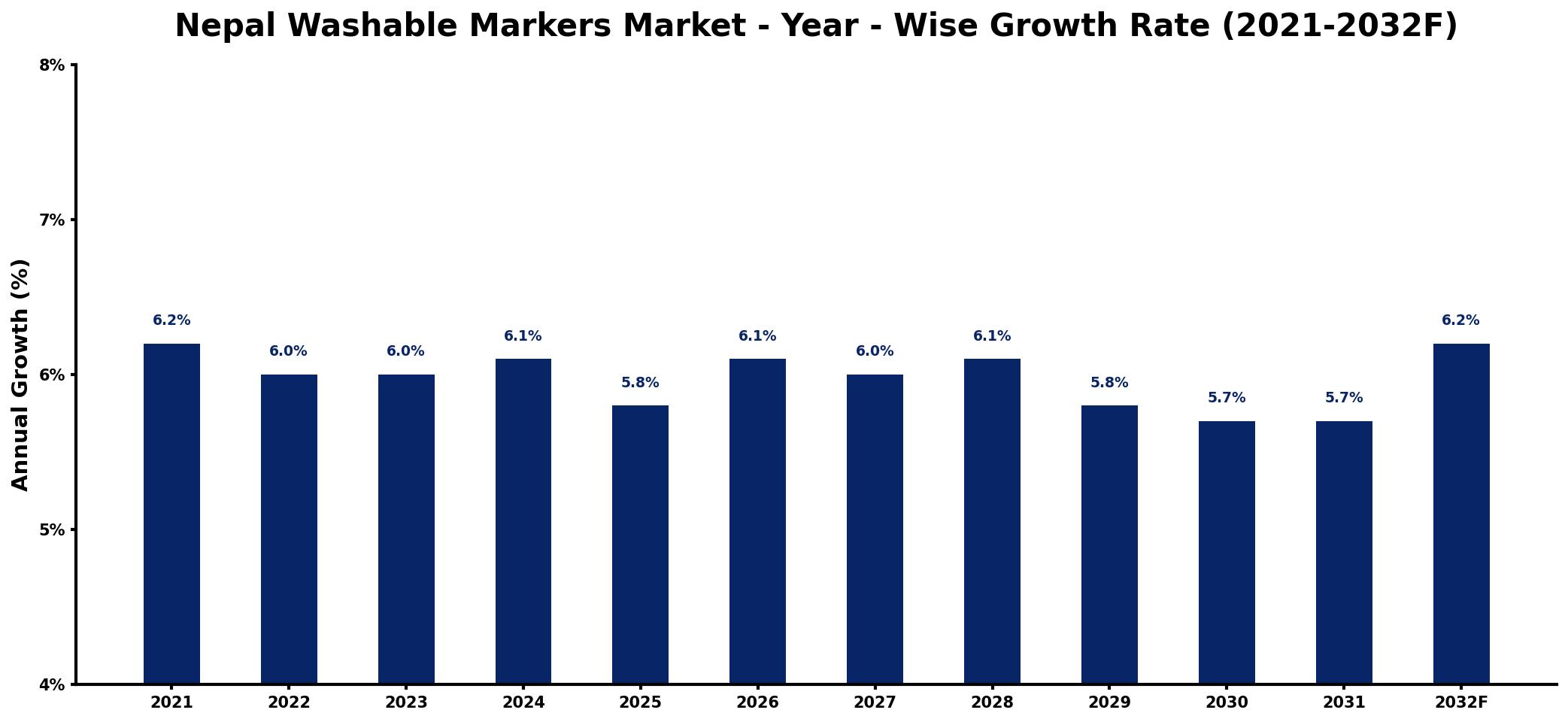
The table below presents the year‑wise growth rates along with the key drivers influencing the market
| Year | Growth Rate | Major Drivers |
| 2021 | 6.2% | Increase in educational investments |
| 2022 | 6.0% | Rise in creative activities demand |
| 2023 | 6.0% | Growth in art supplies market |
| 2024 | 6.1% | Expansion of school programs |
| 2025 | 5.8% | Demand from home schooling rise |
| 2026 | 6.1% | improved raw material availability |
| 2027 | 6.0% | expanding healthcare application demand |
| 2028 | 6.1% | Surge in online education platforms |
| 2029 | 5.8% | rising demand from electronics |
| 2030 | 5.7% | rising infrastructure development spending |
| 2031 | 5.7% | strengthening underlying market demand |
| 2032 | 6.2% | expanding industrial usage applications |
Note: Market size estimations and growth projections presented in this report are based on 6Wresearch's proprietary forecasting methodology, utilizing the latest available industry data, government publications, and primary research inputs.
Nepal Washable Markers Market Synopsis
In Nepal, the growing emphasis on art education has significantly driven the demand for high-quality washable markers, particularly in schools and art institutions. Consumers are increasingly seeking markers that not only offer vibrant colors but are also eco-friendly and non-toxic, reflecting a broader shift towards sustainable consumerism.
Furthermore, the market is diversifying with the introduction of specialized markers designed for various artistic endeavors, from calligraphy to intricate detailing. This is catering to both children and adults, as more individuals embrace activities such as adult coloring books and art therapy, thereby expanding the consumer base.
Nepal Washable Markers Market Key Takeaways
- Increasing literacy rates and education-focused initiatives drive demand for washable markers.
- Environmental concerns boost the popularity of eco-friendly and non-toxic marker options.
- E-commerce growth allows for enhanced product accessibility to a wider audience.
- Demand for specialized markers continues to rise, catering to both educational and artistic needs.
- Continuous product innovation is essential for manufacturers to maintain market relevance.
Evaluation of Restraints in Nepal Washable Markers Market
While the Nepal Washable Markers Market showcases positive growth, it faces several limitations. Intense competition from domestic and international brands puts pressure on pricing strategies, making it challenging for manufacturers to maintain margins. Furthermore, distribution networks struggle to effectively reach remote areas, which limits potential market expansion. The constant need for product innovation, to address rapidly changing consumer preferences, adds another layer of complexity. Ensuring compliance with safety and quality regulations is also critical and can deter new entrants into the market.
Nepal Washable Markers Market Trends
The demand for eco-friendly and non-toxic markers is rapidly increasing as consumers become more environmentally conscious. This trend is motivating manufacturers to innovate and improve the quality of inks, ensuring they are both vibrant and safe. Additionally, the popularity of creative activities like adult coloring is pushing demand for premium markers, leading to the emergence of specialized tips for various artistic applications, such as brush and fine tips.
Nepal Washable Markers Market Opportunities
The market presents numerous investment opportunities, particularly in developing innovative, eco-friendly products tailored for children. Targeting educational institutions and leveraging online retail platforms can open new revenue streams. Collaborating with local artists and influencers offers a unique avenue to enhance brand recognition and reach potential consumers, thereby establishing a solid market presence.
Government Initiatives in the Nepal Washable Markers Market
The Nepalese government has enacted policies to ensure the safety and quality of washable markers in the market. These regulations protect consumers, especially children, from harmful substances commonly found in art supplies. Additionally, the government promotes sustainable production practices within the industry, encouraging manufacturers to adopt environmentally friendly methods. Compliance with labeling and packaging requirements further aids in creating a transparent marketplace.
Future Insights of the Nepal Washable Markers Market
Looking ahead to 2026-2032, the Nepal Washable Markers Market is poised for significant expansion, driven by increasing awareness of art education and the rising popularity of creative activities among all age groups. The emphasis on environmentally friendly products will likely continue to shape market offerings, prompting manufacturers to innovate their product lines. As disposable incomes rise, demand for high-quality, safe coloring products is expected to escalate, creating a fertile environment for growth.
Nepal Washable Markers Market Latest Developments (2025 - 2026)
Recent trends indicate a marked shift towards sustainable production practices within the washable markers industry, as companies begin to prioritize eco-friendly materials. There is a growing focus on online marketing strategies to engage consumers, particularly younger demographics who are increasingly turning to digital platforms for their purchasing needs. The introduction of innovative product features, such as markers that feature dual tips for versatility, is also gaining traction as brands strive to differentiate themselves in a competitive market.
Nepal Washable Markers Market - Key Attractiveness of the Report
- 10 Years of Market Numbers
- Historical Data Starting from 2022 to 2025
- Base Year: 2025
- Forecast Data until 2032
- Key Performance Indicators Impacting the Market
- Major Upcoming Developments and Projects
Key Highlights of the Report:
- Nepal Washable Markers Market Outlook
- Market Size of Nepal Washable Markers Market, 2025
- Forecast of Nepal Washable Markers Market, 2032
- Historical Data and Forecast of Nepal Washable Markers Revenues & Volume for the Period 2022-2032F
- Nepal Washable Markers Market Trend Evolution
- Nepal Washable Markers Market Drivers and Challenges
- Nepal Washable Markers Price Trends
- Nepal Washable Markers Porter's Five Forces
- Nepal Washable Markers Industry Life Cycle
- Historical Data and Forecast of Nepal Washable Markers Market Revenues & Volume By Washability for the Period 2022-2032F
- Historical Data and Forecast of Nepal Washable Markers Market Revenues & Volume By Basic- Washable for the Period 2022-2032F
- Historical Data and Forecast of Nepal Washable Markers Market Revenues & Volume By Super-washable for the Period 2022-2032F
- Historical Data and Forecast of Nepal Washable Markers Market Revenues & Volume By End User for the Period 2022-2032F
- Historical Data and Forecast of Nepal Washable Markers Market Revenues & Volume By Children for the Period 2022-2032F
- Historical Data and Forecast of Nepal Washable Markers Market Revenues & Volume By Professionals for the Period 2022-2032F
- Nepal Washable Markers Import Export Trade Statistics
- Market Opportunity Assessment By Washability
- Market Opportunity Assessment By End User
- Nepal Washable Markers Top Companies Market Share
- Nepal Washable Markers Competitive Benchmarking By Technical and Operational Parameters
- Nepal Washable Markers Company Profiles
- Nepal Washable Markers Key Strategic Recommendations






































