New Zealand Accumulator Market Top 5 Importing Countries and Market Competition (HHI) Analysis
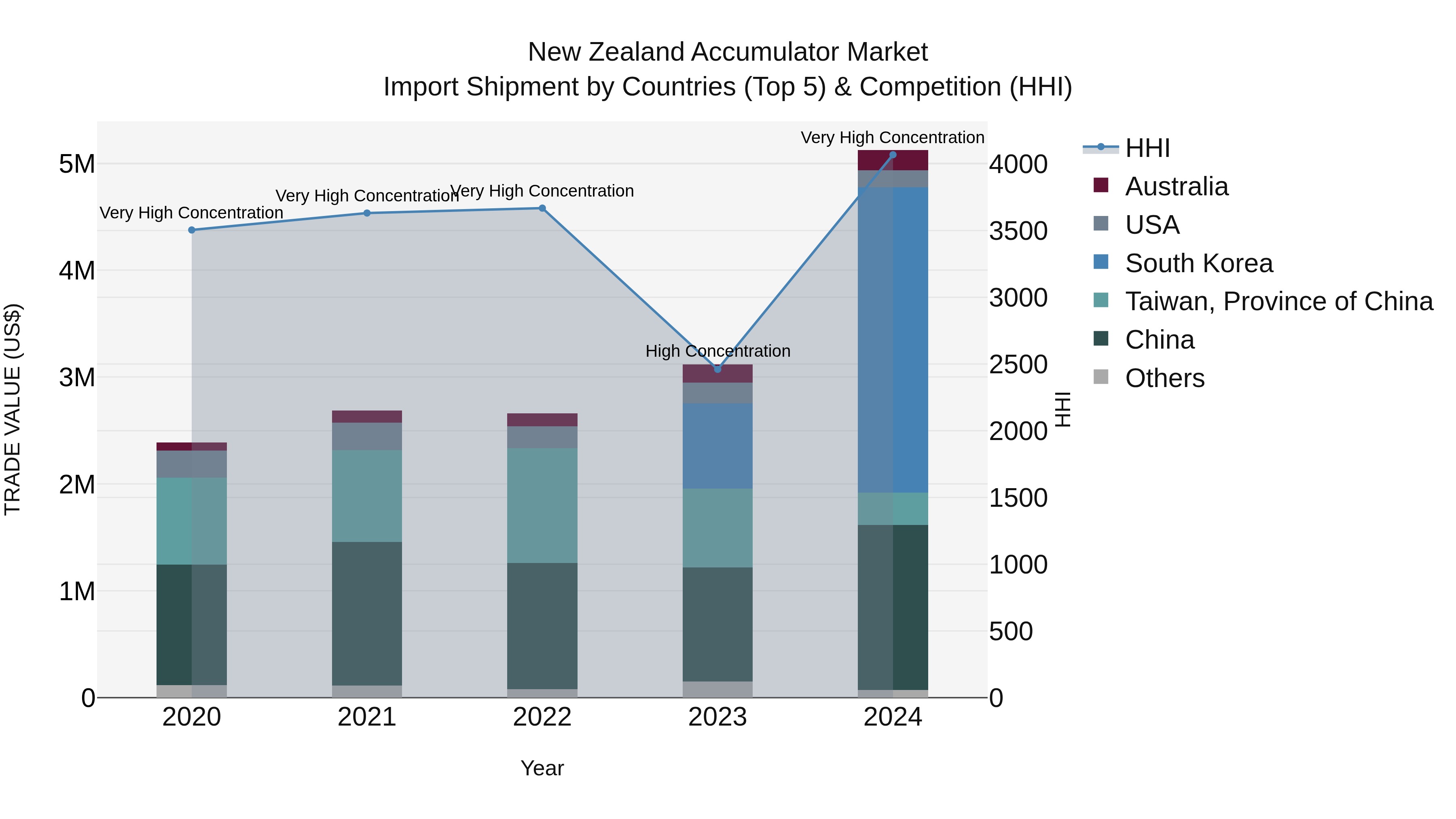
The import shipments of accumulators in New Zealand show a significant increase in concentration levels in 2024, with South Korea, China, Taiwan, Australia, and the USA leading as the top exporting countries. The high concentration levels indicate a strong presence of these key players in the market. With a remarkable Compound Annual Growth Rate (CAGR) of 21.01% from 2020 to 2024 and a notable growth rate of 64.19% from 2023 to 2024, the accumulator import market in New Zealand is experiencing rapid expansion and robust demand for these products.
Key Highlights of the Report:
- New Zealand Accumulator Market Outlook
- Market Size of New Zealand Accumulator Market, 2025
- Forecast of New Zealand Accumulator Market, 2032
- Historical Data and Forecast of New Zealand Accumulator Revenues & Volume for the Period 2022 - 2032F
- New Zealand Accumulator Market Trend Evolution
- New Zealand Accumulator Market Drivers and Challenges
- New Zealand Accumulator Price Trends
- New Zealand Accumulator Porter`s Five Forces
- New Zealand Accumulator Industry Life Cycle
- Historical Data and Forecast of New Zealand Accumulator Market Revenues & Volume By Type for the Period 2022 - 2032F
- Historical Data and Forecast of New Zealand Accumulator Market Revenues & Volume By Bladder Accumulator for the Period 2022 - 2032F
- Historical Data and Forecast of New Zealand Accumulator Market Revenues & Volume By Piston Accumulator for the Period 2022 - 2032F
- Historical Data and Forecast of New Zealand Accumulator Market Revenues & Volume By Diaphragm Accumulator for the Period 2022 - 2032F
- Historical Data and Forecast of New Zealand Accumulator Market Revenues & Volume By Application for the Period 2022 - 2032F
- Historical Data and Forecast of New Zealand Accumulator Market Revenues & Volume By Automobile Industry for the Period 2022 - 2032F
- Historical Data and Forecast of New Zealand Accumulator Market Revenues & Volume By Construction and Agricultural for the Period 2022 - 2032F
- Historical Data and Forecast of New Zealand Accumulator Market Revenues & Volume By Machinery for the Period 2022 - 2032F
- Historical Data and Forecast of New Zealand Accumulator Market Revenues & Volume By Plastics Industry for the Period 2022 - 2032F
- Historical Data and Forecast of New Zealand Accumulator Market Revenues & Volume By Marine Industry for the Period 2022 - 2032F
- Historical Data and Forecast of New Zealand Accumulator Market Revenues & Volume By Oil and Gas Industry for the Period 2022 - 2032F
- Historical Data and Forecast of New Zealand Accumulator Market Revenues & Volume By Sales Channel for the Period 2022 - 2032F
- Historical Data and Forecast of New Zealand Accumulator Market Revenues & Volume By Direct Channel for the Period 2022 - 2032F
- Historical Data and Forecast of New Zealand Accumulator Market Revenues & Volume By Indirect Channel for the Period 2022 - 2032F
- New Zealand Accumulator Import Export Trade Statistics
- Market Opportunity Assessment By Type
- Market Opportunity Assessment By Application
- Market Opportunity Assessment By Sales Channel
- New Zealand Accumulator Top Companies Market Share
- New Zealand Accumulator Competitive Benchmarking By Technical and Operational Parameters
- New Zealand Accumulator Company Profiles
- New Zealand Accumulator Key Strategic Recommendations






































