New Zealand Consumer Goods Market Top 5 Importing Countries and Market Competition (HHI) Analysis
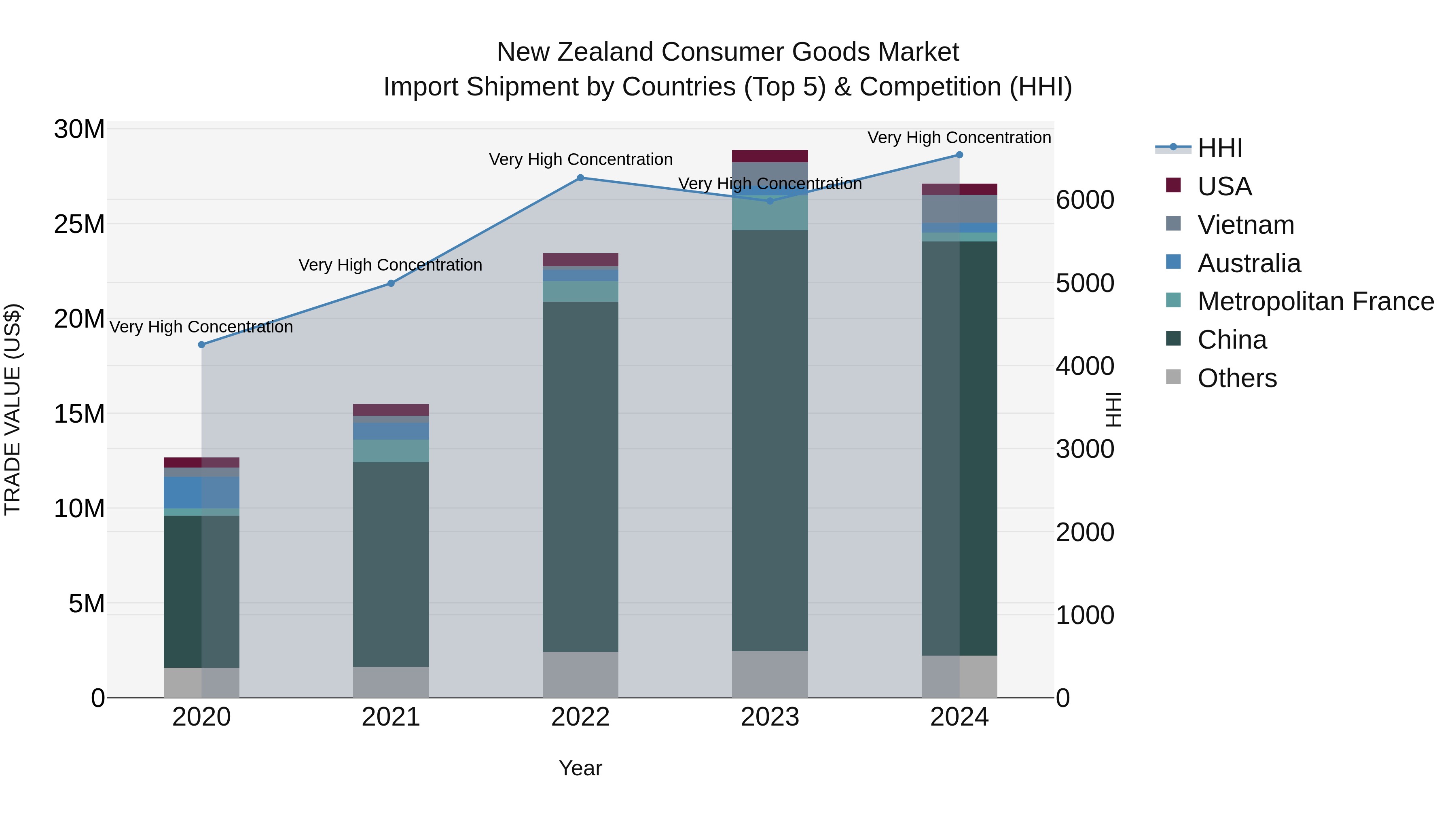
In 2024, New Zealand continued to heavily rely on imports from China, Vietnam, USA, India, and Australia for consumer goods. The high Herfindahl-Hirschman Index (HHI) indicates a concentrated market with limited competition. Despite a remarkable compound annual growth rate (CAGR) of 20.92% from 2020 to 2024, there was a slight decline in the growth rate from 2023 to 2024 at -6.13%. This suggests a potential slowdown in consumer goods import shipments to New Zealand, signaling a need for strategic market adjustments and diversification of import sources for sustainable growth.
Key Highlights of the Report:
- New Zealand Consumer Goods Market Outlook
- Market Size of New Zealand Consumer Goods Market, 2025
- Forecast of New Zealand Consumer Goods Market, 2032
- Historical Data and Forecast of New Zealand Consumer Goods Revenues & Volume for the Period 2022 - 2032F
- New Zealand Consumer Goods Market Trend Evolution
- New Zealand Consumer Goods Market Drivers and Challenges
- New Zealand Consumer Goods Price Trends
- New Zealand Consumer Goods Porter's Five Forces
- New Zealand Consumer Goods Industry Life Cycle
- Historical Data and Forecast of New Zealand Consumer Goods Market Revenues & Volume By Product Type for the Period 2022 - 2032F
- Historical Data and Forecast of New Zealand Consumer Goods Market Revenues & Volume By Electronics for the Period 2022 - 2032F
- Historical Data and Forecast of New Zealand Consumer Goods Market Revenues & Volume By Apparel for the Period 2022 - 2032F
- Historical Data and Forecast of New Zealand Consumer Goods Market Revenues & Volume By Personal Care for the Period 2022 - 2032F
- Historical Data and Forecast of New Zealand Consumer Goods Market Revenues & Volume By Others for the Period 2022 - 2032F
- Historical Data and Forecast of New Zealand Consumer Goods Market Revenues & Volume By Material Type for the Period 2022 - 2032F
- Historical Data and Forecast of New Zealand Consumer Goods Market Revenues & Volume By Plastic for the Period 2022 - 2032F
- Historical Data and Forecast of New Zealand Consumer Goods Market Revenues & Volume By Cotton for the Period 2022 - 2032F
- Historical Data and Forecast of New Zealand Consumer Goods Market Revenues & Volume By Synthetic Materials for the Period 2022 - 2032F
- Historical Data and Forecast of New Zealand Consumer Goods Market Revenues & Volume By Mixed for the Period 2022 - 2032F
- Historical Data and Forecast of New Zealand Consumer Goods Market Revenues & Volume By Distribution Channel for the Period 2022 - 2032F
- Historical Data and Forecast of New Zealand Consumer Goods Market Revenues & Volume By Online Retail for the Period 2022 - 2032F
- Historical Data and Forecast of New Zealand Consumer Goods Market Revenues & Volume By Offline Retail for the Period 2022 - 2032F
- Historical Data and Forecast of New Zealand Consumer Goods Market Revenues & Volume By End User for the Period 2022 - 2032F
- Historical Data and Forecast of New Zealand Consumer Goods Market Revenues & Volume By Individuals for the Period 2022 - 2032F
- Historical Data and Forecast of New Zealand Consumer Goods Market Revenues & Volume By Businesses for the Period 2022 - 2032F
- New Zealand Consumer Goods Import Export Trade Statistics
- Market Opportunity Assessment By Product Type
- Market Opportunity Assessment By Material Type
- Market Opportunity Assessment By Distribution Channel
- Market Opportunity Assessment By End User
- New Zealand Consumer Goods Top Companies Market Share
- New Zealand Consumer Goods Competitive Benchmarking By Technical and Operational Parameters
- New Zealand Consumer Goods Company Profiles
- New Zealand Consumer Goods Key Strategic Recommendations






































