New Zealand Lumber Market Top 5 Importing Countries and Market Competition (HHI) Analysis
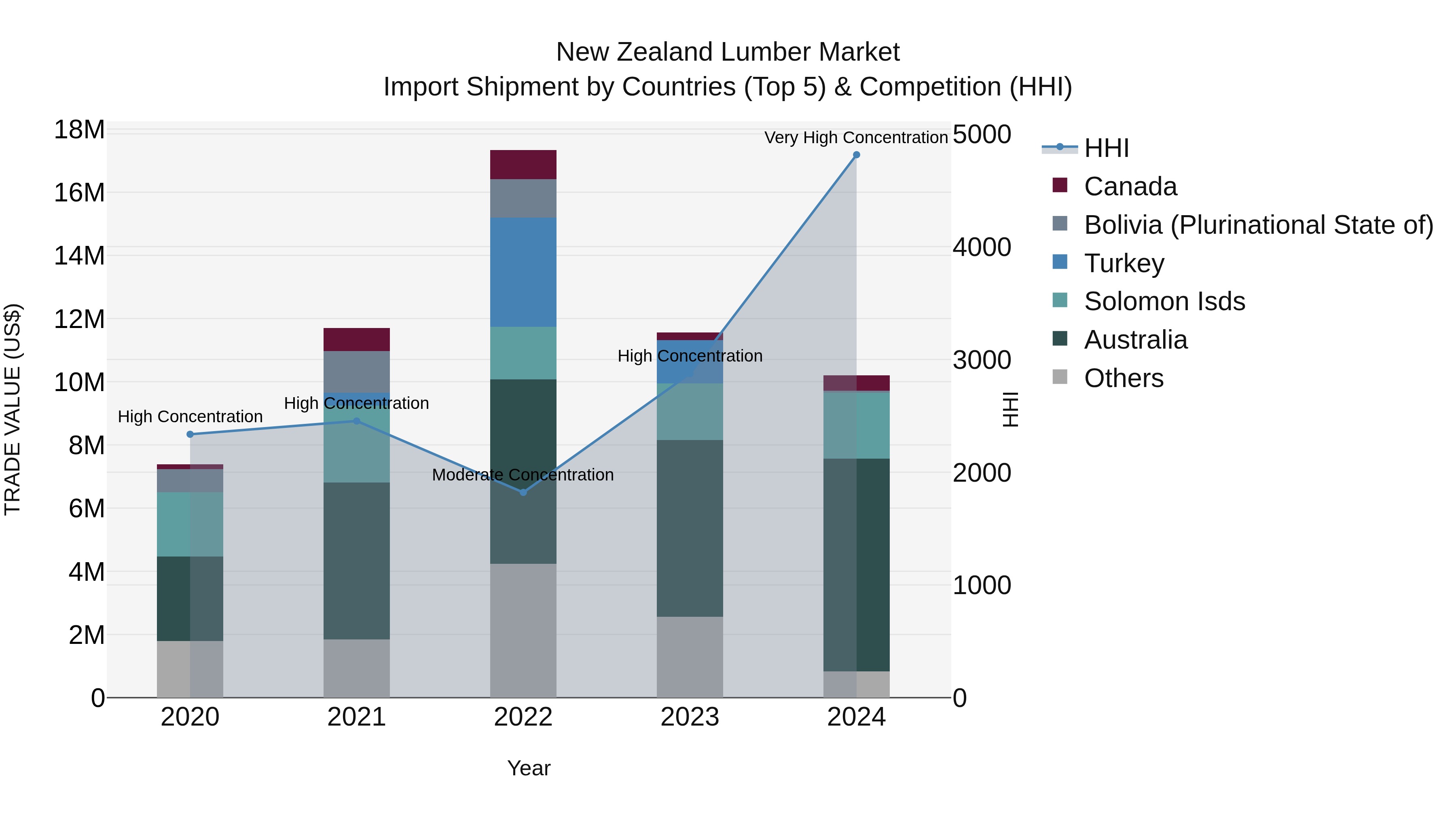
The New Zealand lumber import market continues to show high concentration, with Australia, Solomon Islands, Canada, USA, and Peru being the top exporters in 2024. The Herfindahl-Hirschman Index (HHI) indicates a significant increase in market concentration from 2023 to 2024. Despite a decline in growth rate from 2023 to 2024, the compound annual growth rate (CAGR) for the period 2020-2024 stands at a healthy 8.43%. This data suggests a dynamic and competitive market landscape, with key players vying for a share of New Zealand`s lumber import market.
Lumber Market: New Zealand vs Top 5 Major Economies in 2027 (Asia)
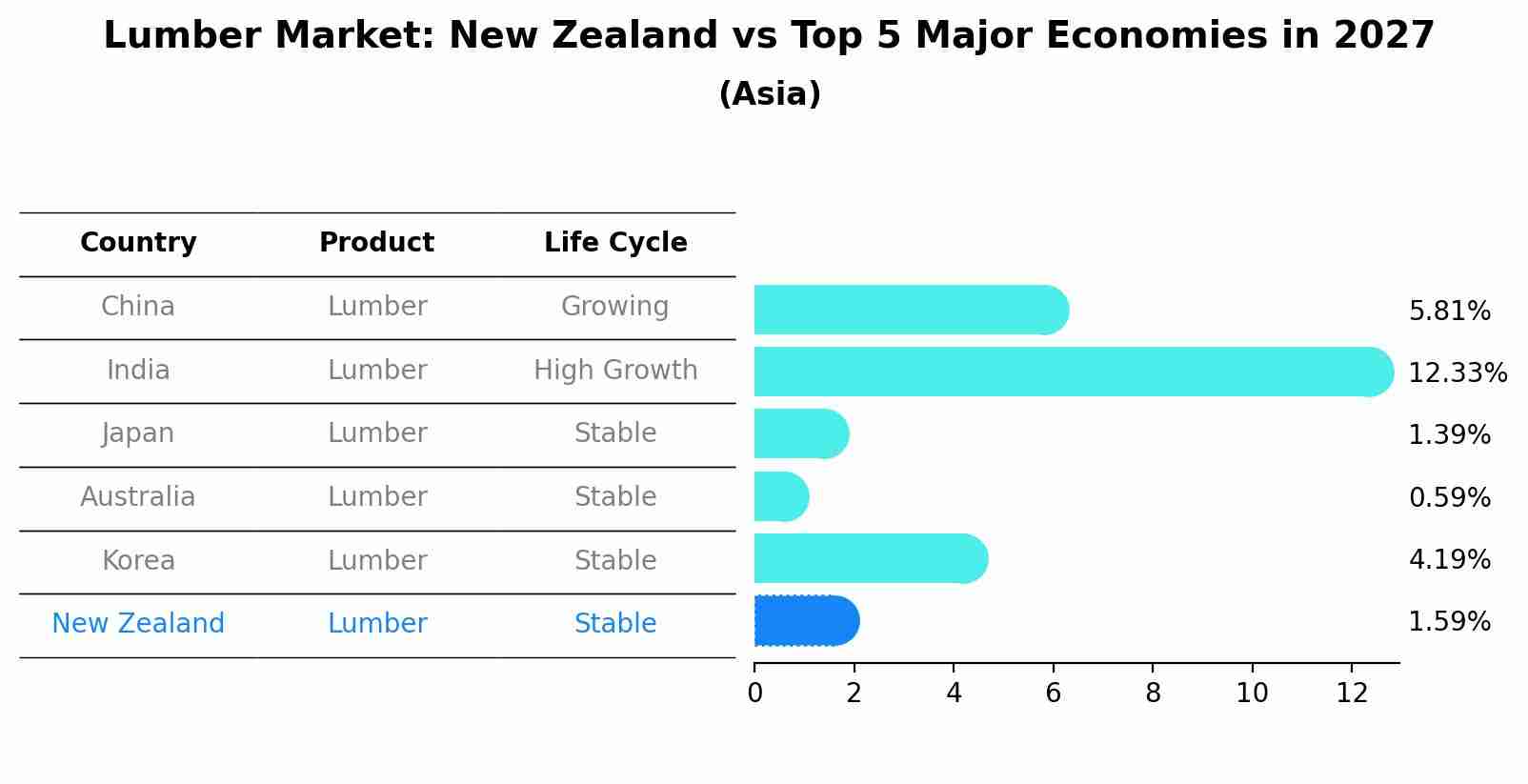
The Lumber market in New Zealand is projected to grow at a stable growth rate of 1.59% by 2027, within the Asia region led by China, along with other countries like India, Japan, Australia and South Korea, collectively shaping a dynamic and evolving market environment driven by innovation and increasing adoption of emerging technologies.
New Zealand Lumber Market Overview
The lumber market in New Zealand encompasses the production, distribution, and trade of timber products. With a significant forestry industry, New Zealand exports timber products globally while also serving domestic construction and manufacturing sectors.
Drivers of the market
The lumber market in New Zealand is driven by the strong demand for timber in construction, furniture, and packaging industries. New Zealand abundant forestry resources and sustainable forestry practices support the production of high-quality lumber. The growth in residential and commercial construction activities, along with the increasing preference for wooden furniture and eco-friendly packaging solutions, drives the demand for lumber. Export opportunities, particularly to markets with high demand for quality timber, also contribute to the market`s expansion.
Challenges of the market
The lumber market in New Zealand encounters hurdles in terms of sustainability and market volatility. As one of the country`s primary export commodities, the lumber industry faces pressure to adopt sustainable forestry practices and mitigate the environmental impact of deforestation. Additionally, fluctuations in global demand and market prices pose challenges for lumber producers and exporters.
Government Policy of the market
Forestry policies, environmental regulations, and housing development plans impact the lumber market. Government support for sustainable forestry practices and compliance with environmental standards drive market growth. Investments in housing and infrastructure development also influence market dynamics.
Key Highlights of the Report:
- New Zealand Lumber Market Outlook
- Market Size of New Zealand Lumber Market, 2024
- Forecast of New Zealand Lumber Market, 2031
- Historical Data and Forecast of New Zealand Lumber Revenues & Volume for the Period 2021-2031
- New Zealand Lumber Market Trend Evolution
- New Zealand Lumber Market Drivers and Challenges
- New Zealand Lumber Price Trends
- New Zealand Lumber Porter`s Five Forces
- New Zealand Lumber Industry Life Cycle
- Historical Data and Forecast of New Zealand Lumber Market Revenues & Volume By Types for the Period 2021-2031
- Historical Data and Forecast of New Zealand Lumber Market Revenues & Volume By Hardwood Lumber for the Period 2021-2031
- Historical Data and Forecast of New Zealand Lumber Market Revenues & Volume By Softwood Lumber for the Period 2021-2031
- Historical Data and Forecast of New Zealand Lumber Market Revenues & Volume By Application for the Period 2021-2031
- Historical Data and Forecast of New Zealand Lumber Market Revenues & Volume By Construction for the Period 2021-2031
- Historical Data and Forecast of New Zealand Lumber Market Revenues & Volume By Furniture for the Period 2021-2031
- Historical Data and Forecast of New Zealand Lumber Market Revenues & Volume By Flooring for the Period 2021-2031
- Historical Data and Forecast of New Zealand Lumber Market Revenues & Volume By Moldings for the Period 2021-2031
- Historical Data and Forecast of New Zealand Lumber Market Revenues & Volume By Others for the Period 2021-2031
- New Zealand Lumber Import Export Trade Statistics
- Market Opportunity Assessment By Types
- Market Opportunity Assessment By Application
- New Zealand Lumber Top Companies Market Share
- New Zealand Lumber Competitive Benchmarking By Technical and Operational Parameters
- New Zealand Lumber Company Profiles
- New Zealand Lumber Key Strategic Recommendations






































