New Zealand Oven Market Top 5 Importing Countries and Market Competition (HHI) Analysis
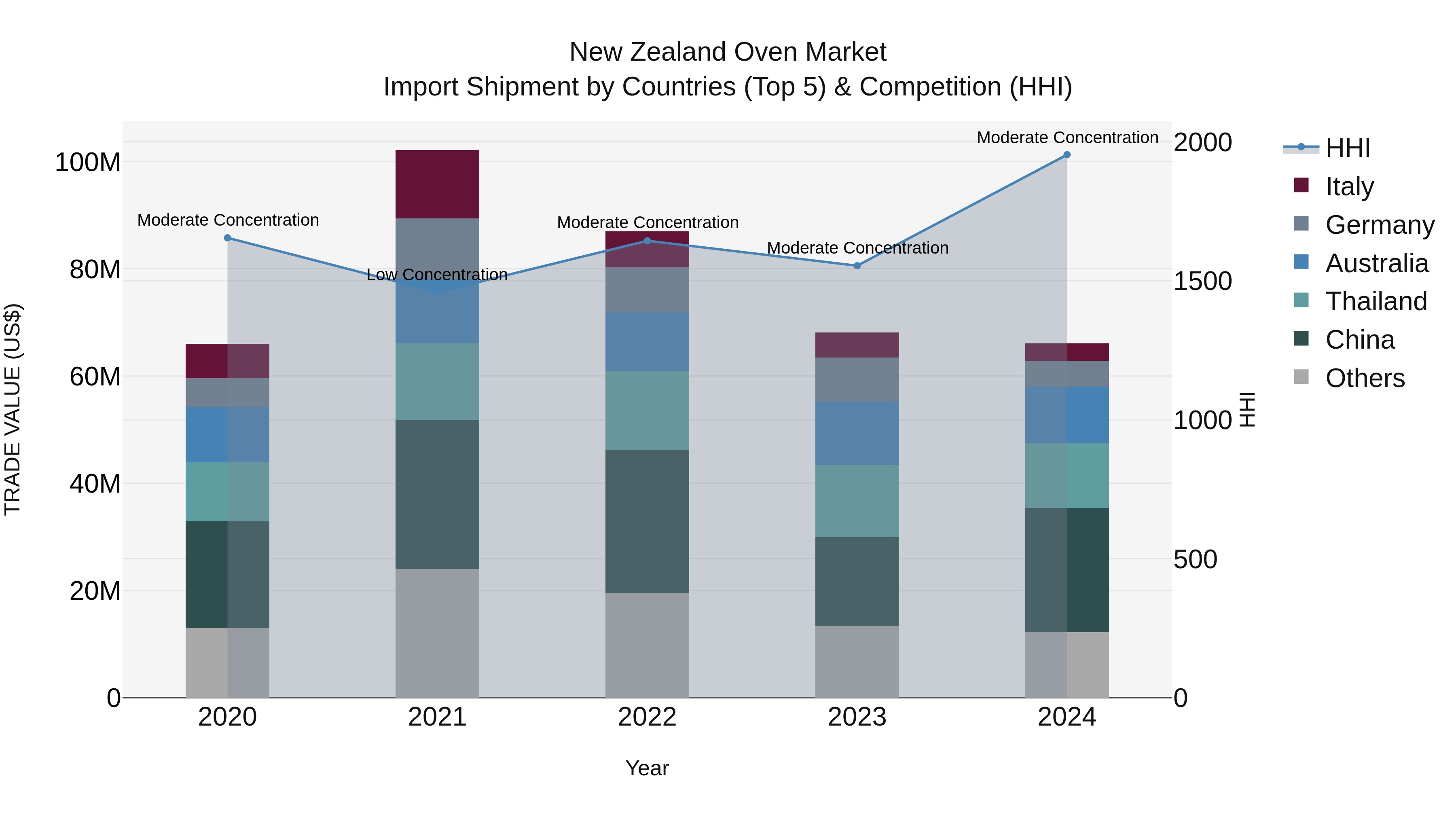
In 2024, New Zealand continued to see a steady flow of oven import shipments, with top exporters being China, Thailand, Australia, Germany, and Turkey. The market remained moderately concentrated, indicating a competitive landscape. Despite a minimal compound annual growth rate (CAGR) from 2020 to 2024, there was a slight decline in growth rate from 2023 to 2024. This suggests a stable market environment with room for potential shifts in the coming years. Keep an eye on evolving trends and trade dynamics to stay ahead in the New Zealand oven import market.
New Zealand Oven Market Overview
The New Zealand Oven Market is characterized by a growing demand for energy-efficient and technologically advanced ovens. Consumers are increasingly looking for features such as convection cooking, smart controls, and self-cleaning functions. Multifunctional ovens that offer a variety of cooking modes are also gaining popularity. With a focus on sustainability, there is a rising interest in electric ovens over gas models. Key players in the market are investing in research and development to introduce innovative products that cater to changing consumer preferences. The market is competitive, with brands offering a range of options across different price points to target various consumer segments. Overall, the New Zealand Oven Market is witnessing a shift towards high-performance, eco-friendly appliances that offer convenience and energy savings.
New Zealand Oven Market Trends and Opportunities
The New Zealand Oven Market is experiencing a growing trend towards smart and energy-efficient appliances, with consumers increasingly seeking features such as connectivity and automation in their ovens. This shift is driven by the desire for convenience and sustainability. Additionally, there is a rising demand for multi-functional ovens that offer a variety of cooking options in a single appliance, catering to the busy lifestyles of consumers. Opportunities lie in the development of innovative technologies that enhance user experience and reduce energy consumption, as well as in catering to the demand for more compact and space-saving oven designs for smaller living spaces. Manufacturers and retailers can capitalize on these trends by offering a diverse range of products that meet the evolving needs and preferences of consumers in the New Zealand market.
New Zealand Oven Market Challenges
In the New Zealand Oven Market, one of the significant challenges faced is the increasing competition from both local and international brands. This competition leads to price wars and a constant need for innovation to stay ahead in the market. Additionally, changing consumer preferences and increased emphasis on energy efficiency and sustainability pose challenges for oven manufacturers to adapt their products accordingly. Distribution and logistics issues in reaching remote areas of New Zealand can also be a hurdle for companies operating in the market. Furthermore, economic fluctuations and regulatory changes can impact consumer spending patterns, affecting the overall demand for ovens in the market. To succeed in this competitive landscape, companies need to focus on product differentiation, marketing strategies, and ensuring efficient distribution channels to address these challenges effectively.
New Zealand Oven Market Drivers
The New Zealand Oven Market is primarily driven by factors such as increasing disposable income levels, changing consumer lifestyles, and a growing trend towards home cooking and entertaining. Consumers are seeking energy-efficient and technologically advanced ovens that offer convenience and smart features to enhance their cooking experience. Additionally, a focus on sustainable living and environmental awareness is leading to a demand for ovens that are eco-friendly and energy-efficient. The rise in renovation and remodeling activities in households is also contributing to the growth of the oven market in New Zealand as consumers look to upgrade their kitchen appliances. Overall, these drivers are shaping the New Zealand Oven Market and influencing consumer preferences towards innovative and high-quality oven products.
New Zealand Oven Market Government Policy
The New Zealand oven market is subject to various government policies aimed at promoting energy efficiency and consumer safety. The government has implemented Energy Efficiency and Conservation Authority (EECA) standards for appliances, including ovens, to reduce energy consumption and greenhouse gas emissions. Additionally, the Electrical (Safety) Regulations ensure that ovens sold in the market meet safety standards to protect consumers from potential hazards. The government also encourages manufacturers to label products with energy efficiency information to help consumers make informed choices. Overall, these policies support sustainability, safety, and consumer awareness in the New Zealand oven market.
New Zealand Oven Market Future Outlook
The future outlook for the New Zealand Oven Market appears positive, driven by factors such as the increasing trend of home cooking, rising disposable incomes, and a growing focus on energy-efficient appliances. Consumers are increasingly looking for ovens with advanced features such as smart technology, multifunctional capabilities, and sleek designs. Additionally, the demand for eco-friendly and sustainable appliances is expected to drive innovation in the market. With a strong emphasis on quality and durability, major players are likely to invest in research and development to offer products that cater to the evolving needs of consumers. Overall, the New Zealand Oven Market is projected to experience steady growth in the coming years, with opportunities for both established brands and new entrants to capture a larger market share.
Key Highlights of the Report:
- New Zealand Oven Market Outlook
- Market Size of New Zealand Oven Market, 2024
- Forecast of New Zealand Oven Market, 2031
- Historical Data and Forecast of New Zealand Oven Revenues & Volume for the Period 2021- 2031
- New Zealand Oven Market Trend Evolution
- New Zealand Oven Market Drivers and Challenges
- New Zealand Oven Price Trends
- New Zealand Oven Porter's Five Forces
- New Zealand Oven Industry Life Cycle
- Historical Data and Forecast of New Zealand Oven Market Revenues & Volume By Type for the Period 2021- 2031
- Historical Data and Forecast of New Zealand Oven Market Revenues & Volume By Convection for the Period 2021- 2031
- Historical Data and Forecast of New Zealand Oven Market Revenues & Volume By Grill for the Period 2021- 2031
- Historical Data and Forecast of New Zealand Oven Market Revenues & Volume By Solo for the Period 2021- 2031
- Historical Data and Forecast of New Zealand Oven Market Revenues & Volume By Distribution Channel for the Period 2021- 2031
- Historical Data and Forecast of New Zealand Oven Market Revenues & Volume By Multi-brand Stores for the Period 2021- 2031
- Historical Data and Forecast of New Zealand Oven Market Revenues & Volume By Exclusive Stores for the Period 2021- 2031
- Historical Data and Forecast of New Zealand Oven Market Revenues & Volume By E-commerce for the Period 2021- 2031
- Historical Data and Forecast of New Zealand Oven Market Revenues & Volume By Other Distribution Channels for the Period 2021- 2031
- Historical Data and Forecast of New Zealand Oven Market Revenues & Volume By Structure for the Period 2021- 2031
- Historical Data and Forecast of New Zealand Oven Market Revenues & Volume By Built-in for the Period 2021- 2031
- Historical Data and Forecast of New Zealand Oven Market Revenues & Volume By Countertop for the Period 2021- 2031
- Historical Data and Forecast of New Zealand Oven Market Revenues & Volume By End Users for the Period 2021- 2031
- Historical Data and Forecast of New Zealand Oven Market Revenues & Volume By Residential for the Period 2021- 2031
- Historical Data and Forecast of New Zealand Oven Market Revenues & Volume By Commercial for the Period 2021- 2031
- New Zealand Oven Import Export Trade Statistics
- Market Opportunity Assessment By Type
- Market Opportunity Assessment By Distribution Channel
- Market Opportunity Assessment By Structure
- Market Opportunity Assessment By End Users
- New Zealand Oven Top Companies Market Share
- New Zealand Oven Competitive Benchmarking By Technical and Operational Parameters
- New Zealand Oven Company Profiles
- New Zealand Oven Key Strategic Recommendations






































