New Zealand Peanut butter Market (2026-2032) | Value, Growth, Industry, Segmentation, Share, Analysis, Trends, Companies, Size, Outlook, Forecast & Revenue
Market Forecast By Product Type (Smooth Peanut Butter, Crunchy Peanut Butter, Others), By Distribution Channel (Supermarkets and Hypermarkets, Convenience Stores, Online Stores, Others) And Competitive Landscape
| Product Code: ETC4780763 | Publication Date: Nov 2023 | Updated Date: Feb 2026 | Product Type: Market Research Report | |
| Publisher: 6Wresearch | Author: Shubham Padhi | No. of Pages: 60 | No. of Figures: 30 | No. of Tables: 5 |
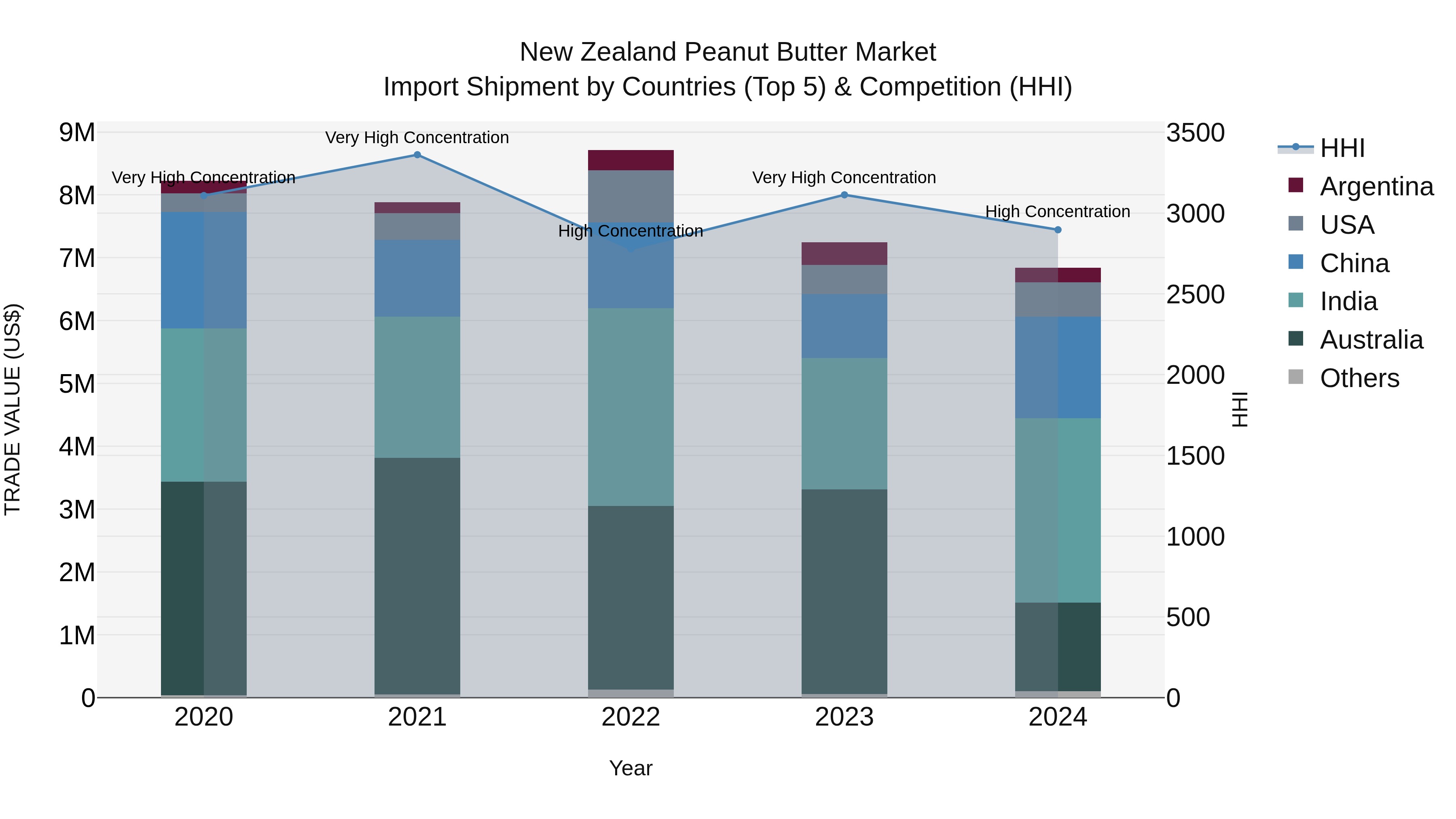
New Zealand Peanut Butter Market Top 5 Importing Countries and Market Competition (HHI) Analysis
New Zealand`s peanut butter import market continues to show a high level of concentration, with top exporters in 2024 being India, China, Australia, USA, and Argentina. Despite a decline in both the CAGR and growth rate from 2020 to 2024, the market remains competitive with a mix of suppliers from various regions. The shift in concentration levels from very high in 2023 to high in 2024 suggests evolving dynamics in the import landscape, indicating potential opportunities for market players to explore in the coming years.
New Zealand Peanut Butter Market Growth Rate
According to 6Wresearch internal database and industry insights, the New Zealand Peanut Butter Market is projected to grow at a compound annual growth rate (CAGR) of 5.8% during the forecast period (2026-2032).
Topics Covered in the New Zealand Peanut Butter Market Report
The New Zealand Peanut Butter Market report thoroughly covers the market by product type and applications. The market report provides an unbiased and detailed analysis of ongoing market trends, opportunities/high growth areas, and market drivers, which help stakeholders devise and align their market strategies according to the current and future market dynamics.
New Zealand Peanut Butter Market Highlights
| Report Name | New Zealand Peanut Butter Market |
| Forecast Period | 2026–2032 |
| CAGR | 5.8% |
| Growing Sector | Online Stores |
New Zealand Peanut Butter Market Synopsis
New Zealand Peanut Butter Market is anticipated to record steady growth due to the growing demand for healthy, natural, and protein-rich food products among consumers. The rising trend of plant-based and clean-label foods is also boosting the demand for peanut butter. In addition, the growing retail infrastructure and the rising influence of premium and local brands are also driving the growth of the market. Moreover, consumers are also opting for organic and low sugar versions of peanut butter, while online platforms are also increasing the availability of the product, especially in smaller towns.
Evaluation of Growth Drivers in the New Zealand Peanut Butter Market
Below mentioned are some prominent drivers and their influence on the market dynamics:
| Drivers | Primary Segments Affected | Why it Matters (Evidence) |
| Rising Health Awareness | Smooth & Natural Variants; Supermarkets | Consumers increasingly prefer protein-rich and low-additive spreads as part of their daily nutrition. |
| Growth of Plant-Based Diets | All Product Types; Online Stores | The increasing adoption of vegan and vegetarian lifestyles is driving demand for plant-based spreads. |
| Expansion of Premium & Organic Products | Smooth & Crunchy; Supermarkets | Health-conscious consumers are attracted to clean-label and organic product offerings. |
| E-commerce Growth | All Types; Online Stores | Digital platforms make it easier for consumers to access a wide variety of products across the country. |
| Strong Retail Distribution | Smooth Peanut Butter; Supermarkets & Hypermarkets | Wide shelf presence improves product visibility and availability, encouraging higher sales. |
New Zealand Peanut Butter Market is expected to grow at the CAGR of 5.8% during the forecast period of 2026-2032. Expansion of the market is being fuelled by a growing consumer preference for healthy breakfast choices and ready, to, eat food items. The continuous need for nature, made, organic, sugar, free products is also leading to new product development and upgrading. Besides this, a high retail penetration, expansion of private label offerings, and increasing online grocery adoption are facilitating product accessibility. Domestic producers are also concentrating on sustainable sourcing and clean, label formulations, whereas changing lifestyle patterns and higher disposable incomes keep supporting steady market demand in both urban and semi, urban households.
Evaluation of Restraints in the New Zealand Peanut Butter Market
Below mentioned are some major restraints and their influence on the market dynamics:
| Restraints | Primary Segments Affected | What This Means (Evidence) |
| Peanut Price Volatility | All Types; Manufacturers | Fluctuating raw material prices affect product pricing, cost stability, and profit margins. |
| Allergy Concerns | All Types; General Consumers | Peanut allergies restrict consumption among certain consumer groups, limiting market potential. |
| Competition from Alternative Spreads | Smooth & Crunchy; Supermarkets | Competing products such as almond butter, hazelnut spreads, and chocolate spreads reduce market share. |
| Premium Product Pricing | Organic Variants; Online & Specialty Stores | Higher prices of premium and organic products may discourage price-sensitive consumers. |
| Import Dependency for Raw Peanuts | All Types; Manufacturers | Reliance on imports creates supply risks and higher logistics costs, affecting production continuity. |
New Zealand Peanut Butter Industry Challenges
Despite steady growth, the New Zealand Peanut Butter Industry faces several challenges that could affect its long-term expansion. One of the key concerns is the volatility in global peanut prices, which directly impacts production costs and retail pricing. Additionally, the competition of nut butters from other nuts and chocolate, based spreads is making the consumers choose less. The issue of peanut allergy is also limiting the potential market in certain segments. The small manufacturers face the battle to scale and distribution, at the same time, the cost of running the business goes up when they keep the product standards as clean, label and organic. Furthermore, the reliance on imported raw materials and the unpredictability of logistics costs put more strain on the profit margins and the regularity of the supply.
New Zealand Peanut Butter Market Trends
Key trends shaping the growth of the New Zealand Peanut Butter Market Growth include:
- Clean-Label and Natural Formulations: Nowadays, consumers are opting more for peanut butter with only a few ingredients and without any extra preservatives. This consumer behavior is convincing manufacturers to look at natural processing methods, transparency, and simple ingredient labeling.
- Rise of Premium and Gourmet Variants: Premium branding enables companies to attract consumers with higher health awareness and purchasing power who are looking for qualities such as differentiation in taste and quality.
- Growth of Online Grocery Platforms: Online retail is becoming a preferred channel for specialty and bulk purchases. Digital platforms provide convenience, wider product choices, and easier access to niche and imported brands.
- Sustainable Packaging Initiatives: Manufacturers are adopting recyclable and eco-friendly packaging materials. Sustainability messaging is becoming an important factor influencing purchase decisions among environmentally conscious consumers.
Investment Opportunities in the New Zealand Peanut Butter Market
Key areas offering investment potential in the New Zealand Peanut Butter Market include:
- Organic and Specialty Product Development – Investing money into organic, sugar-free and high, protein versions will help to grab the health, friendly consumer segment that is growing. In addition, specialty formulations provide brands with the opportunity to command higher prices and foster greater brand loyalty.
- E-commerce and Direct-to-Consumer Channels – Developing strong digital sales platforms enables brands to reach a wider audience efficiently. Subscription models and online promotions can improve customer retention and recurring revenue.
- Local Peanut Processing Facilities – Establishing peanut sourcing and processing operations at local level is an excellent method to lessen your reliance on imports and to decrease the supplier risk.
- Innovative Packaging Solutions – Investment in convenient, eco-friendly, and portion-controlled packaging can enhance consumer convenience. Sustainable packaging also strengthens brand differentiation in environmentally conscious markets.
Top 5 Leading Players in the New Zealand Peanut Butter Market
Some leading players operating in the New Zealand Peanut Butter Market include:
1. Sanitarium Health and Wellbeing Company
| Company Name | Sanitarium Health and Wellbeing Company |
|---|---|
| Established Year | 1898 |
| Headquarters | New South Wales, Australia |
| Official Website | Click Here |
Sanitarium is a major player offering a wide range of peanut butter products known for quality and nutrition. The company focuses on natural formulations, strong retail distribution, and health-oriented branding to maintain a strong presence in the New Zealand market.
2. Pics Peanut Butter
| Company Name | Pics Peanut Butter |
|---|---|
| Established Year | 2007 |
| Headquarters | Nelson, New Zealand |
| Official Website | Click Here |
Pics Peanut Butter is a leading local brand known for its simple, natural ingredients and premium quality. The company emphasizes sustainability, local branding, and strong supermarket and export presence, making it a preferred choice among health-conscious consumers.
3. Mars Incorporated
| Company Name | Mars Incorporated (MasterFoods) |
|---|---|
| Established Year | 1911 |
| Headquarters | Virginia, USA |
| Official Website | Click Here |
Mars offers peanut butter products under established food brands with strong retail penetration. The company leverages extensive distribution networks, product innovation, and brand recognition to maintain a competitive position in the packaged spreads category.
4. Kraft Heinz Company
| Company Name | Kraft Heinz Company |
|---|---|
| Established Year | 2015 |
| Headquarters | Illinois, USA |
| Official Website | Click Here |
Kraft Heinz supplies widely recognized peanut butter products known for consistent quality and taste. Its strong brand equity, large-scale production capabilities, and wide availability across supermarkets support steady demand in the market.
5. Bega Cheese Limited
| Company Name | Bega Cheese Limited |
|---|---|
| Established Year | 1899 |
| Headquarters | New South Wales, Australia |
| Official Website | - |
Bega offers peanut butter products through well-known regional brands and focuses on value-driven offerings. The company benefits from strong supply chains, competitive pricing, and established retail relationships across New Zealand.
Government Regulations Introduced in the New Zealand Peanut Butter Market
According to New Zealand’s Government data, several regulatory measures support the quality and safety of peanut butter products across the country. The Ministry for Primary Industries (MPI) is the authority that enforces the Food Act, which is a comprehensive set of food safety standards. Among others, they require manufacturers, packagers, and allergen disclosers to comply with these standards. Therefore, the nutrition labeling requirements provide consumers with information on sugar, salt, and fat content and thus help them to make more informed choices.
Future Insights of the New Zealand Peanut Butter Market
The New Zealand Peanut Butter Market intends to see stable growth in future years. It will be mainly due to changing consumer habits that show a preference for healthy and natural food products. One of the major reasons for a continuous product innovation and premiumization will be the rising demand for organic, clean, label, and high protein products. The expansion of online grocery platforms and direct-to-consumer models will further improve accessibility and brand reach. Additionally, growing interest in sustainable packaging and locally produced food items will shape future product strategies. With rising health awareness, strong retail infrastructure, and ongoing investment in specialty offerings, the market is likely to present steady long-term growth opportunities.
Market Segmentation Analysis
The report offers a comprehensive study of the subsequent market segments and their leading categories.
Smooth Peanut Butter to Dominate the Market – By Product Type
According to Mohit, Senior Research Analyst, 6Wresearch, the Smooth Peanut Butter category holds the largest market segment in the New Zealand Peanut Butter Market Share. This dominance is basically due to its being the favorite in most homes, its being easily spreadable and hence, strong couples among children and everyday consumers. People who prefer smooth variants want to get their products from major retail channels that are widely accessible which are normally used for sandwiches, baking and breakfast consumption.
Supermarkets and Hypermarkets to Dominate the Market – By Distribution Channel
Supermarkets and hypermarkets dominate the New Zealand peanut butter market in terms of market share as they have a wide range of products, offer competitive prices, and attract a lot of consumers through their stores. These retail formats provide easy access to multiple brands, including private label and premium options. Good shelf placement, promotional discounts, and bulk purchase offers incentivize customers to make impulse purchases which results in higher sales volumes.
Key Attractiveness of the Report
- 10 Years of Market Numbers.
- Historical Data Starting from 2022 to 2025.
- Base Year: 2025.
- Forecast Data until 2032.
- Key Performance Indicators Impacting the Market.
- Major Upcoming Developments and Projects.
Key Highlights of the Report:
- New Zealand Peanut butter Market Outlook
- Market Size of New Zealand Peanut butter Market, 2025
- Forecast of New Zealand Peanut butter Market, 2032
- Historical Data and Forecast of New Zealand Peanut butter Revenues & Volume for the Period 2022-2032
- New Zealand Peanut butter Market Trend Evolution
- New Zealand Peanut butter Market Drivers and Challenges
- New Zealand Peanut butter Price Trends
- New Zealand Peanut butter Porter`s Five Forces
- New Zealand Peanut butter Industry Life Cycle
- Historical Data and Forecast of New Zealand Peanut butter Market Revenues & Volume By Product Type for the Period 2022-2032
- Historical Data and Forecast of New Zealand Peanut butter Market Revenues & Volume By Smooth Peanut Butter for the Period 2022-2032
- Historical Data and Forecast of New Zealand Peanut butter Market Revenues & Volume By Crunchy Peanut Butter for the Period 2022-2032
- Historical Data and Forecast of New Zealand Peanut butter Market Revenues & Volume By Others for the Period 2022-2032
- Historical Data and Forecast of New Zealand Peanut butter Market Revenues & Volume By Distribution Channel for the Period 2022-2032
- Historical Data and Forecast of New Zealand Peanut butter Market Revenues & Volume By Supermarkets and Hypermarkets for the Period 2022-2032
- Historical Data and Forecast of New Zealand Peanut butter Market Revenues & Volume By Convenience Stores for the Period 2022-2032
- Historical Data and Forecast of New Zealand Peanut butter Market Revenues & Volume By Online Stores for the Period 2022-2032
- Historical Data and Forecast of New Zealand Peanut butter Market Revenues & Volume By Others for the Period 2022-2032
- New Zealand Peanut butter Import Export Trade Statistics
- Market Opportunity Assessment By Product Type
- Market Opportunity Assessment By Distribution Channel
- New Zealand Peanut butter Top Companies Market Share
- New Zealand Peanut butter Competitive Benchmarking By Technical and Operational Parameters
- New Zealand Peanut butter Company Profiles
- New Zealand Peanut butter Key Strategic Recommendations
Market Covered
The report offers a comprehensive study of the subsequent market segments:
By Product Type
- Smooth Peanut Butter
- Crunchy Peanut Butter
- Others
By Distribution Channel
- Supermarkets and Hypermarkets
- Convenience Stores
- Online Stores
- Others
New Zealand Peanut butter Market (2026-2032): FAQs
The New Zealand Peanut Butter Market is projected to grow at a CAGR of 5.8% during the forecast period 2026-2032.
The factors are the increasing awareness of health, changing food habits especially the shift to plant, based proteins, and secondly, the growing demand for clean, label, and natural food products.
One of the major regulatory frameworks of the market is food safety compliance under the Food Act, allergen labeling requirements, and nutrition transparency standards, all of which are enforced by the Ministry for Primary Industries.
The market outlook remains positive, driven by the growing popularity of healthy snacking, expansion of organic and specialty variants, and increasing online and modern retail distribution.
6Wresearch actively monitors the New Zealand Peanut butter Market and publishes its comprehensive annual report, highlighting emerging trends, growth drivers, revenue analysis, and forecast outlook. Our insights help businesses to make data-backed strategic decisions with ongoing market dynamics. Our analysts track relevent industries related to the New Zealand Peanut butter Market, allowing our clients with actionable intelligence and reliable forecasts tailored to emerging regional needs.
Yes, we provide customisation as per your requirements. To learn more, feel free to contact us on sales@6wresearch.com
| 1 Executive Summary |
| 2 Introduction |
| 2.1 Key Highlights of the Report |
| 2.2 Report Description |
| 2.3 Market Scope & Segmentation |
| 2.4 Research Methodology |
| 2.5 Assumptions |
| 3 New Zealand Peanut butter Market Overview |
| 3.1 New Zealand Country Macro Economic Indicators |
| 3.2 New Zealand Peanut butter Market Revenues & Volume, 2022 & 2032F |
| 3.3 New Zealand Peanut butter Market - Industry Life Cycle |
| 3.4 New Zealand Peanut butter Market - Porter's Five Forces |
| 3.5 New Zealand Peanut butter Market Revenues & Volume Share, By Product Type, 2022 & 2032F |
| 3.6 New Zealand Peanut butter Market Revenues & Volume Share, By Distribution Channel, 2022 & 2032F |
| 4 New Zealand Peanut butter Market Dynamics |
| 4.1 Impact Analysis |
| 4.2 Market Drivers |
| 4.2.1 Increasing health consciousness and demand for natural, protein-rich food products |
| 4.2.2 Growing awareness of the nutritional benefits of peanut butter |
| 4.2.3 Rising trend of plant-based diets and veganism in New Zealand |
| 4.3 Market Restraints |
| 4.3.1 Fluctuating prices of raw materials such as peanuts |
| 4.3.2 Intense competition from other spreads like almond butter or cashew butter |
| 4.3.3 Regulatory challenges related to food safety standards and labeling requirements |
| 5 New Zealand Peanut butter Market Trends |
| 6 New Zealand Peanut butter Market Segmentations |
| 6.1 New Zealand Peanut butter Market, By Product Type |
| 6.1.1 Overview and Analysis |
| 6.1.2 New Zealand Peanut butter Market Revenues & Volume, By Smooth Peanut Butter, 2022-2032F |
| 6.1.3 New Zealand Peanut butter Market Revenues & Volume, By Crunchy Peanut Butter, 2022-2032F |
| 6.1.4 New Zealand Peanut butter Market Revenues & Volume, By Others, 2022-2032F |
| 6.2 New Zealand Peanut butter Market, By Distribution Channel |
| 6.2.1 Overview and Analysis |
| 6.2.2 New Zealand Peanut butter Market Revenues & Volume, By Supermarkets and Hypermarkets, 2022-2032F |
| 6.2.3 New Zealand Peanut butter Market Revenues & Volume, By Convenience Stores, 2022-2032F |
| 6.2.4 New Zealand Peanut butter Market Revenues & Volume, By Online Stores, 2022-2032F |
| 6.2.5 New Zealand Peanut butter Market Revenues & Volume, By Others, 2022-2032F |
| 7 New Zealand Peanut butter Market Import-Export Trade Statistics |
| 7.1 New Zealand Peanut butter Market Export to Major Countries |
| 7.2 New Zealand Peanut butter Market Imports from Major Countries |
| 8 New Zealand Peanut butter Market Key Performance Indicators |
| 8.1 Consumer engagement on social media platforms (e.g., likes, shares, comments) |
| 8.2 Number of new product launches and innovations in the peanut butter market |
| 8.3 Growth in the number of peanut butter brands available in the New Zealand market |
| 9 New Zealand Peanut butter Market - Opportunity Assessment |
| 9.1 New Zealand Peanut butter Market Opportunity Assessment, By Product Type, 2022 & 2032F |
| 9.2 New Zealand Peanut butter Market Opportunity Assessment, By Distribution Channel, 2022 & 2032F |
| 10 New Zealand Peanut butter Market - Competitive Landscape |
| 10.1 New Zealand Peanut butter Market Revenue Share, By Companies, 2025 |
| 10.2 New Zealand Peanut butter Market Competitive Benchmarking, By Operating and Technical Parameters |
| 11 Company Profiles |
| 12 Recommendations |
| 13 Disclaimer |
Global Go To Market Strategy - 2030
Export potential enables firms to identify high-growth global markets with greater confidence by combining advanced trade intelligence with a structured quantitative methodology. The framework analyzes emerging demand trends and country-level import patterns while integrating macroeconomic and trade datasets such as GDP and population forecasts, bilateral import–export flows, tariff structures, elasticity differentials between developed and developing economies, geographic distance, and import demand projections. Using weighted trade values from 2020–2024 as the base period to project country-to-country export potential for 2030, these inputs are operationalized through calculated drivers such as gravity model parameters, tariff impact factors, and projected GDP per-capita growth. Through an analysis of hidden potentials, demand hotspots, and market conditions that are most favorable to success, this method enables firms to focus on target countries, maximize returns, and global expansion with data, backed by accuracy.
By factoring in the projected importer demand gap that is currently unmet and could be potential opportunity, it identifies the potential for the Exporter (Country) among 190 countries, against the general trade analysis, which identifies the biggest importer or exporter.
To discover high-growth global markets and optimize your business strategy:
Click Here
Pricing
- Single User License$ 1,995
- Department License$ 2,400
- Site License$ 3,120
- Global License$ 3,795

Leadership Perspectives from Industry Events
Search
Thought Leadership and Analyst Meet





Our Clients








6WResearch In News
- India Export Attractiveness Tracker 2026
- India Air Conditioner Market Set for Strong Rebound in 2026 After Weather-Led Correction and GST-Driven Recovery: 6Wresearch
- ADAS in India: How Automatic Emergency Braking, Blind Spot Detection & Driver Monitoring are Transforming Road Safety
- Doha a strategic location for EV manufacturing hub: IPA Qatar
- Demand for luxury TVs surging in the GCC, says Samsung
- Empowering Growth: The Thriving Journey of Bangladesh’s Cable Industry
Latest Reports
- Nicaragua RPG Gaming Market (2026-2032)
- New Zealand RPG Gaming Market (2026-2032)
- Netherlands RPG Gaming Market (2026-2032)
- Nauru RPG Gaming Market (2026-2032)
- Namibia RPG Gaming Market (2026-2032)
- Mozambique RPG Gaming Market (2026-2032)
- Montenegro RPG Gaming Market (2026-2032)
- Mongolia RPG Gaming Market (2026-2032)
- Monaco RPG Gaming Market (2026-2032)
- Micronesia RPG Gaming Market (2026-2032)
Industry Events and Analyst Meet

EV India Expo 2026

HIMTEX 2026

India Refining Summit 2026

India EV Show 2026

EV tech India Expo 2026
Whitepaper
- Middle East & Africa Commercial Security Market Click here to view more.
- Middle East & Africa Fire Safety Systems & Equipment Market Click here to view more.
- GCC Drone Market Click here to view more.
- Middle East Lighting Fixture Market Click here to view more.
- GCC Physical & Perimeter Security Market Click here to view more.


