New Zealand Phosphate Fertilizers Market Growth Rate Analysis (2025 - 2031)
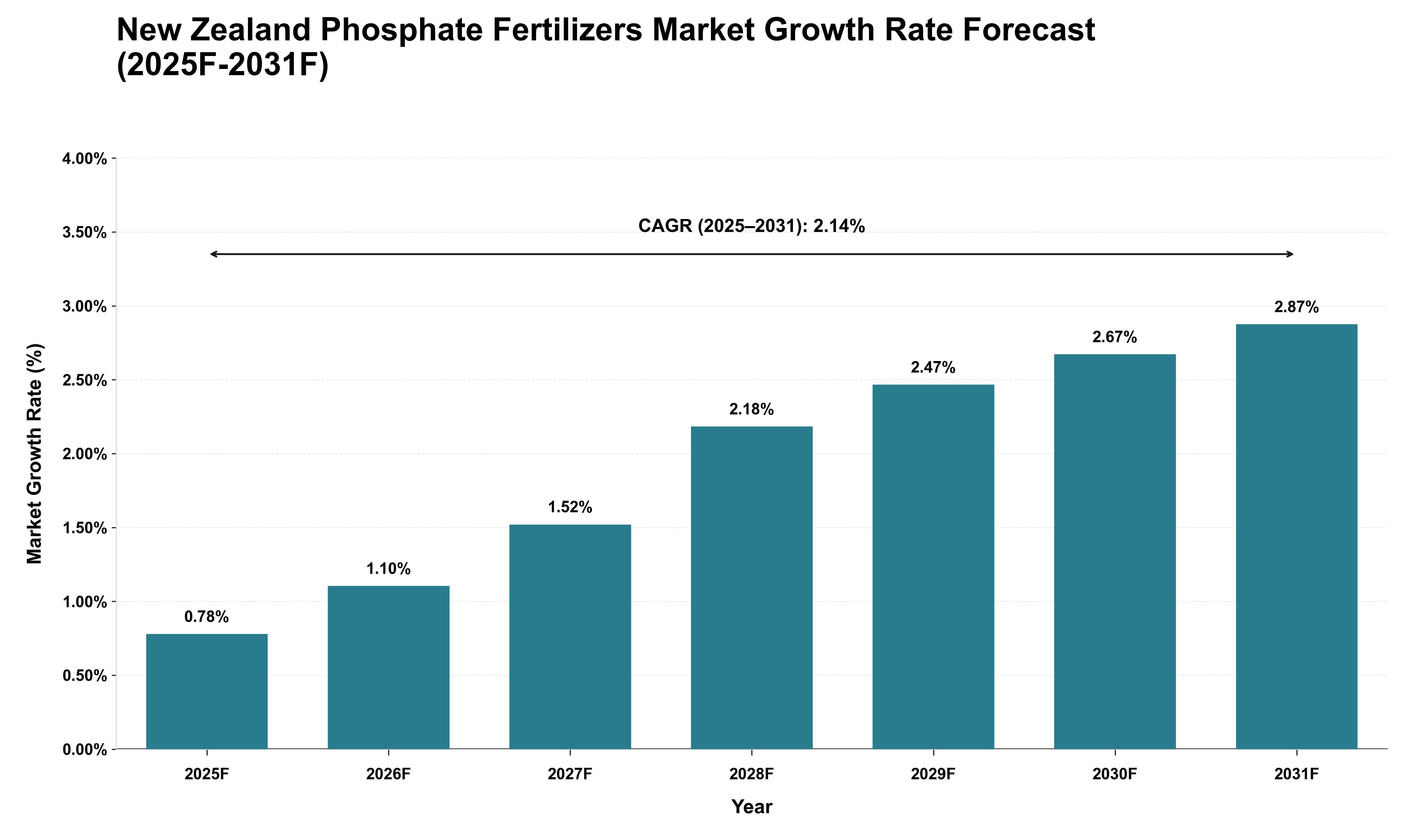
The New Zealand phosphate fertilizers market will experience a gradual increase in trade flows, driven by rising agricultural demands and evolving farming practices. As the forecast period progresses, the annual growth rates will reflect an upward trajectory, with a notable acceleration from 0.78% in 2025 to 2.87% by 2031, indicating a compound annual growth rate (CAGR) of 2.14%. This trend will be influenced by New Zealand's reliance on imported phosphate fertilizers to meet domestic agricultural needs, as local production capabilities remain limited. Additionally, global supply chain dynamics and trade agreements will play crucial roles in shaping import volumes and pricing structures. The anticipated cyclical trends in agriculture, alongside increasing environmental regulations promoting sustainable practices, will further drive demand for phosphate fertilizers, positioning New Zealand's market for steady growth within the broader context of international trade flows.
Key Highlights of the Report:
- New Zealand Phosphate Fertilizers Market Outlook
- Market Size of New Zealand Phosphate Fertilizers Market, 2025
- Forecast of New Zealand Phosphate Fertilizers Market, 2032
- Historical Data and Forecast of New Zealand Phosphate Fertilizers Revenues & Volume for the Period 2022 - 2032F
- New Zealand Phosphate Fertilizers Market Trend Evolution
- New Zealand Phosphate Fertilizers Market Drivers and Challenges
- New Zealand Phosphate Fertilizers Price Trends
- New Zealand Phosphate Fertilizers Porter`s Five Forces
- New Zealand Phosphate Fertilizers Industry Life Cycle
- Historical Data and Forecast of New Zealand Phosphate Fertilizers Market Revenues & Volume By Product for the Period 2022 - 2032F
- Historical Data and Forecast of New Zealand Phosphate Fertilizers Market Revenues & Volume By Monoammonium Phosphate (MAP) for the Period 2022 - 2032F
- Historical Data and Forecast of New Zealand Phosphate Fertilizers Market Revenues & Volume By Diammonium Phosphate (DAP) for the Period 2022 - 2032F
- Historical Data and Forecast of New Zealand Phosphate Fertilizers Market Revenues & Volume By Superphosphate for the Period 2022 - 2032F
- Historical Data and Forecast of New Zealand Phosphate Fertilizers Market Revenues & Volume By Others for the Period 2022 - 2032F
- Historical Data and Forecast of New Zealand Phosphate Fertilizers Market Revenues & Volume By Applications for the Period 2022 - 2032F
- Historical Data and Forecast of New Zealand Phosphate Fertilizers Market Revenues & Volume By Cereals & Grains for the Period 2022 - 2032F
- Historical Data and Forecast of New Zealand Phosphate Fertilizers Market Revenues & Volume By Oilseeds for the Period 2022 - 2032F
- Historical Data and Forecast of New Zealand Phosphate Fertilizers Market Revenues & Volume By Fruits & Vegetables for the Period 2022 - 2032F
- Historical Data and Forecast of New Zealand Phosphate Fertilizers Market Revenues & Volume By Others for the Period 2022 - 2032F
- New Zealand Phosphate Fertilizers Import Export Trade Statistics
- Market Opportunity Assessment By Product
- Market Opportunity Assessment By Applications
- New Zealand Phosphate Fertilizers Top Companies Market Share
- New Zealand Phosphate Fertilizers Competitive Benchmarking By Technical and Operational Parameters
- New Zealand Phosphate Fertilizers Company Profiles
- New Zealand Phosphate Fertilizers Key Strategic Recommendations






































