Tea Market: New Zealand vs Top 5 Major Economies in 2027 (Asia)
By 2027, the Tea market in New Zealand is anticipated to reach a growth rate of 1.40%, as part of an increasingly competitive Asia region, where China remains at the forefront, supported by India, Japan, Australia and South Korea, driving innovations and market adoption across sectors.
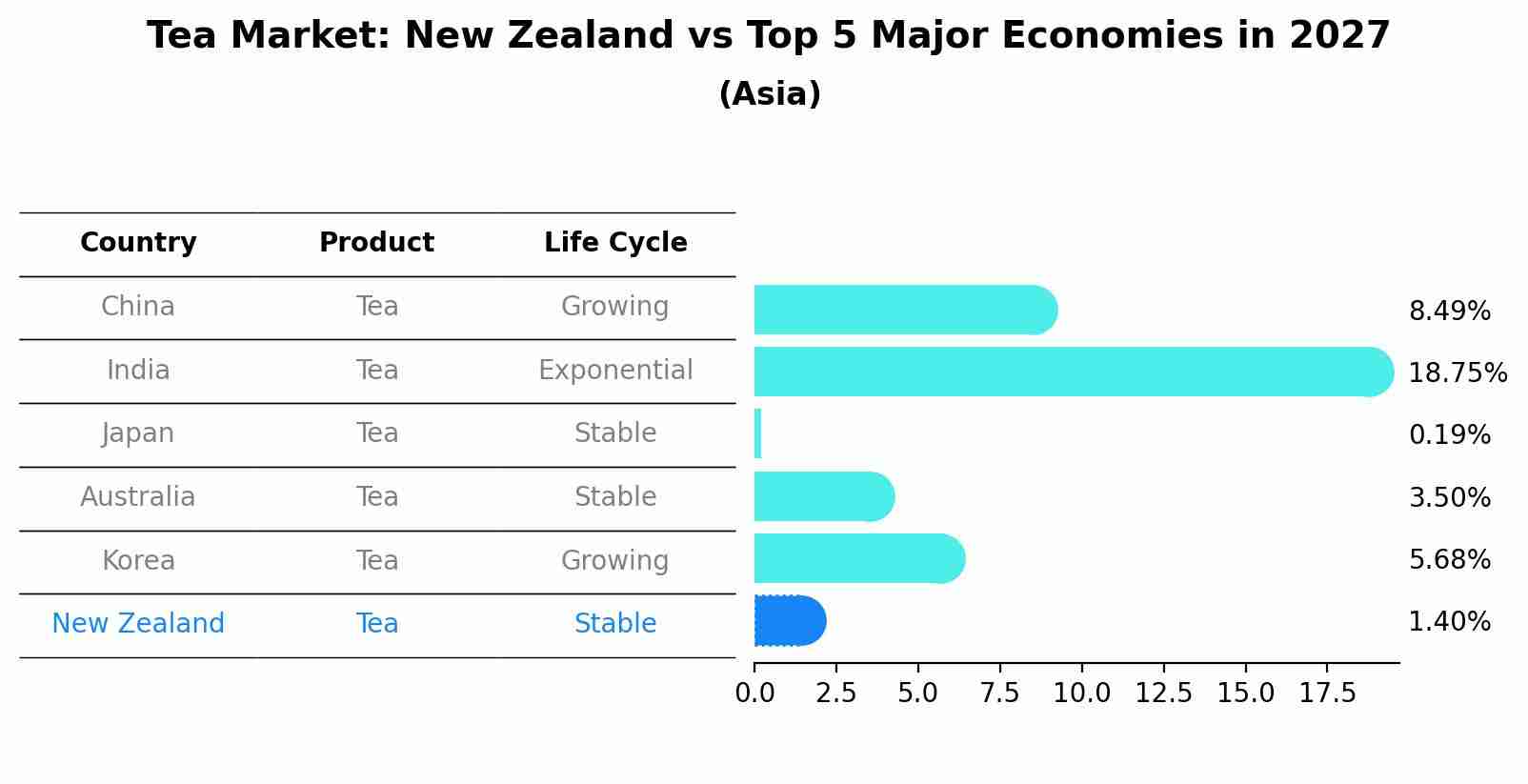
New Zealand Tea Market Growth Rate
According to 6Wresearch internal database and industry insights, the New Zealand Tea Market is projected to grow at a compound annual growth rate (CAGR) of 5.4% during the forecast period (2026-2032).
Five-Year Growth Trajectory of the New Zealand Tea Market with Core Drivers
Below mentioned are the evaluation of years-wise growth rate along with key growth drivers:
| Years | Est. Annual Growth (%) | Growth Drivers |
| 2021 | 2.1 | Rising consumer shift toward premium and specialty tea blends |
| 2022 | 2.8 | Increased availability of imported organic tea varieties |
| 2023 | 3.3 | Expansion of tea cafés and artisanal beverage establishments |
| 2024 | 3.9 | Growing awareness of functional and wellness-based herbal teas |
| 2025 | 4.6 | Rising demand for sustainable and eco-friendly packaging |
Topics Covered in the New Zealand Tea Market Report
The New Zealand Tea Market report thoroughly covers the market by product type, Packaging, Distribution Channel and applications. The market report provides an unbiased and detailed analysis of ongoing market trends, opportunities/high growth areas, and market drivers, which help stakeholders devise and align their market strategies according to the current and future market dynamics.
New Zealand Tea Market Highlights
| Report Name | New Zealand Tea Market |
| Forecast period | 2026-2032 |
| CAGR | 5.4% |
| Growing Sector | Residential |
New Zealand Tea Market Synopsis
New Zealand Tea Market is anticipated to register strong growth on the back of rising consumer preference for premium tea blends, expanding awareness regarding the health benefits associated with herbal and green tea consumption, and the increasing availability of sustainably sourced tea products across retail channels. The market has been experiencing a rising shift toward artisanal and specialty teas, which is driven by local producers who focus on organic cultivation while digital retailing continues to widen access to diverse tea varieties in the country.
Evaluation of Growth Drivers in the New Zealand Tea Market
Below mentioned are some prominent drivers and their influence to the market dynamics:
| Drivers | Primary Segments Affected | Why it Matters (Evidence) |
| Rise in Specialty Tea Consumption | By Type; Specialty Stores | The demand for artisanal tea is increasing with consumers increasingly prefer premium and unique blends. |
| Increasing Health Awareness | Green Tea & Herbal Tea; Residential | The adoption of health-focused tea varieties is high with the growing interest in antioxidant-rich beverages. |
| Expansion of Retail Distribution | Packaging & Distribution Channels | Large retail chains enhance nationwide product accessibility, supporting higher sales volumes. |
| Growth of E-Commerce Platforms | Online Stores | Digital retailing provides convenient access to diverse tea categories. |
| Sustainability-Driven Consumption | Packaging; Commercial | Demand for eco-friendly packaging encourages product innovation. |
New Zealand Tea Market is expected to grow at the CAGR of 5.4% during the forecast period of 2026-2032. Growth is influenced by rising premium tea consumption, expanding retail networks, and the growing trend of wellness-oriented beverages, in addition to the strengthening role of digital retailing and sustainable product development across the country. The New Zealand tea market is driven by increasing consumer interest in natural and healthy beverages, with rising demand for green, herbal, and specialty teas as part of a wellness-focused lifestyle. Consumers have now been shifting towards premium quality and artisanal blends more than traditional commodity teas. Along with this, as more people recognizing the health and wellness benefits of tea, the demand for convenient tea formats is on the rise. Additionally, demand for organic and environmentally conscious tea options is on the rise, as sustainability and ethical sourcing have become important factors.
Evaluation of Restraints in the New Zealand Tea Market
Below mentioned are some major restraints and their influence to the market dynamics:
| Restraints | Primary Segments Affected | What This Means (Evidence) |
| High Cost of Premium Tea | Specialty Stores; Others | Premium imports increase retail prices, reducing access for cost-sensitive buyers. |
| Limited Local Tea Production | By Type; Commercial | Dependency on imports leads to fluctuating supply availability and vulnerability to global price changes. |
| Growing Competition from Coffee Culture | Residential & Commercial | Strong café culture slows the transition toward regular tea consumption. |
| Seasonal Demand Variations | All Types; Packaging | Consumption patterns fluctuate with weather shifts, affecting consistent sales trends. |
| Supply Chain Vulnerabilities | Packaging; Retail Channels | Delays in international shipments impact product availability and inventory stability. |
New Zealand Tea Industry Challenges
On the other hand, the market deals with numerous challenges, such as limited domestic production capacity and competition from the well-established coffee segment. Rising import reliance which increases sensitivity to global price changes proven as another major challenge. Along with this, operational stability of tea suppliers and distributors is affected owing to seasonal fluctuations in demand and competitive pressure from private-label brands.
New Zealand Tea Market Trends
Key trends evaluating the landscape of the New Zealand Tea Market are:
- Growth of Organic and Fair-Trade Tea Segments: Consumers increasingly value ethically sourced and environmentally responsible products, encouraging suppliers to expand organic portfolios.
- Rising Popularity of Functional Herbal Teas: Herbal blends infused with botanicals for digestion, immunity, and relaxation are gaining traction across retail and specialty tea cafés.
- Premiumisation of Tea Experiences: Artisanal brewing methods, tea tasting sessions, and gourmet tea lounges elevate consumption preferences toward high-value blends.
Investment Opportunities in the New Zealand Tea Market
Some prominent investment opportunities in the New Zealand Tea Market include:
- Expansion of Organic Tea Brands – Opportunities arise for companies offering clean-label, ethically sourced tea varieties to address increasing health-driven consumer behaviour.
- Development of Sustainable Packaging Solutions – Innovations in biodegradable packaging enhance brand differentiation and support regulatory compliance.
- Growth in Digital Retailing – Investing in e-commerce infrastructure and subscription-based tea models can expand market penetration among younger consumers.
Top 5 Leading Players in the New Zealand Tea Market
Some leading players operating in the New Zealand Tea Market include:
1. Twinings & Co. Ltd.
| Company Name | Twinings & Co. Ltd. |
|---|---|
| Established Year | 1706 |
| Headquarters | London, United Kingdom |
| Official Website | Click Here |
Twinings offers a wide portfolio of black, green, and herbal teas widely consumed across retail and foodservice sectors.
2. Dilmah Ceylon Tea Company PLC
| Company Name | Dilmah Ceylon Tea Company PLC |
|---|---|
| Established Year | 1988 |
| Headquarters | Colombo, Sri Lanka |
| Official Website | Click Here |
Dilmah provides premium Ceylon teas with a strong emphasis on ethical sourcing and specialty tea craftsmanship.
3. T2 Tea Pty Ltd.
| Company Name | T2 Tea Pty Ltd. |
|---|---|
| Established Year | 1996 |
| Headquarters | Melbourne, Australia |
| Official Website | Click Here |
T2 Tea specialises in contemporary blends and innovative tea flavours that appeal strongly to modern tea consumers.
4. Bell Tea Company
| Company Name | Bell Tea Company |
|---|---|
| Established Year | 1898 |
| Headquarters | Auckland, New Zealand |
| Official Website | Click Here |
Bell Tea is a major domestic brand offering everyday tea blends and sustainably packaged products tailored to New Zealand preferences.
5. Harney & Sons
| Company Name | Harney & Sons |
|---|---|
| Established Year | 1983 |
| Headquarters | New York, USA |
| Official Website | Click Here |
Harney & Sons delivers premium artisanal teas and luxury blends, reinforcing strong demand in high-value consumer segments.
Government Regulations Introduced in the New Zealand Tea Market
According to New Zealand’s government data, the market of tea in New Zealand is estimated to surge with the support of government favourable policies. One of these is the New Zealand Food and Beverage Sustainability Initiative 2022, which pushes environmentally responsible practices among beverage suppliers. While at the same time it is strengthening labelling transparency to ensure product reality. Additionally, various things are being done by the Ministry for Primary Industries, such as supporting consumer trust and expanding access to sustainably packaged tea offerings across the country. These are done by introducing guidelines promoting ethical sourcing and safe production standards.
Future Insights of the New Zealand Tea Market
The future outlook for the New Zealand Tea Market seems promising owing to various drivers, such as increasing demand for wellness-driven beverages and rising adoption of premium artisanal teas. Additionally, the rising expansion of eco-friendly packaging technologies collectively supports long-term growth of the industry. Moreover, the New Zealand Tea Market share is estimated to increase with the evolving consumer preferences for organic and sustainably sourced teas, which are driven by retail channel digitalisation. This will create opportunities for both established brands and emerging specialty tea producers within the country.
Market Segmentation Analysis
The report offers a comprehensive study of the subsequent market segments and their leading categories.
Green Tea to Dominate the Market – By Type
According to Mohit, Senior Research Analyst, 6Wresearch, the Green Tea segment dominates the New Zealand Tea Market owing to rising health consciousness, increasing preference for antioxidant-rich beverages, and strong adoption among young urban consumers seeking functional wellness drinks.
Tea Bags to Dominate the Market – By Packaging
The Tea Bags category leads the market due to its convenience, portability, and widespread acceptance across both retail and commercial spaces, enabling faster brewing and consistent flavour profiles that support high consumption frequency.
Supermarkets/Hypermarkets to Dominate the Market – By Distribution Channel
Supermarkets/Hypermarkets dominate the New Zealand Tea Market Share as these outlets provide extensive product variety, competitive pricing, and strong promotional campaigns that significantly influence purchase decisions.
Residential Segment to Dominate – By Application
The Residential category holds the largest share as households increasingly incorporate tea into daily consumption routines, supported by rising preferences for wellness-focused beverages and diverse flavour options.
Key Attractiveness of the Report
- 10 Years of Market Numbers.
- Historical Data Starting from 2022 to 2025.
- Base Year: 2025.
- Forecast Data until 2032.
- Key Performance Indicators Impacting the Market.
- Major Upcoming Developments and Projects.
Key Highlights of the Report:
- New Zealand Tea Market Outlook
- Market Size of New Zealand Tea Market, 2025
- Forecast of New Zealand Tea Market, 2032
- Historical Data and Forecast of New Zealand Tea Revenues & Volume for the Period 2022-2032
- New Zealand Tea Market Trend Evolution
- New Zealand Tea Market Drivers and Challenges
- New Zealand Tea Price Trends
- New Zealand Tea Porter`s Five Forces
- New Zealand Tea Industry Life Cycle
- Historical Data and Forecast of New Zealand Tea Market Revenues & Volume By Type for the Period 2022-2032
- Historical Data and Forecast of New Zealand Tea Market Revenues & Volume By Green Tea for the Period 2022-2032
- Historical Data and Forecast of New Zealand Tea Market Revenues & Volume By Black Tea for the Period 2022-2032
- Historical Data and Forecast of New Zealand Tea Market Revenues & Volume By Oolong Tea for the Period 2022-2032
- Historical Data and Forecast of New Zealand Tea Market Revenues & Volume By Fruit/Herbal Tea for the Period 2022-2032
- Historical Data and Forecast of New Zealand Tea Market Revenues & Volume By Others for the Period 2022-2032
- Historical Data and Forecast of New Zealand Tea Market Revenues & Volume By Packaging for the Period 2022-2032
- Historical Data and Forecast of New Zealand Tea Market Revenues & Volume By Plastic Containers for the Period 2022-2032
- Historical Data and Forecast of New Zealand Tea Market Revenues & Volume By Loose Tea for the Period 2022-2032
- Historical Data and Forecast of New Zealand Tea Market Revenues & Volume By Paperboards for the Period 2022-2032
- Historical Data and Forecast of New Zealand Tea Market Revenues & Volume By Aluminum Tins for the Period 2022-2032
- Historical Data and Forecast of New Zealand Tea Market Revenues & Volume By Tea Bags for the Period 2022-2032
- Historical Data and Forecast of New Zealand Tea Market Revenues & Volume By Distribution Channel for the Period 2022-2032
- Historical Data and Forecast of New Zealand Tea Market Revenues & Volume By Supermarkets/Hypermarkets for the Period 2022-2032
- Historical Data and Forecast of New Zealand Tea Market Revenues & Volume By Specialty Stores for the Period 2022-2032
- Historical Data and Forecast of New Zealand Tea Market Revenues & Volume By Convenience Stores for the Period 2022-2032
- Historical Data and Forecast of New Zealand Tea Market Revenues & Volume By Online Stores for the Period 2022-2032
- Historical Data and Forecast of New Zealand Tea Market Revenues & Volume By Others for the Period 2022-2032
- Historical Data and Forecast of New Zealand Tea Market Revenues & Volume By Application for the Period 2022-2032
- Historical Data and Forecast of New Zealand Tea Market Revenues & Volume By Residential for the Period 2022-2032
- Historical Data and Forecast of New Zealand Tea Market Revenues & Volume By Commercial for the Period 2022-2032
- New Zealand Tea Import Export Trade Statistics
- Market Opportunity Assessment By Type
- Market Opportunity Assessment By Packaging
- Market Opportunity Assessment By Distribution Channel
- Market Opportunity Assessment By Application
- New Zealand Tea Top Companies Market Share
- New Zealand Tea Competitive Benchmarking By Technical and Operational Parameters
- New Zealand Tea Company Profiles
- New Zealand Tea Key Strategic Recommendations
Market Covered
The report offers a comprehensive study of the subsequent market segments:
By Type
- Green Tea
- Black Tea
- Oolong Tea
- Fruit/Herbal Tea
- Others
By Packaging
- Plastic Containers
- Loose Tea
- Paperboards
- Aluminum Tins
- Tea Bags
By Distribution Channel
- Supermarkets/Hypermarkets
- Specialty Stores
- Convenience Stores
- Online Stores
- Others
By Application
- Residential
- Commercial






































