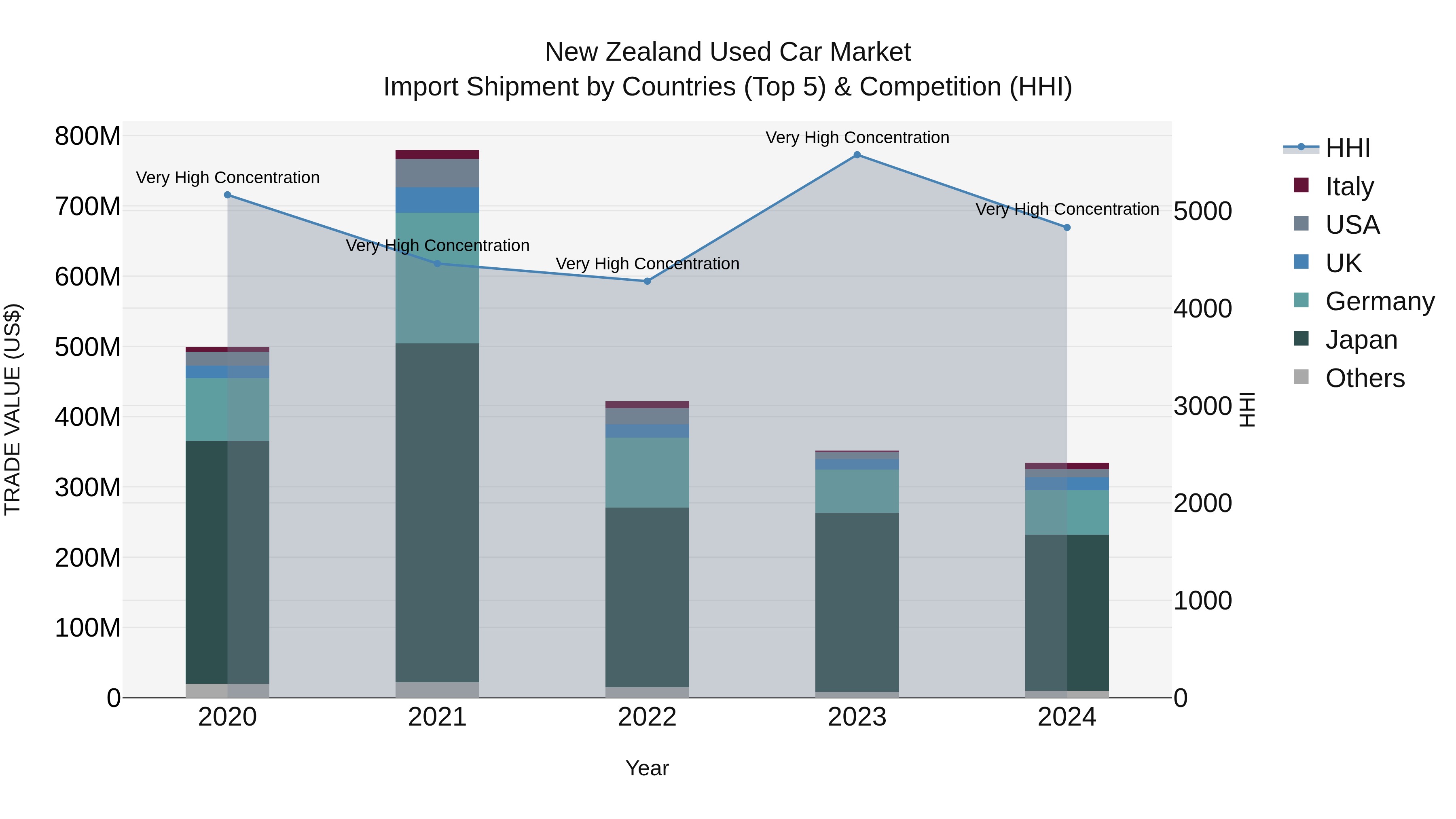
New Zealand Used Car Market Top 5 Importing Countries and Market Competition (HHI) Analysis
Despite a negative CAGR of -9.52% from 2020 to 2024, the New Zealand used car import market saw top exporting countries such as Japan, Germany, UK, USA, and Italy maintaining their strong presence. The high Herfindahl-Hirschman Index (HHI) indicates a concentration of imports among these key players. However, the growth rate in 2024 declined by -5.01%, suggesting a challenging year for the industry. Monitoring these trends will be crucial for stakeholders to adapt strategies and navigate the evolving market dynamics.
Key Highlights of the Report:
- New Zealand Used Car Market Outlook
- Market Size of New Zealand Used Car Market, 2025
- Forecast of New Zealand Used Car Market, 2032
- Historical Data and Forecast of New Zealand Used Car Revenues & Volume for the Period 2022 - 2032F
- New Zealand Used Car Market Trend Evolution
- New Zealand Used Car Market Drivers and Challenges
- New Zealand Used Car Price Trends
- New Zealand Used Car Porter`s Five Forces
- New Zealand Used Car Industry Life Cycle
- Historical Data and Forecast of New Zealand Used Car Market Revenues & Volume By Vehicle Type for the Period 2022 - 2032F
- Historical Data and Forecast of New Zealand Used Car Market Revenues & Volume By Hatchbacks for the Period 2022 - 2032F
- Historical Data and Forecast of New Zealand Used Car Market Revenues & Volume By Sedan for the Period 2022 - 2032F
- Historical Data and Forecast of New Zealand Used Car Market Revenues & Volume By Sports Utility Vehicle for the Period 2022 - 2032F
- Historical Data and Forecast of New Zealand Used Car Market Revenues & Volume By Others for the Period 2022 - 2032F
- Historical Data and Forecast of New Zealand Used Car Market Revenues & Volume By Vendor for the Period 2022 - 2032F
- Historical Data and Forecast of New Zealand Used Car Market Revenues & Volume By Organized for the Period 2022 - 2032F
- Historical Data and Forecast of New Zealand Used Car Market Revenues & Volume By Unorganized for the Period 2022 - 2032F
- Historical Data and Forecast of New Zealand Used Car Market Revenues & Volume By Fuel Type for the Period 2022 - 2032F
- Historical Data and Forecast of New Zealand Used Car Market Revenues & Volume By Gasoline for the Period 2022 - 2032F
- Historical Data and Forecast of New Zealand Used Car Market Revenues & Volume By Diesel for the Period 2022 - 2032F
- Historical Data and Forecast of New Zealand Used Car Market Revenues & Volume By Alternative Fuel Vehicles for the Period 2022 - 2032F
- New Zealand Used Car Import Export Trade Statistics
- Market Opportunity Assessment By Vehicle Type
- Market Opportunity Assessment By Vendor
- Market Opportunity Assessment By Fuel Type
- New Zealand Used Car Top Companies Market Share
- New Zealand Used Car Competitive Benchmarking By Technical and Operational Parameters
- New Zealand Used Car Company Profiles
- New Zealand Used Car Key Strategic Recommendations






































