Niger Packaged Water Market: Top 5 Importing Countries and Market Competition (HHI) Analysis
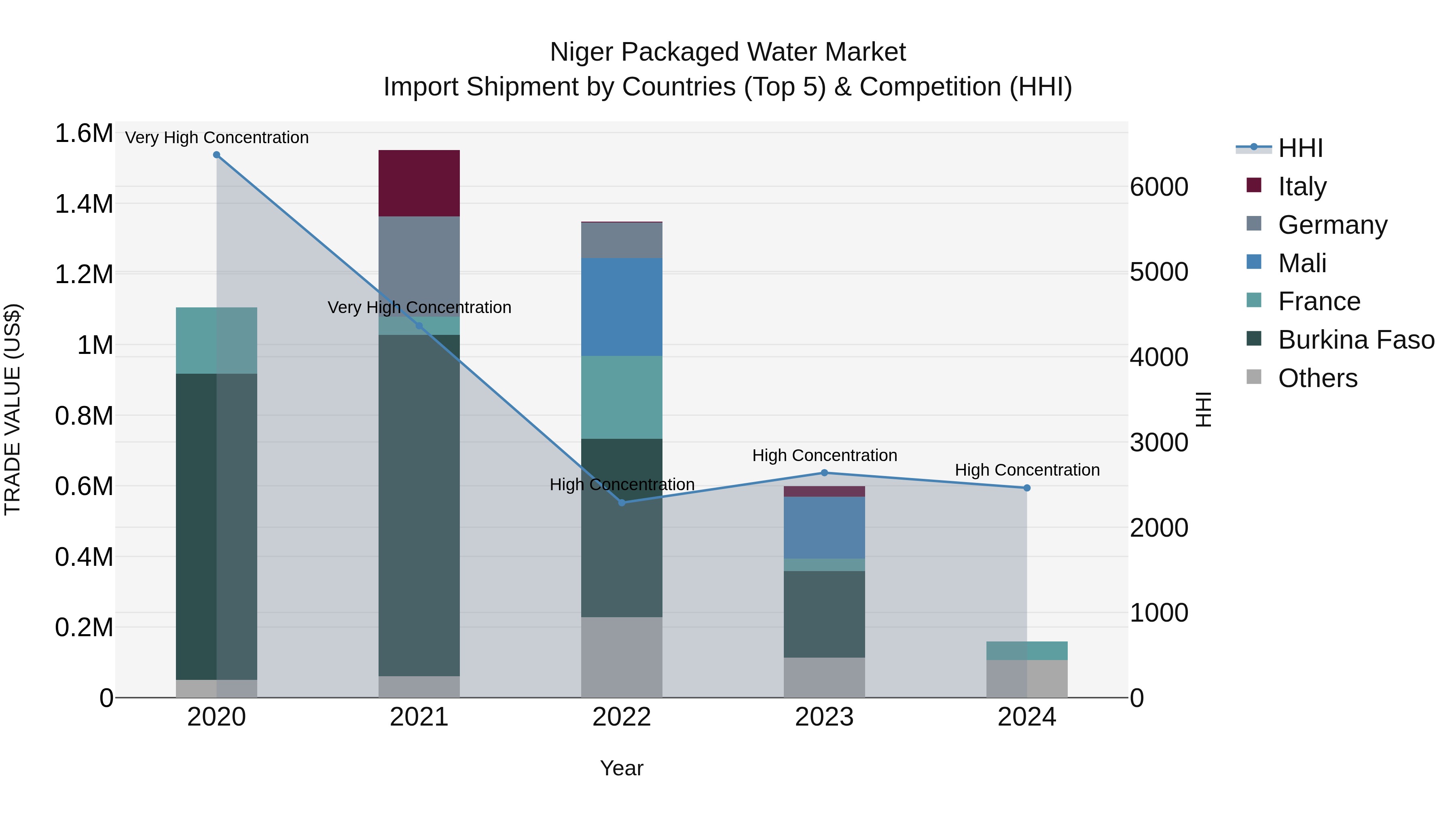
Despite the high concentration of top exporting countries such as France, Ghana, Nigeria, Turkey, and China, Niger`s packaged water import market took a significant hit with a negative CAGR of -38.38% from 2020 to 2024. The sharp decline in growth rate by -73.4% in 2024 indicates a challenging environment for the industry. Stakeholders should closely monitor market dynamics and explore strategies to stimulate demand and drive growth in the coming years.
Niger Packaged water Market Overview
The packaged water market in Niger is experiencing steady growth driven by increasing awareness about the importance of clean drinking water and the convenience of packaged water for on-the-go consumption. The market is primarily dominated by a few key players who offer a range of bottled water products in various sizes to cater to different consumer preferences. The demand for packaged water is also being fueled by factors such as urbanization, rising disposable incomes, and a growing population. However, challenges such as competition from alternative beverages and concerns about environmental sustainability are also influencing consumer choices in the packaged water market in Niger. Overall, the market is expected to continue its growth trajectory, with opportunities for innovation and differentiation to capture a larger share of the consumer base.
Niger Packaged water Market Trends and Opportunities
The packaged water market in Niger is experiencing significant growth due to increased urbanization, rising disposable incomes, and a growing awareness of the importance of safe drinking water. Consumers are opting for packaged water due to convenience, portability, and concerns about water quality. The market presents opportunities for companies to introduce innovative packaging, promote sustainability practices, and expand distribution networks to reach rural areas. With a young and rapidly growing population, there is a strong potential for market penetration and brand loyalty among consumers. However, challenges such as price sensitivity and competition from other beverages also exist. Overall, the Niger packaged water market is poised for continued growth and offers opportunities for companies willing to adapt to consumer preferences and market dynamics.
Niger Packaged water Market Challenges
In the Niger packaged water market, some challenges faced include inconsistent water quality standards, intense competition leading to price wars, unreliable electricity supply affecting production and distribution, lack of proper infrastructure for storage and transportation, and the presence of unregulated informal players. The fluctuating costs of raw materials and packaging materials also impact the profitability of packaged water companies in Niger. Additionally, regulatory issues and compliance requirements can pose challenges for market players, especially smaller businesses. Overall, navigating these challenges requires companies in the Niger packaged water market to focus on ensuring quality control, managing costs effectively, investing in reliable infrastructure, and complying with regulatory standards to maintain a competitive edge in the market.
Niger Packaged water Market Drivers
The Niger Packaged water market is primarily driven by a growing awareness among consumers about the importance of safe drinking water and the convenience of packaged water for on-the-go consumption. The increasing urbanization and changing lifestyles in Niger have also contributed to the rising demand for packaged water as a convenient and portable hydration option. Additionally, the lack of access to clean drinking water in certain regions of the country has further fueled the demand for packaged water as a safe alternative. The competitive pricing and availability of a wide range of packaged water brands in the market have also played a key role in driving market growth. Overall, the market is expected to continue expanding due to these factors, as well as the increasing focus on health and wellness among consumers.
Niger Packaged water Market Government Policy
In Niger, the packaged water market is regulated by government policies to ensure safety and quality standards are met. The government has established guidelines for packaging, labeling, and production processes to safeguard public health. Additionally, there are regulations in place to monitor the pricing of packaged water to prevent monopolistic practices and ensure affordability for consumers. The government also encourages local production and supports small-scale packaged water businesses through initiatives such as training programs and financial incentives. Overall, the government`s policies in the Niger packaged water market aim to promote consumer protection, quality assurance, and market competition while fostering growth and sustainability in the industry.
Niger Packaged water Market Future Outlook
The future outlook for the packaged water market in Niger appears to be promising, driven by factors such as increasing awareness about the importance of clean drinking water, rising disposable incomes, and a growing population. The market is expected to witness steady growth due to the convenience and portability offered by packaged water, especially in urban areas. Additionally, the government`s initiatives to improve access to safe drinking water and the expanding retail sector are likely to further boost market demand. To capitalize on this growth potential, key players in the industry may focus on enhancing distribution networks, introducing innovative packaging solutions, and promoting sustainability practices. Overall, the Niger packaged water market is poised for expansion in the coming years, providing opportunities for market players to thrive and meet the growing consumer demand for safe and convenient drinking water options.
Key Highlights of the Report:
- Niger Packaged water Market Outlook
- Market Size of Niger Packaged water Market, 2024
- Forecast of Niger Packaged water Market, 2031
- Historical Data and Forecast of Niger Packaged water Revenues & Volume for the Period 2021- 2031
- Niger Packaged water Market Trend Evolution
- Niger Packaged water Market Drivers and Challenges
- Niger Packaged water Price Trends
- Niger Packaged water Porter's Five Forces
- Niger Packaged water Industry Life Cycle
- Historical Data and Forecast of Niger Packaged water Market Revenues & Volume By Product for the Period 2021- 2031
- Historical Data and Forecast of Niger Packaged water Market Revenues & Volume By Still for the Period 2021- 2031
- Historical Data and Forecast of Niger Packaged water Market Revenues & Volume By Carbonated for the Period 2021- 2031
- Historical Data and Forecast of Niger Packaged water Market Revenues & Volume By Flavored for the Period 2021- 2031
- Historical Data and Forecast of Niger Packaged water Market Revenues & Volume By Functional for the Period 2021- 2031
- Niger Packaged water Import Export Trade Statistics
- Market Opportunity Assessment By Product
- Niger Packaged water Top Companies Market Share
- Niger Packaged water Competitive Benchmarking By Technical and Operational Parameters
- Niger Packaged water Company Profiles
- Niger Packaged water Key Strategic Recommendations






































