Nigeria Accounting Software Market Size, Share & Growth Rate
The Nigeria Accounting Software Market was estimated at USD 338 Million in 2025 and is projected to reach USD 454 Million by 2032, growing at a CAGR of 4.3% from 2026 to 2032. This growth trajectory is primarily fueled by the expanding small and medium-sized enterprises (SME) sector, which increasingly seeks streamlined financial solutions. Additionally, governmental pushes towards digitization and an acute need for compliance and efficiency in financial management are propelling this market forward.
Nigeria Accounting Software Market Year-wise Growth Rate and Key Drivers
This graph highlights how the Nigeria Accounting Software Market has steadily grown over the years, supported by major growth factors.
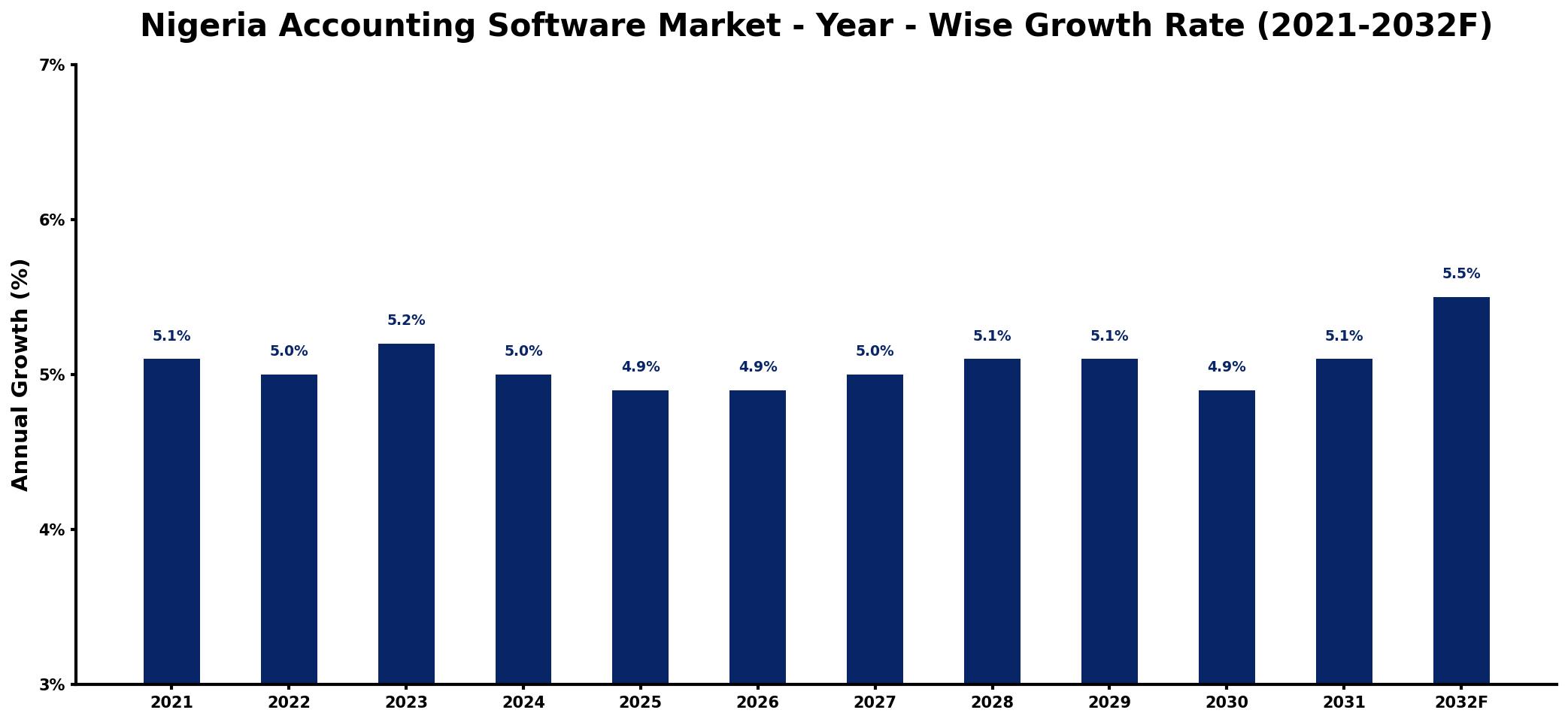
The table below presents the year‑wise growth rates along with the key drivers influencing the market
| Year | Growth Rate | Major Drivers |
| 2021 | 5.1% | Rising demand for financial solutions |
| 2022 | 5.0% | Increased digital transformation initiatives |
| 2023 | 5.2% | Growing adoption of cloud technologies |
| 2024 | 5.0% | Expansion of small business sector |
| 2025 | 4.9% | Surge in remote work trends |
| 2026 | 4.9% | Enhancement of regulatory compliance needs |
| 2027 | 5.0% | Investment in fintech innovations |
| 2028 | 5.1% | Growing awareness of financial literacy |
| 2029 | 5.1% | Development of mobile payment systems |
| 2030 | 4.9% | Increase in e-commerce platforms |
| 2031 | 5.1% | improved processing technologies adoption |
| 2032 | 5.5% | Rising focus on financial analytics |
Note: Market size estimations and growth projections presented in this report are based on 6Wresearch's proprietary forecasting methodology, utilizing the latest available industry data, government publications, and primary research inputs.
Nigeria Accounting Software Market Synopsis
As Nigerian businesses embrace digital transformation, the demand for accounting software is surging. Particularly, SMEs are turning to affordable and user-friendly software solutions that enhance operational efficiency and compliance with local regulations.
Moreover, the trend towards cloud-based solutions is notable as these platforms offer scalable features that allow businesses to adapt to their growing financial management needs. This shift towards digital solutions has set the stage for innovative offerings tailored to the unique challenges of the Nigerian market.
Nigeria Accounting Software Market Key Takeaways
- Cloud-based solutions are gaining traction among Nigerian businesses due to their scalability and cost-effectiveness.
- Government initiatives are fostering a conducive environment for the adoption of accounting software in compliance with tax regulations.
- SMEs represent a significant demand segment, seeking efficiency and automation in their financial processes.
- Local providers are focusing on customization to meet specific regulatory and operational needs.
- Awareness and training initiatives are essential to drive greater adoption among SMEs in Nigeria.
Evaluation of Restraints in Nigeria Accounting Software Market
Despite its growth potential, the Nigeria Accounting Software Market faces several constraints that may hinder its expansion. One significant issue is the widespread lack of awareness regarding the benefits of such solutions among SMEs, which limits market penetration. Moreover, concerns about data security and the prevalence of counterfeit software can undermine confidence in adopting legitimate accounting platforms. Furthermore, the inconsistent internet connectivity and existing infrastructure challenges in Nigeria may restrict effective utilization of cloud-based solutions, emphasizing the need for targeted interventions to overcome these barriers.
Nigeria Accounting Software Market Trends
The Nigeria Accounting Software Market is currently witnessing a pronounced shift towards integrated cloud-based solutions that offer automation and real-time reporting capabilities. Businesses are increasingly recognizing the importance of financial data analytics as a tool for strategic decision-making. Additionally, customization is becoming paramount, as local providers craft solutions that align closely with Nigerian accounting regulations and business practices, enhancing user engagement and satisfaction.
Nigeria Accounting Software Market Opportunities
The current landscape presents numerous investment opportunities, particularly in developing accounting software that meets the unique needs of Nigerian businesses. With the government pushing for digital transformation, solutions that include multi-currency support, tax compliance features, and integration with local financial institutions are poised for success. Furthermore, providing training and support services to facilitate effective software adoption will be critical in ensuring long-term growth and satisfaction among users.
Government Initiatives in the Nigeria Accounting Software Market
The Nigerian government has been proactive in encouraging the use of accounting software as part of its broader digital transformation agenda. Policies established by the Federal Inland Revenue Service (FIRS) mandate the use of electronic accounting systems for accurate financial reporting, thereby reinforcing the significance of compliant record-keeping. Additionally, initiatives under the Ease of Doing Business program are designed to streamline processes and enhance transparency, which aligns well with the adoption of advanced accounting technologies.
Future Insights of the Nigeria Accounting Software Market
Looking ahead to 2026-2032, the Nigeria Accounting Software Market is set to continue on its growth trajectory driven by the ongoing digital transformation. The strong emphasis on financial management efficiency, automation, and real-time analytics will remain key factors in shaping market dynamics. As businesses increasingly prioritize technological solutions to enhance their operational capabilities, the market is likely to see innovative developments that address local challenges while also fostering compliance and efficiency.
Nigeria Accounting Software Market Latest Developments (2025 - 2026)
Recent developments in the Nigeria Accounting Software Market indicate a shift towards platforms offering enhanced security features and user-friendly interfaces. Industry players are focusing on integrating artificial intelligence capabilities for improved financial forecasting and reporting. Moreover, there is a growing emphasis on partnerships between local providers and international technology firms, aimed at enhancing the availability of tailored solutions that meet the specific requirements of Nigerian businesses.
Nigeria Accounting Software Market - Key Attractiveness of the Report
- 10 Years of Market Numbers
- Historical Data Starting from 2022 to 2025
- Base Year: 2025
- Forecast Data until 2032
- Key Performance Indicators Impacting the Market
- Major Upcoming Developments and Projects
Key Highlights of the Report:
- Nigeria Accounting Software Market Outlook
- Market Size of Nigeria Accounting Software Market, 2025
- Forecast of Nigeria Accounting Software Market, 2032
- Historical Data and Forecast of Nigeria Accounting Software Revenues & Volume for the Period 2022-2032F
- Nigeria Accounting Software Market Trend Evolution
- Nigeria Accounting Software Market Drivers and Challenges
- Nigeria Accounting Software Price Trends
- Nigeria Accounting Software Porter's Five Forces
- Nigeria Accounting Software Industry Life Cycle
- Historical Data and Forecast of Nigeria Accounting Software Market Revenues & Volume By Component for the Period 2022-2032F
- Historical Data and Forecast of Nigeria Accounting Software Market Revenues & Volume By Software for the Period 2022-2032F
- Historical Data and Forecast of Nigeria Accounting Software Market Revenues & Volume By Services for the Period 2022-2032F
- Historical Data and Forecast of Nigeria Accounting Software Market Revenues & Volume By Enterprise Size for the Period 2022-2032F
- Historical Data and Forecast of Nigeria Accounting Software Market Revenues & Volume By Large for the Period 2022-2032F
- Historical Data and Forecast of Nigeria Accounting Software Market Revenues & Volume By Small & Medium for the Period 2022-2032F
- Historical Data and Forecast of Nigeria Accounting Software Market Revenues & Volume By Type for the Period 2022-2032F
- Historical Data and Forecast of Nigeria Accounting Software Market Revenues & Volume By Spreadsheets for the Period 2022-2032F
- Historical Data and Forecast of Nigeria Accounting Software Market Revenues & Volume By ERP for the Period 2022-2032F
- Historical Data and Forecast of Nigeria Accounting Software Market Revenues & Volume By Custom Accounting Software for the Period 2022-2032F
- Historical Data and Forecast of Nigeria Accounting Software Market Revenues & Volume By Tax Management Software for the Period 2022-2032F
- Historical Data and Forecast of Nigeria Accounting Software Market Revenues & Volume By End-use Industry for the Period 2022-2032F
- Historical Data and Forecast of Nigeria Accounting Software Market Revenues & Volume By BFSI for the Period 2022-2032F
- Historical Data and Forecast of Nigeria Accounting Software Market Revenues & Volume By IT & Telecommunication for the Period 2022-2032F
- Historical Data and Forecast of Nigeria Accounting Software Market Revenues & Volume By Government & Public Sector for the Period 2022-2032F
- Historical Data and Forecast of Nigeria Accounting Software Market Revenues & Volume By Automotive for the Period 2022-2032F
- Historical Data and Forecast of Nigeria Accounting Software Market Revenues & Volume By Retail & Consumer Goods for the Period 2022-2032F
- Historical Data and Forecast of Nigeria Accounting Software Market Revenues & Volume By Oil & Gas for the Period 2022-2032F
- Historical Data and Forecast of Nigeria Accounting Software Market Revenues & Volume By Manufacturing for the Period 2022-2032F
- Historical Data and Forecast of Nigeria Accounting Software Market Revenues & Volume By Others for the Period 2022-2032F
- Nigeria Accounting Software Import Export Trade Statistics
- Market Opportunity Assessment By Component
- Market Opportunity Assessment By Enterprise Size
- Market Opportunity Assessment By Type
- Market Opportunity Assessment By End-use Industry
- Nigeria Accounting Software Top Companies Market Share
- Nigeria Accounting Software Competitive Benchmarking By Technical and Operational Parameters
- Nigeria Accounting Software Company Profiles
- Nigeria Accounting Software Key Strategic Recommendations






































