Nigeria Agriculture Market Size, Share & Growth Rate
The Nigeria Agriculture Market was estimated at USD 425 Million in 2025 and is projected to reach USD 556 Million by 2032, growing at a CAGR of 3.9% from 2026 to 2032. This positive trajectory is fueled by a burgeoning population, driving up food demand, alongside government initiatives aimed at enhancing agricultural productivity. The rising trend of technological adoption among farmers is also set to play a critical role in this growth, making the sector more efficient and sustainable.
Nigeria Agriculture Market Year-wise Growth Rate and Key Drivers
This graph highlights how the Nigeria Agriculture Market has steadily grown over the years, supported by major growth factors.
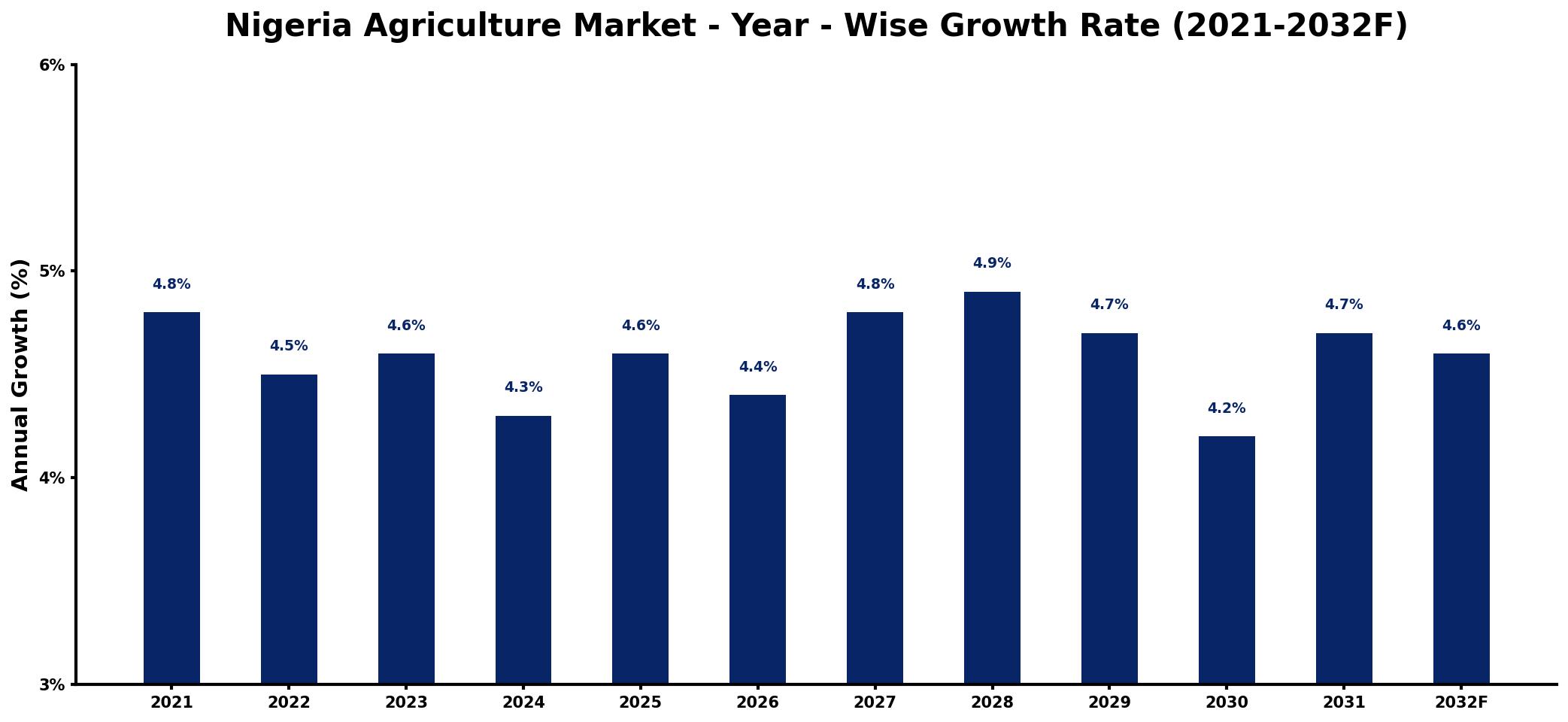
The table below presents the year‑wise growth rates along with the key drivers influencing the market
| Year | Growth Rate | Major Drivers |
| 2021 | 4.8% | Rising consumer demand for food |
| 2022 | 4.5% | Increased investment in technology |
| 2023 | 4.6% | Expansion of export markets |
| 2024 | 4.3% | Growing interest in sustainability practices |
| 2025 | 4.6% | Improved infrastructure for logistics |
| 2026 | 4.4% | Diversification of crop production methods |
| 2027 | 4.8% | Boost in local processing facilities |
| 2028 | 4.9% | Enhanced access to financing options |
| 2029 | 4.7% | Strengthened partnerships with cooperatives |
| 2030 | 4.2% | Emerging trends in organic farming |
| 2031 | 4.7% | Increased government support initiatives |
| 2032 | 4.6% | Growth in agro-tourism opportunities |
Note: Market size estimations and growth projections presented in this report are based on 6Wresearch's proprietary forecasting methodology, utilizing the latest available industry data, government publications, and primary research inputs.
Nigeria Agriculture Market Synopsis
The strongest force shaping the Nigeria Agriculture Market right now is the increased emphasis on sustainable practices and technological innovations. This shift is steering the agricultural landscape towards enhanced productivity and food security, addressing some of the persistent challenges faced by farmers.
Nigeria's agriculture sector is multifaceted, encompassing crops, livestock, fisheries, and forestry. While cassava, yams, maize, and rice stand out as major crops, livestock farming remains integral, focusing primarily on cattle, poultry, and goats. Such diversity positions the market well for growth, despite ongoing challenges.
Nigeria Agriculture Market Key Takeaways
- The market is projected to grow from USD 425 Million in 2025 to USD 556 Million by 2032.
- Sustainable practices and technological advancements are reshaping agriculture in Nigeria.
- Government initiatives provide crucial support to smallholder farmers and agribusinesses.
- Challenges like infrastructure deficits and climate change continue to impede growth.
- Investment opportunities abound across various subsectors, including crop production and agro-processing.
Evaluation of Restraints in Nigeria Agriculture Market
The Nigeria Agriculture Market is grappling with significant restraints that hinder its full potential. Limited access to financing for smallholder farmers stifles growth and discourages investments in modern farming technologies. Additionally, inadequate infrastructure—ranging from poor roads to insufficient storage facilities—exacerbates the post-harvest losses. The fluctuating and inconsistent government policies further complicate the agricultural landscape, leaving farmers to navigate an unpredictable environment. These challenges, coupled with the impacts of climate change and outdated farming practices, create a complex web that needs targeted interventions to untangle.
Nigeria Agriculture Market Trends
Current trends in the Nigeria Agriculture Market reveal a distinct shift toward technology-driven practices. Precision farming techniques—employing tools like drones and sensors—are gaining traction among progressive farmers aiming to boost productivity. Moreover, an increasing number of agriculturalists are exploring organic farming, as the demand for healthier, sustainably-produced food continues to rise. The governments push for agribusiness and support for smallholder farmers is also indicative of a larger trend toward transforming agriculture into a viable business rather than merely a means of subsistence.
Nigeria Agriculture Market Opportunities
Investment opportunities in the Nigeria Agriculture Market are particularly promising. High-yield crop production such as cassava, rice, and maize presents lucrative ventures for investors. The livestock sector, encompassing poultry and fish farming, also shows significant potential for growth. Additionally, agro-processing activities, including the processing and packaging of agricultural products, are increasingly sought after to enhance value. As technological solutions continue to evolve, investments in irrigation systems and other precision farming technologies offer compelling avenues for improving agricultural efficiency and productivity.
Government Initiatives in the Nigeria Agriculture Market
The Nigerian government has rolled out several policies aimed at fostering growth within the agriculture sector. Notable initiatives include the Anchor Borrowers' Program, which provides financial assistance to smallholder farmers, and the Growth Enhancement Support Scheme, which offers subsidized agricultural inputs. Furthermore, the Livestock Transformation Plan focuses on increasing livestock production capabilities. Establishing the National Food Security Council underscores the government's commitment to tackling food security challenges, while programs like the Nigeria Incentive-Based Risk Sharing System for Agricultural Lending aim to reduce financial risks for agricultural investments.
Future Insights of the Nigeria Agriculture Market
Looking ahead to 2026-2032, the Nigeria Agriculture Market is well-positioned for transformative growth. With a rapidly growing population demanding increased food production, the sector stands to benefit from rising consumer interest in sustainable agriculture. Government support, coupled with heightened investment in infrastructure and technology, should further bolster agricultural productivity. As these changes take root, the potential for expanding export markets represents an exciting opportunity for Nigerian farmers and agribusinesses alike, provided that existing challenges are adequately addressed.
Nigeria Agriculture Market Latest Developments (2025 - 2026)
Recent developments in the Nigeria Agriculture Market indicate a strong push towards enhancing the agricultural value chain. There has been an uptick in initiatives focused on improving infrastructure, particularly in rural areas where many farmers operate. Additionally, various technology-driven solutions are being introduced to help farmers better manage resources and improve yield. The government's continued engagement with stakeholders in the agricultural sector has led to collaborative efforts aimed at both boosting productivity and achieving long-term sustainability.
Nigeria Agriculture Market - Key Attractiveness of the Report
- 10 Years of Market Numbers
- Historical Data Starting from 2022 to 2025
- Base Year: 2025
- Forecast Data until 2032
- Key Performance Indicators Impacting the Market
- Major Upcoming Developments and Projects
Key Highlights of the Report:
- Nigeria Agriculture Market Outlook
- Market Size of Nigeria Agriculture Market, 2025
- Forecast of Nigeria Agriculture Market, 2032
- Historical Data and Forecast of Nigeria Agriculture Revenues & Volume for the Period 2022-2032F
- Nigeria Agriculture Market Trend Evolution
- Nigeria Agriculture Market Drivers and Challenges
- Nigeria Agriculture Price Trends
- Nigeria Agriculture Porter's Five Forces
- Nigeria Agriculture Industry Life Cycle
- Historical Data and Forecast of Nigeria Agriculture Market Revenues & Volume By Type for the Period 2022-2032F
- Historical Data and Forecast of Nigeria Agriculture Market Revenues & Volume By Animal Produce for the Period 2022-2032F
- Historical Data and Forecast of Nigeria Agriculture Market Revenues & Volume By Crop Production for the Period 2022-2032F
- Historical Data and Forecast of Nigeria Agriculture Market Revenues & Volume By Distribution Channel for the Period 2022-2032F
- Historical Data and Forecast of Nigeria Agriculture Market Revenues & Volume By Supermarkets/Hypermarkets for the Period 2022-2032F
- Historical Data and Forecast of Nigeria Agriculture Market Revenues & Volume By Convenience Stores for the Period 2022-2032F
- Historical Data and Forecast of Nigeria Agriculture Market Revenues & Volume By E-Commerce for the Period 2022-2032F
- Historical Data and Forecast of Nigeria Agriculture Market Revenues & Volume By Others for the Period 2022-2032F
- Historical Data and Forecast of Nigeria Agriculture Market Revenues & Volume By Nature for the Period 2022-2032F
- Historical Data and Forecast of Nigeria Agriculture Market Revenues & Volume By Organic for the Period 2022-2032F
- Historical Data and Forecast of Nigeria Agriculture Market Revenues & Volume By Conventional for the Period 2022-2032F
- Nigeria Agriculture Import Export Trade Statistics
- Market Opportunity Assessment By Type
- Market Opportunity Assessment By Distribution Channel
- Market Opportunity Assessment By Nature
- Nigeria Agriculture Top Companies Market Share
- Nigeria Agriculture Competitive Benchmarking By Technical and Operational Parameters
- Nigeria Agriculture Company Profiles
- Nigeria Agriculture Key Strategic Recommendations






































