Nigeria Bisphenol A Market Top 5 Importing Countries and Market Competition (HHI) Analysis
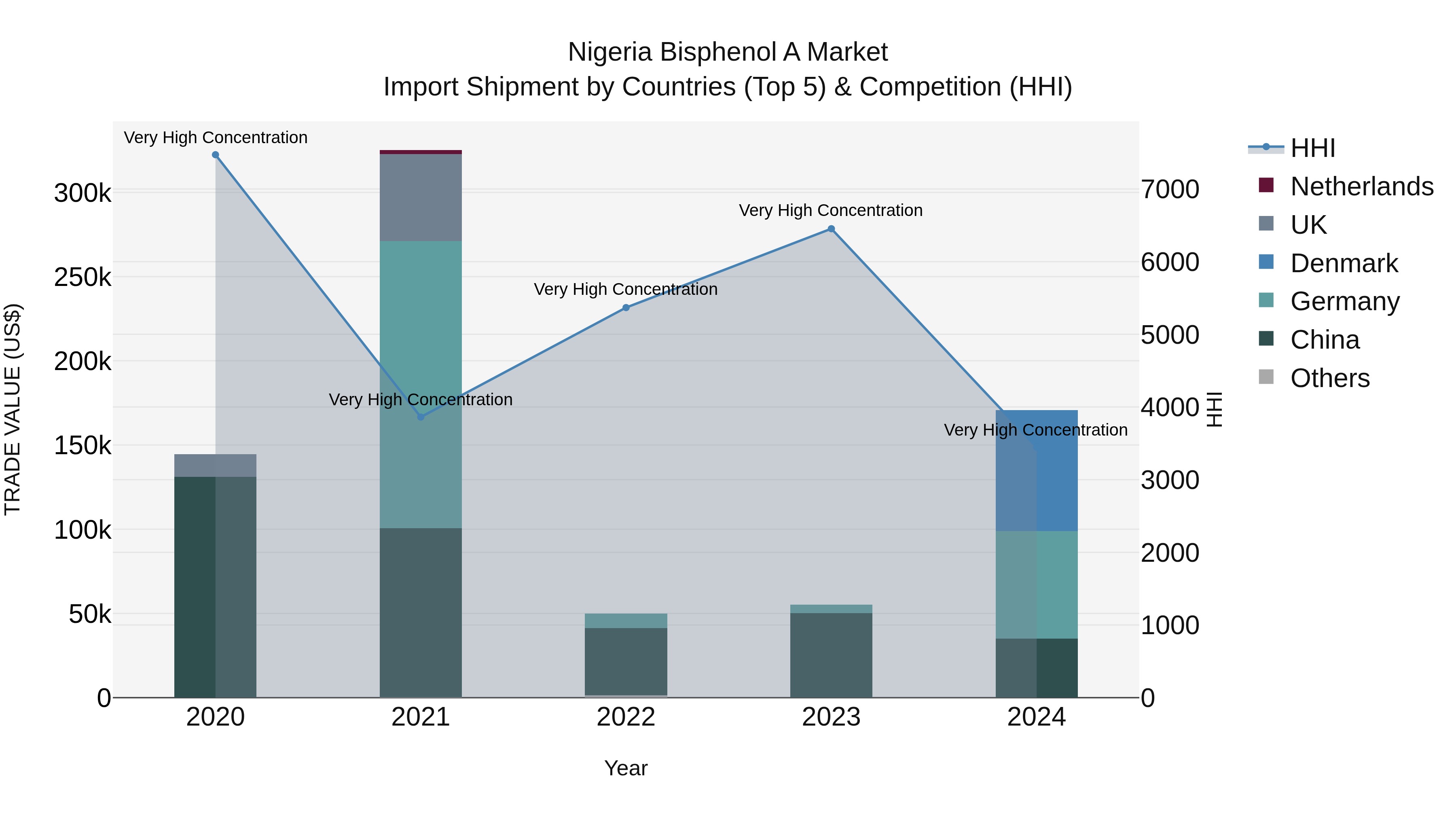
The import shipments of bisphenol A to Nigeria in 2024 continued to show a high level of concentration, with the top exporting countries being Denmark, Germany, China, India, and Netherlands. The Herfindahl-Hirschman Index (HHI) remained at a very high level, indicating a dominant market presence of these countries. The compound annual growth rate (CAGR) from 2020 to 2024 was a steady 4.24%, while the growth rate from 2023 to 2024 spiked significantly at 208.55%, showcasing a surge in demand or supply dynamics in the market during that period.
Nigeria Bisphenol A Market Overview
The Nigeria Bisphenol A market is witnessing steady growth attributed to the increasing demand from various industries such as automotive, electronics, and packaging. Bisphenol A is a key ingredient in the production of polycarbonate plastics and epoxy resins, which find wide applications in these sectors. The market is driven by the rising disposable income, urbanization, and changing consumer lifestyles, leading to higher consumption of products containing Bisphenol A. However, environmental concerns and regulatory restrictions on the use of Bisphenol A in certain products may pose challenges to market growth. Manufacturers are focusing on developing BPA-free alternatives and investing in research and development to address these issues. Overall, the Nigeria Bisphenol A market is expected to continue expanding, driven by the growing industrial applications and consumer demand for quality products.
Nigeria Bisphenol A Market Trends
The Nigeria Bisphenol A market is experiencing a shift towards increased awareness of health and environmental concerns related to BPA exposure. Consumers are seeking BPA-free alternatives in products such as food and beverage packaging, medical devices, and consumer goods. This trend is driving manufacturers to innovate and develop BPA-free materials to meet the growing demand for safer alternatives. Regulatory bodies in Nigeria are also introducing stricter guidelines and regulations on the use of BPA in various industries, further pushing companies towards more sustainable and health-conscious practices. Overall, the Nigeria Bisphenol A market is witnessing a transition towards eco-friendly and health-oriented products, with a focus on reducing BPA exposure and promoting safer alternatives.
Nigeria Bisphenol A Market Challenges
In the Nigeria Bisphenol A market, some challenges faced include regulatory uncertainty surrounding the safety and use of Bisphenol A in consumer products. The lack of clear guidelines and regulations on its usage can lead to confusion among manufacturers and consumers and potentially hinder market growth. Additionally, there is a growing consumer awareness of the potential health risks associated with Bisphenol A exposure, leading to a shift towards alternative products and materials. Competition from substitute materials that are perceived as safer, such as glass or BPA-free plastics, also poses a challenge to the market. Overall, navigating these regulatory, consumer perception, and competitive challenges is crucial for companies operating in the Nigeria Bisphenol A market to ensure sustainable growth and market relevance.
Nigeria Bisphenol A Market Investment Opportunities
The Nigeria Bisphenol A market presents promising investment opportunities due to the growing demand for this chemical compound in various industries such as automotive, electronics, and packaging. With the increasing focus on sustainable and eco-friendly materials, there is a rising need for Bisphenol A alternatives, creating a niche market for innovative products. Investing in research and development of sustainable Bisphenol A substitutes or in the production of Bisphenol A with enhanced properties could prove to be lucrative in the Nigerian market. Additionally, partnerships with local manufacturers and suppliers can help investors establish a strong presence and distribution network in the region, tapping into the growing demand for Bisphenol A and related products.
Nigeria Bisphenol A Market Government Policy
The Nigerian government has not implemented specific regulations or restrictions on Bisphenol A (BPA) in consumer products such as plastic bottles, food containers, and receipts. However, Nigeria is a member of the African Union and may align with regional policies on chemicals and hazardous substances, which could indirectly impact the BPA market. The government generally follows guidelines set by international organizations such as the World Health Organization (WHO) and the United Nations Environment Programme (UNEP) to ensure the safety of consumer products. As awareness of the potential health risks associated with BPA grows globally, there may be future developments in Nigerian regulations to address the use of BPA in various products to protect public health and the environment.
Nigeria Bisphenol A Market Future Outlook
The Nigeria Bisphenol A market is expected to experience steady growth in the coming years due to increasing awareness about the harmful effects of BPA on human health and the environment. As consumers become more conscious about the products they use, there is a growing demand for BPA-free alternatives in various industries such as food and beverage packaging, healthcare, and electronics. Additionally, regulatory initiatives aimed at restricting the use of BPA in consumer products are likely to drive the market towards more sustainable and safer alternatives. Overall, the Nigeria Bisphenol A market is poised for growth as manufacturers and consumers alike shift towards more environmentally friendly and health-conscious products.
Key Highlights of the Report:
- Nigeria Bisphenol A Market Outlook
- Market Size of Nigeria Bisphenol A Market, 2021
- Forecast of Nigeria Bisphenol A Market, 2031
- Historical Data and Forecast of Nigeria Bisphenol A Revenues & Volume for the Period 2021 - 2031
- Nigeria Bisphenol A Market Trend Evolution
- Nigeria Bisphenol A Market Drivers and Challenges
- Nigeria Bisphenol A Price Trends
- Nigeria Bisphenol A Porter's Five Forces
- Nigeria Bisphenol A Industry Life Cycle
- Historical Data and Forecast of Nigeria Bisphenol A Market Revenues & Volume By Application for the Period 2021 - 2031
- Historical Data and Forecast of Nigeria Bisphenol A Market Revenues & Volume By Polycarbonate Resin for the Period 2021 - 2031
- Historical Data and Forecast of Nigeria Bisphenol A Market Revenues & Volume By Epoxy Resin for the Period 2021 - 2031
- Historical Data and Forecast of Nigeria Bisphenol A Market Revenues & Volume By Unsaturated Polyester Resins for the Period 2021 - 2031
- Historical Data and Forecast of Nigeria Bisphenol A Market Revenues & Volume By Flame Retardants for the Period 2021 - 2031
- Historical Data and Forecast of Nigeria Bisphenol A Market Revenues & Volume By Others for the Period 2021 - 2031
- Historical Data and Forecast of Nigeria Bisphenol A Market Revenues & Volume By End-use for the Period 2021 - 2031
- Historical Data and Forecast of Nigeria Bisphenol A Market Revenues & Volume By Eye wear for the Period 2021 - 2031
- Historical Data and Forecast of Nigeria Bisphenol A Market Revenues & Volume By Automotive component for the Period 2021 - 2031
- Historical Data and Forecast of Nigeria Bisphenol A Market Revenues & Volume By Electronics for the Period 2021 - 2031
- Historical Data and Forecast of Nigeria Bisphenol A Market Revenues & Volume By Wind Energy Composites for the Period 2021 - 2031
- Historical Data and Forecast of Nigeria Bisphenol A Market Revenues & Volume By Paint and Coating for the Period 2021 - 2031
- Historical Data and Forecast of Nigeria Bisphenol A Market Revenues & Volume By Green House for the Period 2021 - 2031
- Historical Data and Forecast of Nigeria Bisphenol A Market Revenues & Volume By Others for the Period 2021 - 2031
- Nigeria Bisphenol A Import Export Trade Statistics
- Market Opportunity Assessment By Application
- Market Opportunity Assessment By End-use
- Nigeria Bisphenol A Top Companies Market Share
- Nigeria Bisphenol A Competitive Benchmarking By Technical and Operational Parameters
- Nigeria Bisphenol A Company Profiles
- Nigeria Bisphenol A Key Strategic Recommendations






































