Venezuela Bisphenol A Market Size, Share & Growth Rate
The Venezuela Bisphenol A Market was estimated at USD 323 Million in 2025 and is projected to reach USD 423 Million by 2032, growing at a CAGR of 3.9% from 2026 to 2032. This growth trajectory is primarily driven by escalating demand from industries such as automotive and electronics, where Bisphenol A plays a crucial role in the production of polycarbonate plastics and epoxy resins. Additionally, the packaging sector remains a significant contributor, leveraging Bisphenol A's properties for durable and versatile products.
Venezuela Bisphenol A Market Year-wise Growth Rate and Key Drivers
This graph highlights how the Venezuela Bisphenol A Market has steadily grown over the years, supported by major growth factors.
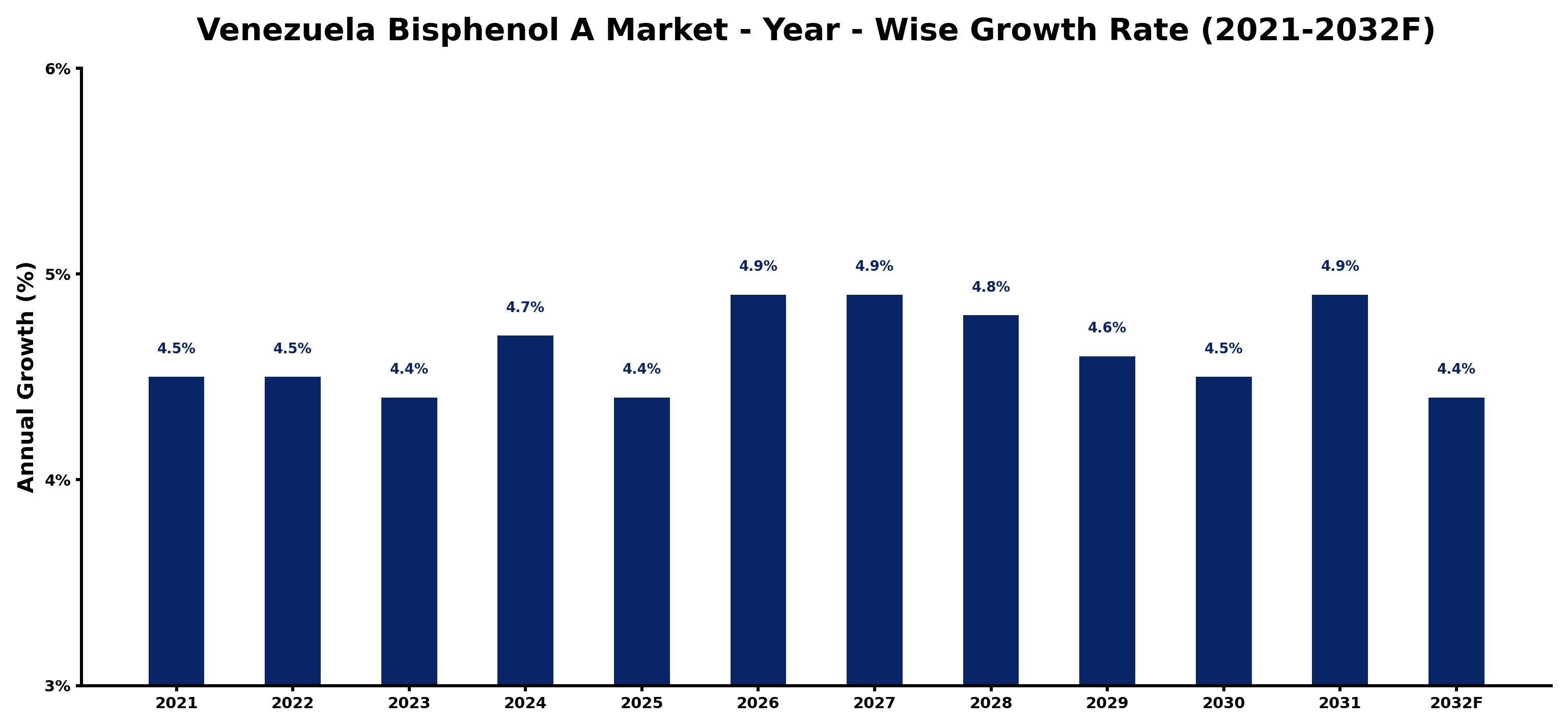
The table below presents the year‑wise growth rates along with the key drivers influencing the market
| Year | Growth Rate | Major Drivers |
| 2021 | 4.5% | Rising electricity demand across industries |
| 2022 | 4.5% | Rising electricity demand across industries |
| 2023 | 4.4% | Increasing industrial automation investments |
| 2024 | 4.7% | Increasing industrial automation investments |
| 2025 | 4.4% | Increasing adoption of advanced technologies |
| 2026 | 4.9% | Increasing industrial infrastructure investments |
| 2027 | 4.9% | Government infrastructure modernization initiatives |
| 2028 | 4.8% | Expansion of commercial construction activities |
| 2029 | 4.6% | Expansion of transportation and logistics networks |
| 2030 | 4.5% | Rapid growth in telecom and data center sectors |
| 2031 | 4.9% | Rapid growth in telecom and data center sectors |
| 2032 | 4.4% | Increasing adoption of advanced technologies |
Note - Market size estimations and growth projections presented in this report are based on 6Wresearch's advanced forecasting approach, validated with industry datasets as of June 2026.
Venezuela Bisphenol A Market Synopsis
The production and consumption of Bisphenol A in Venezuela are notably influenced by local manufacturing capabilities and the demand for high-performance plastics. With an increasing need for sustainable packaging solutions and advanced electronics, the market is witnessing a gradual shift towards more innovative applications of Bisphenol A. This is set against a backdrop of significant regulatory scrutiny surrounding the chemical.
As environmental concerns rise, manufacturers are compelled to address the health implications associated with Bisphenol A. Consequently, there is a growing emphasis on research and development aimed at creating BPA-free alternatives, which, while challenging, could open new avenues for businesses in Venezuela's chemical industry.
Venezuela Bisphenol A Market Key Takeaways
- The Venezuelan Bisphenol A market is projected to grow steadily due to strong demand in automotive and electronics sectors.
- Increasing regulatory pressures are driving the shift towards BPA-free alternatives, influencing market dynamics.
- Economic instability and foreign currency shortages pose significant challenges to the Bisphenol A supply chain.
- Innovations in product formulations are essential as manufacturers strive to meet new consumer and regulatory expectations.
- Strategic partnerships and investments could foster growth opportunities despite the political and economic landscape.
Evaluation of Restraints in Venezuela Bisphenol A Market
The Venezuela Bisphenol A market is currently hindered by a multitude of restraints linked to the country's economic and political situation. Fluctuating exchange rates and hyperinflation pose significant challenges for companies reliant on imported raw materials, severely impacting pricing stability and supply chain efficiency. Furthermore, the shortage of foreign currency exacerbates these issues, making it increasingly difficult for manufacturers to procure necessary inputs for production.
Additionally, regulatory compliance is becoming more complex, with the government enforcing stricter controls over Bisphenol A usage in consumer products. The resulting bureaucratic hurdles require companies to invest in compliance strategies, which can divert resources away from core business operations and stifle growth potential in the sector.
Venezuela Bisphenol A Market Trends
In recent years, a discernible trend has emerged within the Venezuela Bisphenol A market as consumer awareness regarding health implications linked to BPA exposure increases. Consequently, manufacturers are actively pursuing BPA-free alternatives, aligning their product offerings with changing consumer preferences. This transition is not merely a response to demand; it also reflects a broader commitment to sustainability that is becoming increasingly central to corporate strategy.
Moreover, advancements in technology and materials science are facilitating innovative approaches to product development, allowing companies to retain performance while reducing or eliminating reliance on Bisphenol A. As a result, the market is poised for dynamic shifts that prioritize both consumer safety and environmental responsibility.
Venezuela Bisphenol A Market Opportunities
Despite its challenges, the Venezuela Bisphenol A market holds considerable opportunities for growth and investment, particularly in the manufacturing sector. The rise in demand across diverse industries, especially in packaging and electronics, presents a fertile landscape for investment in production capabilities. Collaborative ventures or partnerships could be particularly advantageous as Venezuela seeks to attract foreign investment amidst its ongoing economic transition.
Moreover, as organizations pivot towards research and development of alternative materials, there is an opportunity for early adopters to capture significant market share. Engaging in innovation while balancing regulatory compliance may provide a competitive edge for businesses poised to meet evolving consumer expectations.
Government Initiatives in the Venezuela Bisphenol A Market
Government initiatives surrounding the Bisphenol A market in Venezuela focus primarily on regulatory oversight and public health safety. The Ministry of Health has implemented guidelines aimed at controlling the levels of Bisphenol A in food and beverage packaging, reflecting global movements toward heightened consumer protection. These efforts are designed to mitigate health risks associated with the chemical and ensure the safety of end-users.
In conjunction with these regulations, the government is also exploring frameworks to encourage the adoption of safer alternatives, which could foster innovation within the industry. As policies evolve, manufacturers must adapt to these changes to comply with safety standards while meeting market demands.
Future Insights of the Venezuela Bisphenol A Market
Looking ahead to the 2026-2032 period, the Venezuela Bisphenol A market is expected to navigate a complex landscape influenced by political and economic variables. With ongoing instability potentially impacting industrial production, companies may face challenges in sustaining growth rates. However, the increasing recognition of health and safety concerns surrounding Bisphenol A is likely to drive further innovation in alternative materials.
Future market dynamics will hinge on both regulatory frameworks and consumer sentiments. Those companies that effectively harness market intelligence and adapt to these evolving landscapes will be best positioned to thrive in a potentially volatile environment.
Venezuela Bisphenol A Market Latest Developments (May 2025 - June 2026)
Recent developments in the Venezuela Bisphenol A market have been characterized by a marked focus on sustainability and compliance with stricter regulatory standards. Companies are increasingly prioritizing research into alternative materials that can replace Bisphenol A while maintaining product integrity. Additionally, collaborations between industry players are emerging, aimed at sharing knowledge and resources to better navigate the complexities of market demands.
Venezuela Bisphenol A Market - Key Attractiveness of the Report
- 10 Years of Market Numbers
- Historical Data Starting from 2022 to 2025
- Base Year: 2025
- Forecast Data until 2032
- Key Performance Indicators Impacting the Market
- Major Upcoming Developments and Projects
Key Highlights of the Report:
- Venezuela Bisphenol A Market Outlook
- Market Size of Venezuela Bisphenol A Market, 2025
- Forecast of Venezuela Bisphenol A Market, 2032
- Historical Data and Forecast of Venezuela Bisphenol A Revenues & Volume for the Period 2022-2032F
- Venezuela Bisphenol A Market Trend Evolution
- Venezuela Bisphenol A Market Drivers and Challenges
- Venezuela Bisphenol A Price Trends
- Venezuela Bisphenol A Porter's Five Forces
- Venezuela Bisphenol A Industry Life Cycle
- Historical Data and Forecast of Venezuela Bisphenol A Market Revenues & Volume By Application for the Period 2022-2032F
- Historical Data and Forecast of Venezuela Bisphenol A Market Revenues & Volume By Polycarbonate Resin for the Period 2022-2032F
- Historical Data and Forecast of Venezuela Bisphenol A Market Revenues & Volume By Epoxy Resin for the Period 2022-2032F
- Historical Data and Forecast of Venezuela Bisphenol A Market Revenues & Volume By Unsaturated Polyester Resins for the Period 2022-2032F
- Historical Data and Forecast of Venezuela Bisphenol A Market Revenues & Volume By Flame Retardants for the Period 2022-2032F
- Historical Data and Forecast of Venezuela Bisphenol A Market Revenues & Volume By Others for the Period 2022-2032F
- Historical Data and Forecast of Venezuela Bisphenol A Market Revenues & Volume By End-use for the Period 2022-2032F
- Historical Data and Forecast of Venezuela Bisphenol A Market Revenues & Volume By Eye wear for the Period 2022-2032F
- Historical Data and Forecast of Venezuela Bisphenol A Market Revenues & Volume By Automotive component for the Period 2022-2032F
- Historical Data and Forecast of Venezuela Bisphenol A Market Revenues & Volume By Electronics for the Period 2022-2032F
- Historical Data and Forecast of Venezuela Bisphenol A Market Revenues & Volume By Wind Energy Composites for the Period 2022-2032F
- Historical Data and Forecast of Venezuela Bisphenol A Market Revenues & Volume By Paint and Coating for the Period 2022-2032F
- Historical Data and Forecast of Venezuela Bisphenol A Market Revenues & Volume By Green House for the Period 2022-2032F
- Historical Data and Forecast of Venezuela Bisphenol A Market Revenues & Volume By Others for the Period 2022-2032F
- Venezuela Bisphenol A Import Export Trade Statistics
- Market Opportunity Assessment By Application
- Market Opportunity Assessment By End-use
- Venezuela Bisphenol A Top Companies Market Share
- Venezuela Bisphenol A Competitive Benchmarking By Technical and Operational Parameters
- Venezuela Bisphenol A Company Profiles
- Venezuela Bisphenol A Key Strategic Recommendations






































