Nigeria Food Blenders And Mixers Market Top 5 Importing Countries and Market Competition (HHI) Analysis
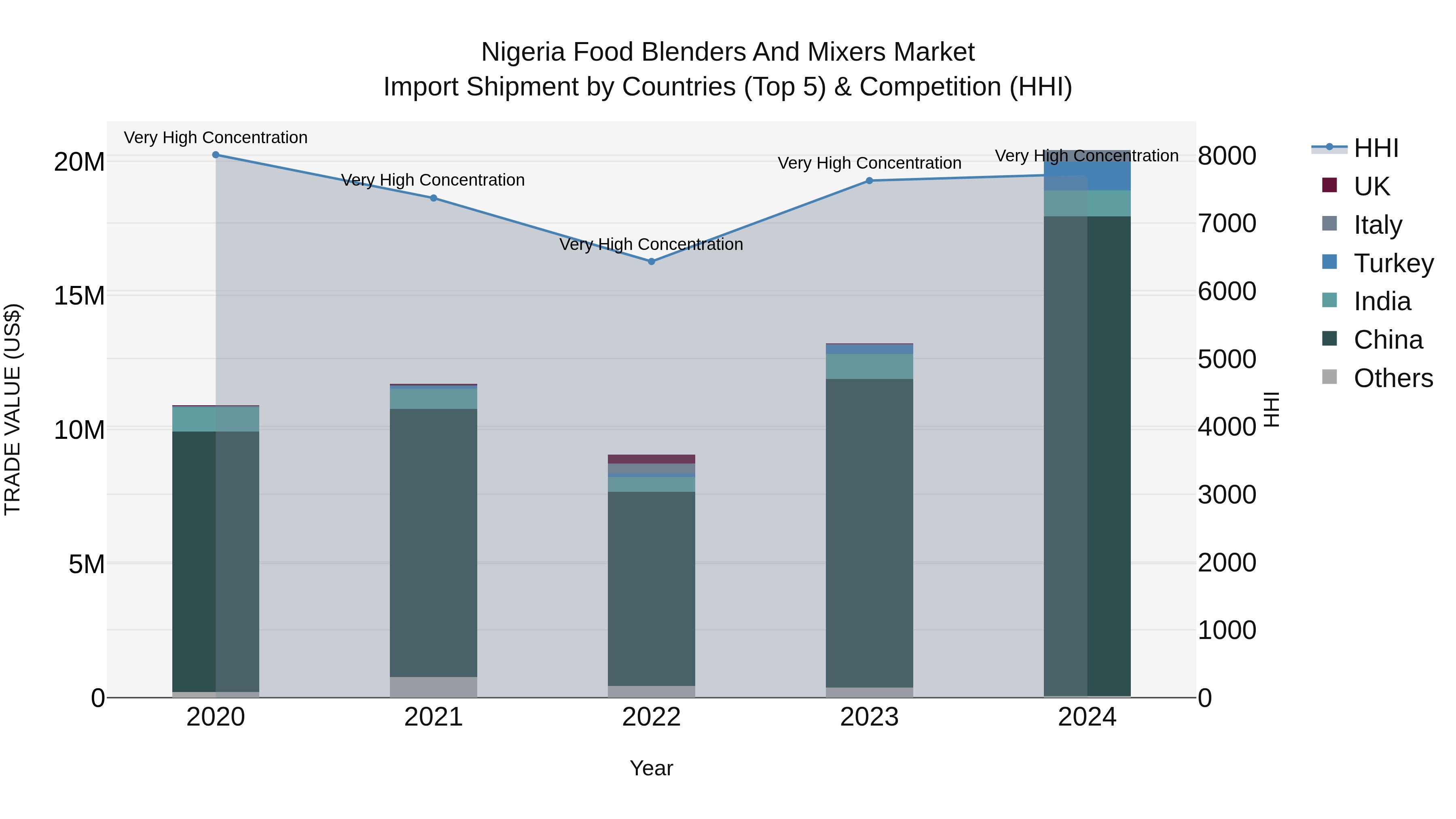
The Nigeria food blenders and mixers import market continues to see strong growth, with top exporting countries such as China, Turkey, and India leading the way in 2024. The high Herfindahl-Hirschman Index (HHI) indicates a concentrated market, offering opportunities for further competition and innovation. With a remarkable compound annual growth rate (CAGR) of 16.97% from 2020 to 2024, and a notable growth rate of 54.56% in 2024 alone, the market is poised for continued expansion and increased competition among key players.
Nigeria Food Blenders and Mixers Market Synopsis
The Nigeria Food Blenders and Mixers market is experiencing steady growth driven by increasing demand for convenient and efficient kitchen appliances. Factors such as urbanization, changing consumer lifestyles, and a growing middle-class population are fueling the market expansion. Key players in the market are introducing innovative products with advanced features such as multiple speed settings, powerful motors, and durable blade systems to cater to the evolving consumer preferences. Additionally, rising awareness about healthy eating habits and the popularity of homemade food preparations are further boosting the demand for food blenders and mixers in Nigeria. The market is characterized by intense competition, with players focusing on product differentiation, marketing strategies, and pricing to gain a competitive edge in the market.
Nigeria Food Blenders and Mixers Market Trends
The Nigeria Food Blenders and Mixers market is experiencing a growing demand for efficient and technologically advanced equipment to meet the increasing consumer needs for convenience and quality. Key trends in the market include the rising popularity of multifunctional blenders and mixers that offer a variety of functions such as blending, grinding, and juicing in one appliance. There is also a shift towards more durable and energy-efficient models to reduce operational costs. Opportunities in the market lie in the introduction of innovative features such as smart technology integration for remote operation and customization, as well as the expansion of product offerings to cater to the diverse culinary preferences of Nigerian consumers. Additionally, partnerships with local retailers and online platforms can help manufacturers reach a wider customer base and capitalize on the growing e-commerce trend in the country.
Nigeria Food Blenders and Mixers Market Challenges
In the Nigeria Food Blenders and Mixers Market, several challenges exist, including unreliable power supply, which impacts production processes and overall efficiency. Additionally, the market faces stiff competition from both local and international manufacturers, leading to price wars and margin pressures. Limited access to affordable financing also hinders the growth and expansion of businesses in this sector. Furthermore, inadequate infrastructure and logistics issues contribute to delays in production and distribution, affecting the timely delivery of products to consumers. Lastly, the lack of standardized regulations and quality control measures presents a challenge in ensuring product quality and safety, impacting consumer trust and brand reputation in the market. Addressing these challenges will be crucial for companies operating in the Nigeria Food Blenders and Mixers Market to sustain growth and remain competitive.
Nigeria Food Blenders and Mixers Market Investment Opportunities
The Nigeria Food Blenders and Mixers Market is primarily driven by the increasing demand for convenience food products, rising disposable incomes, and the growing trend of home baking and cooking among consumers. Additionally, the expanding food processing industry and the adoption of advanced technologies in food preparation are fueling the demand for food blenders and mixers in the country. Furthermore, the focus on healthy eating habits and the need for efficient kitchen appliances are also contributing to the market growth. The market is expected to witness further growth due to urbanization, changing consumer preferences, and the emergence of online retail channels, providing convenience and accessibility to a wide range of food blenders and mixers for consumers across Nigeria.
Nigeria Food Blenders and Mixers Market Government Polices
The Nigerian government has implemented various policies related to the Food Blenders and Mixers Market to promote food processing and manufacturing in the country. These policies include the Agricultural Promotion Policy (2016) which aims to boost agricultural productivity and food processing, the National Policy on Food and Nutrition (2016) to address malnutrition and improve food quality, and the National Policy on Food Safety (2014) to ensure food safety standards. Additionally, the government has established the Bank of Industry (BOI) Food Processing Fund to provide financial support to food processing businesses. These policies are geared towards promoting growth and investment in the Food Blenders and Mixers Market, enhancing food security, and improving the overall quality of food products in Nigeria.
Nigeria Food Blenders and Mixers Market Future Outlook
The Nigeria Food Blenders and Mixers Market is expected to witness steady growth in the coming years, driven by factors such as increasing urbanization, changing consumer lifestyles, and a growing preference for convenience foods. The market is likely to be influenced by the rising demand for efficient and time-saving kitchen appliances, particularly among the younger population. Additionally, technological advancements in food blending and mixing equipment, as well as the emergence of innovative product offerings, are expected to further propel market growth. However, challenges such as fluctuating raw material prices and intense competition among market players may impact the overall market dynamics. Overall, the Nigeria Food Blenders and Mixers Market is poised for expansion, with opportunities for manufacturers to cater to the evolving consumer preferences in the country.
Key Highlights of the Report:
- Nigeria Food Blenders and Mixers Market Outlook
- Market Size of Nigeria Food Blenders and Mixers Market, 2024
- Forecast of Nigeria Food Blenders and Mixers Market, 2031
- Historical Data and Forecast of Nigeria Food Blenders and Mixers Revenues & Volume for the Period 2021 - 2031
- Nigeria Food Blenders and Mixers Market Trend Evolution
- Nigeria Food Blenders and Mixers Market Drivers and Challenges
- Nigeria Food Blenders and Mixers Price Trends
- Nigeria Food Blenders and Mixers Porter's Five Forces
- Nigeria Food Blenders and Mixers Industry Life Cycle
- Historical Data and Forecast of Nigeria Food Blenders and Mixers Market Revenues & Volume By Type for the Period 2021 - 2031
- Historical Data and Forecast of Nigeria Food Blenders and Mixers Market Revenues & Volume By High Shear for the Period 2021 - 2031
- Historical Data and Forecast of Nigeria Food Blenders and Mixers Market Revenues & Volume By Shaft for the Period 2021 - 2031
- Historical Data and Forecast of Nigeria Food Blenders and Mixers Market Revenues & Volume By Ribbon Mixer for the Period 2021 - 2031
- Historical Data and Forecast of Nigeria Food Blenders and Mixers Market Revenues & Volume By Double Cone for the Period 2021 - 2031
- Historical Data and Forecast of Nigeria Food Blenders and Mixers Market Revenues & Volume By Planetary Mixer for the Period 2021 - 2031
- Historical Data and Forecast of Nigeria Food Blenders and Mixers Market Revenues & Volume By Screw Mixers & Blenders for the Period 2021 - 2031
- Historical Data and Forecast of Nigeria Food Blenders and Mixers Market Revenues & Volume By Application for the Period 2021 - 2031
- Historical Data and Forecast of Nigeria Food Blenders and Mixers Market Revenues & Volume By Bakery for the Period 2021 - 2031
- Historical Data and Forecast of Nigeria Food Blenders and Mixers Market Revenues & Volume By Dairy for the Period 2021 - 2031
- Historical Data and Forecast of Nigeria Food Blenders and Mixers Market Revenues & Volume By Beverages for the Period 2021 - 2031
- Historical Data and Forecast of Nigeria Food Blenders and Mixers Market Revenues & Volume By Confectionery for the Period 2021 - 2031
- Nigeria Food Blenders and Mixers Import Export Trade Statistics
- Market Opportunity Assessment By Type
- Market Opportunity Assessment By Application
- Nigeria Food Blenders and Mixers Top Companies Market Share
- Nigeria Food Blenders and Mixers Competitive Benchmarking By Technical and Operational Parameters
- Nigeria Food Blenders and Mixers Company Profiles
- Nigeria Food Blenders and Mixers Key Strategic Recommendations






































